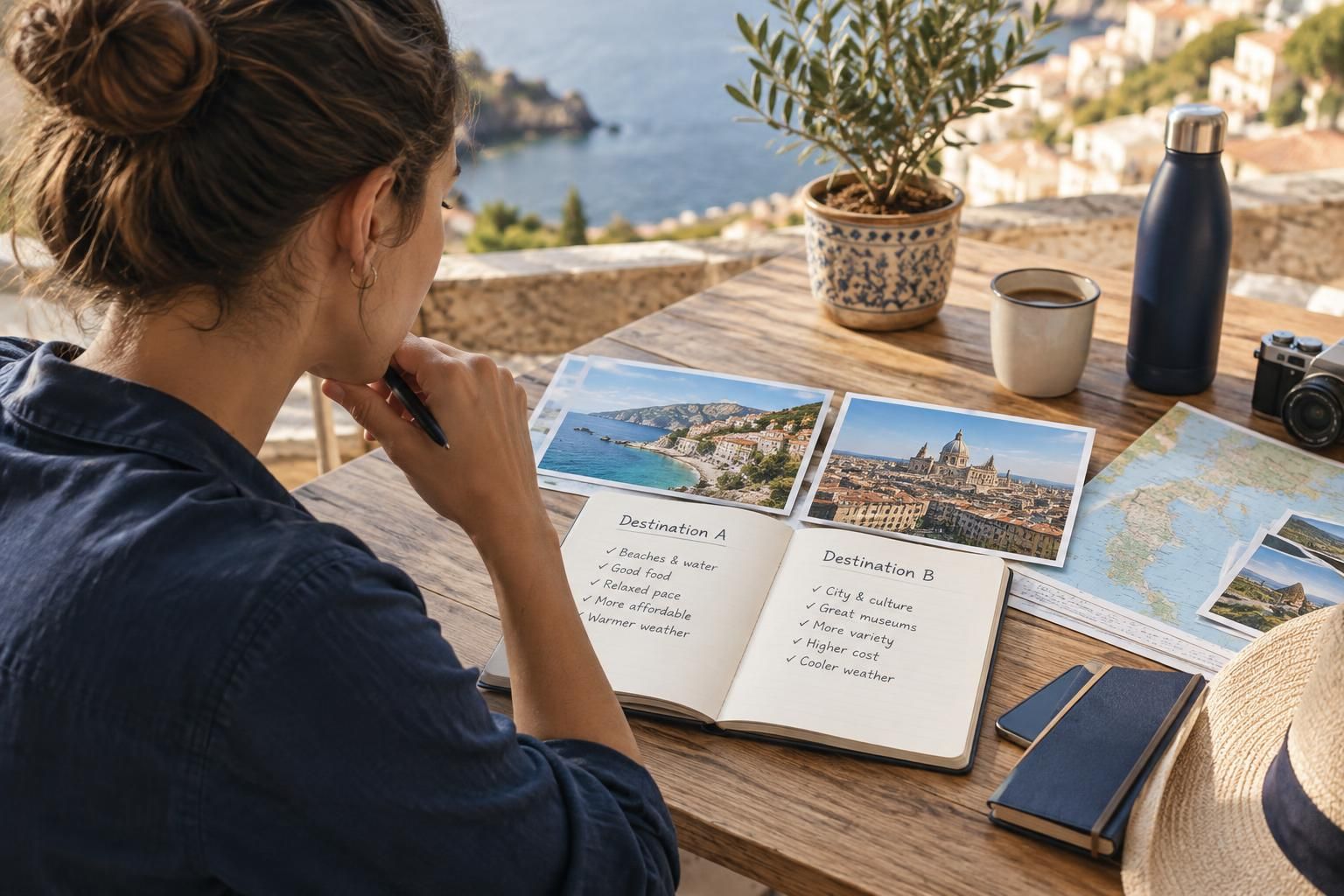
Choosing between two appealing destinations can take more effort than planning the trip itself. One offers memorable scenery; the other promises interesting neighborhoods and excellent food. Both look attractive in photographs, but photographs rarely reveal how your limited time, budget and energy will feel on the ground. Rather than building two complete itineraries, compare a small set of practical factors. The goal is not to prove that one place is better. It is to identify which destination makes more sense for this particular holiday.
1. Decide what this trip needs to deliver
Before comparing destinations, write down three outcomes you want from the holiday. Make them specific enough to guide a choice: several days without driving, long walks followed by relaxed meals, or meaningful time with a travel companion. Broad aims such as “have fun” will not help distinguish a coastal town from a lively capital.
Separate essential conditions from preferences. A private bedroom might be essential, while a sea view is simply desirable. If traveling with someone else, each person should name one priority and one deal-breaker before discussing places. This prevents the decision from being dominated by whichever destination has the longest attraction list. A place with fewer headline sights may still deliver the experience you both want.
2. Compare usable holiday time, not just travel distance
Consider the complete journey from your front door to your accommodation. Include getting to the departure point, waiting, connections, arrival procedures and the final transfer. A shorter main journey does not automatically create an easier travel day. For a brief break, a straightforward route can matter more than a destination’s overall appeal.
Sketch the likely shape of arrival and departure days without treating tentative transport options as fixed. Would either day leave time and energy for something enjoyable? Compare how many useful mornings and evenings each destination could provide. Also consider recovery: if one option involves an overnight journey or a substantial time-zone change, avoid assuming you will arrive ready for a demanding itinerary.
3. Build one ordinary day in each place
Instead of collecting twenty attractions, outline one realistic day for each destination. Choose a plausible accommodation area, a morning activity, lunch, an afternoon outing and dinner. Include the journeys between them. A museum, a market and a waterfront walk might look like an easy combination until you notice that they sit in widely separated areas.
Use this exercise to compare daily rhythm. Would you spend much of the day arranging transport, or could you explore on foot? Does the destination reward early starts when you prefer slow mornings? Can a companion comfortably skip an activity and rejoin later? An ordinary day often reveals compatibility more clearly than a list of exceptional experiences. Leave one stretch unassigned so you can judge whether the place appeals beyond its main sights.
4. Price the same kind of holiday in both destinations
Make the comparison fair by using equivalent assumptions. Compare accommodation with the same privacy level, a similar location and the features you actually need. Then outline the same broad spending categories: transport, meals, local journeys, activities and a contingency. Comparing a central apartment in one destination with an outlying shared room in another creates a misleading result.
Focus on structural differences rather than chasing a precise total too early. One destination might suit a single base with inexpensive self-directed days; another might require a vehicle, guided excursions or frequent transfers to deliver what interests you. Use provisional figures and note what they include. The useful question is whether the overall trip fits comfortably within your budget, not whether one appealing headline cost is lower.
5. Test the weak points, including weather and effort
Ask what happens if the most anticipated activity cannot happen. A destination built around one boat outing, mountain walk or outdoor event may need a stronger backup plan than a place offering several independent attractions. Think about seasonal conditions, daylight and your tolerance for heat, rain or cold without assuming any particular forecast.
Then identify the organizing effort each choice demands. Consider advance reservations, equipment, luggage handling, driving, accessibility needs and the number of decisions required each day. Neither a complex trip nor a simple one is inherently better. The important distinction is whether that effort feels worthwhile now. During a tiring period, choosing the destination with fewer moving parts can be a positive decision rather than a compromise.
6. Set a decision point and keep the runner-up
Summarize each destination in four lines: its strongest advantage, its main drawback, the likely daily experience and the biggest unresolved question. Resolve only questions that could genuinely change your choice. If both options satisfy the essentials, use your leading priority as the deciding factor rather than continuing to collect information indefinitely.
Set a date to choose, then move into detailed planning for the winner. Keep a short note explaining why the other destination appealed and what circumstances would suit it better: a longer holiday, a different season or another travel companion. This turns the runner-up into a future possibility instead of a lost opportunity.
The best destination is the one that fits the holiday you can actually take. Compare priorities, usable time, an ordinary day, comparable costs and the effort involved. Once those factors point in a clear direction, stop planning two trips and start shaping one you will enjoy.
AI-assisted evergreen travel guide. Featured image is an AI-generated illustration, not a specific product or booking.