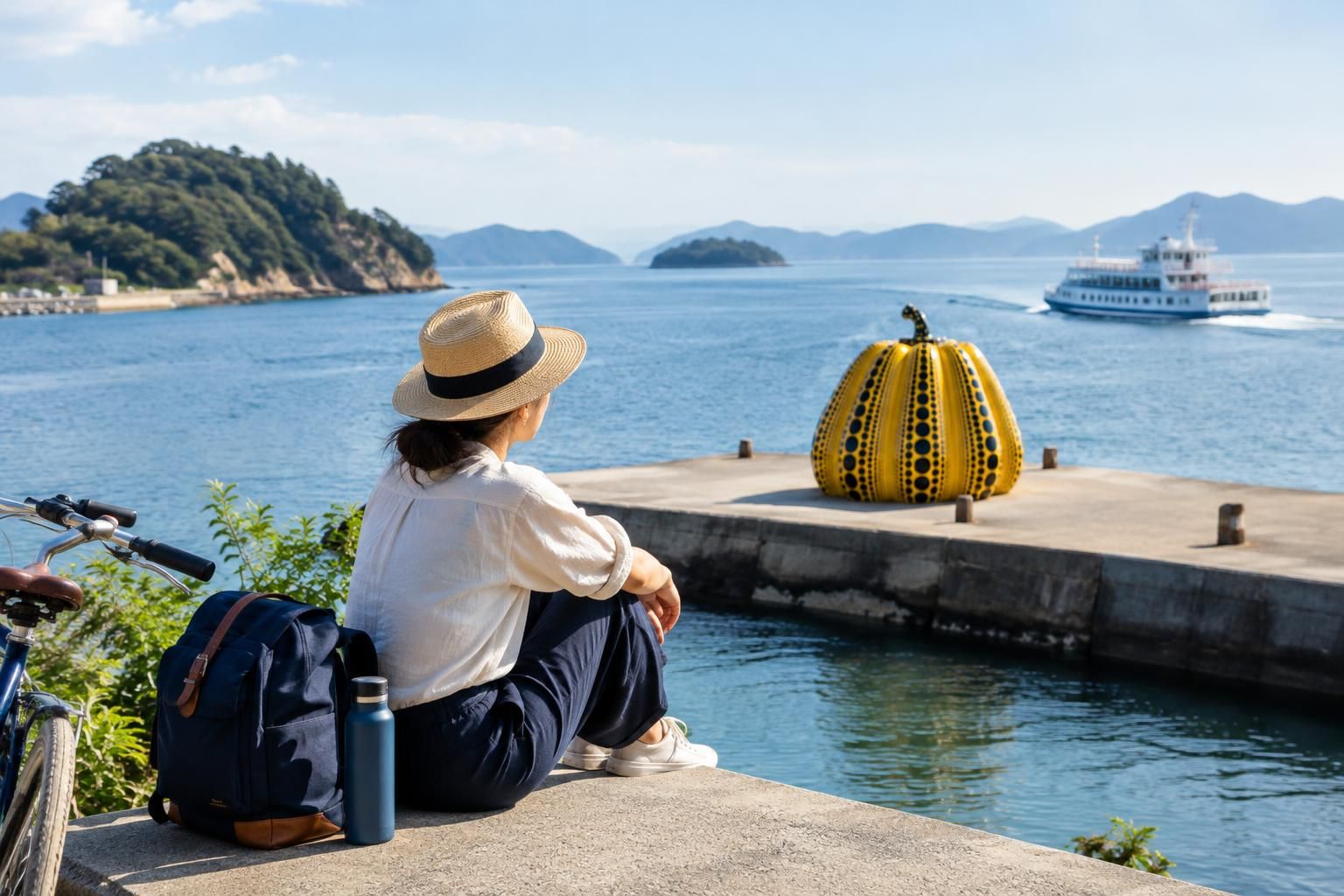
An art-focused journey through Japan’s Seto Inland Sea offers a different rhythm from a big-city itinerary. Gallery visits sit alongside harbor walks, hillside villages and stretches of water between islands. Naoshima and Teshima make a compelling starting point, but the experience works best when you resist treating the region as a checklist. Boats, local transport and admission arrangements create a framework that rewards a little advance organization. Plan around one main island each day, leave room between connections and decide early whether you want the convenience of a mainland base or the quieter pace of an island overnight.
1. Choose a manageable island combination
For a first visit, build the trip around Naoshima and Teshima rather than trying to sample every art destination in the inland sea. Naoshima combines museums, architecture and art woven into village settings. Teshima lends itself to a more spacious day, where the landscape and the journey between stops are part of the experience. Neither needs to be treated as a quick stop between ferries.
Allow a full day for each island, plus time for arrival and departure. A three-night stay is a useful starting point if you want two substantial sightseeing days without squeezing both between long-distance travel legs. With less time, choose one island and explore it properly. Adding another island is worthwhile only if its particular art or scenery interests you enough to justify another transfer.
2. Match your base to the trip you want
Uno, on the Honshu side of the sea, is a practical base to consider for a Naoshima-centered itinerary. Takamatsu, on Shikoku, suits travelers who want to combine island excursions with an urban stay, regional food and onward travel around Shikoku. Compare the actual connections needed for your chosen islands rather than assuming either base makes every excursion equally straightforward.
An island stay offers a different benefit: time outside the day-trip pattern. You can enjoy a village walk or an unhurried breakfast without beginning every morning with a sea crossing. The trade-off is that accommodation, evening meals and luggage storage deserve more advance attention. Before booking, check the property's distance from your arrival port and whether dinner requires a separate plan.
3. Build each day around its least flexible commitment
Start with the art experience you most want to see. Check its admission arrangements and operating calendar for your travel dates, then fit transport and smaller stops around it. Some venues use timed admission, and separate sites may follow different closure patterns. A ferry connection alone does not establish that the visit you want will work that day.
Write a simple daily sequence: departure port, arrival port, main visit, lunch area and return crossing. Islands can have more than one port, so record the port name rather than just the island name. Leave a generous gap before your return boat, and avoid making the final possible crossing the foundation of an essential onward journey. Wind or other operational disruption can upset even a carefully arranged day.
4. Decide how you will move beyond the harbor
A small island is not necessarily an easy walking destination. Art sites may be spread between villages, coastal roads and hills. Group visits geographically before choosing between walking, bicycles and local transport. A day that looks compact on a map can feel much longer when it includes gradients, summer heat or repeated stops.
If cycling appeals, consider your comfort with hills and unfamiliar roads, not just the distance. An electric-assist bicycle may reduce the effort, but availability, collection arrangements and return requirements need checking. Walking works best when you deliberately choose a smaller cluster of sights. Do not assume you can improvise a vehicle transfer from every venue; keep the route realistic for the transport you have arranged.
5. Pack lightly and give meals a place in the plan
Use your mainland accommodation or another confirmed storage option for large luggage when possible. A small overnight bag is easier to handle on boats, village streets and local transport. Carry weather protection, comfortable footwear, water and a charged phone, with essential booking details saved for offline access. Check each venue's bag restrictions before arriving with anything bulky.
Treat lunch as a planned pause rather than something to find only after you are hungry. Smaller settlements offer less scope for spontaneous choice than major Japanese cities, and a restaurant may not fit your route or visiting day. Identify a meal area near your main stops and carry a modest snack. If staying overnight, establish your evening food options before committing to remote accommodation.
6. Leave space for the islands beyond the art
Balance a major museum or installation with time outdoors rather than filling every gap with another admission. A harbor view, a quiet lane or a long lunch can give an art-heavy day breathing room. These are inhabited places, not open-air exhibition grounds: keep entrances clear, respect private property and follow photography guidance at individual sites.
A flexible final day is especially useful. You might revisit an area, spend time in Takamatsu or Uno, or simply continue your wider Japan itinerary without another island crossing. For anyone connecting to a flight or another hard deadline, consider returning to the mainland beforehand rather than linking a boat journey directly to a time-critical departure.
A satisfying Setouchi art trip depends less on how many islands you reach than on how comfortably the pieces fit together. Choose a small number of priorities, match your base to the necessary crossings and give each island enough time beyond its headline attraction. With meals, luggage and return transport considered in advance, there is more room to enjoy what makes this region distinctive: art encountered through sea journeys, village streets and changing landscapes.
AI-assisted evergreen travel guide. Featured image is an AI-generated illustration, not a specific product or booking.