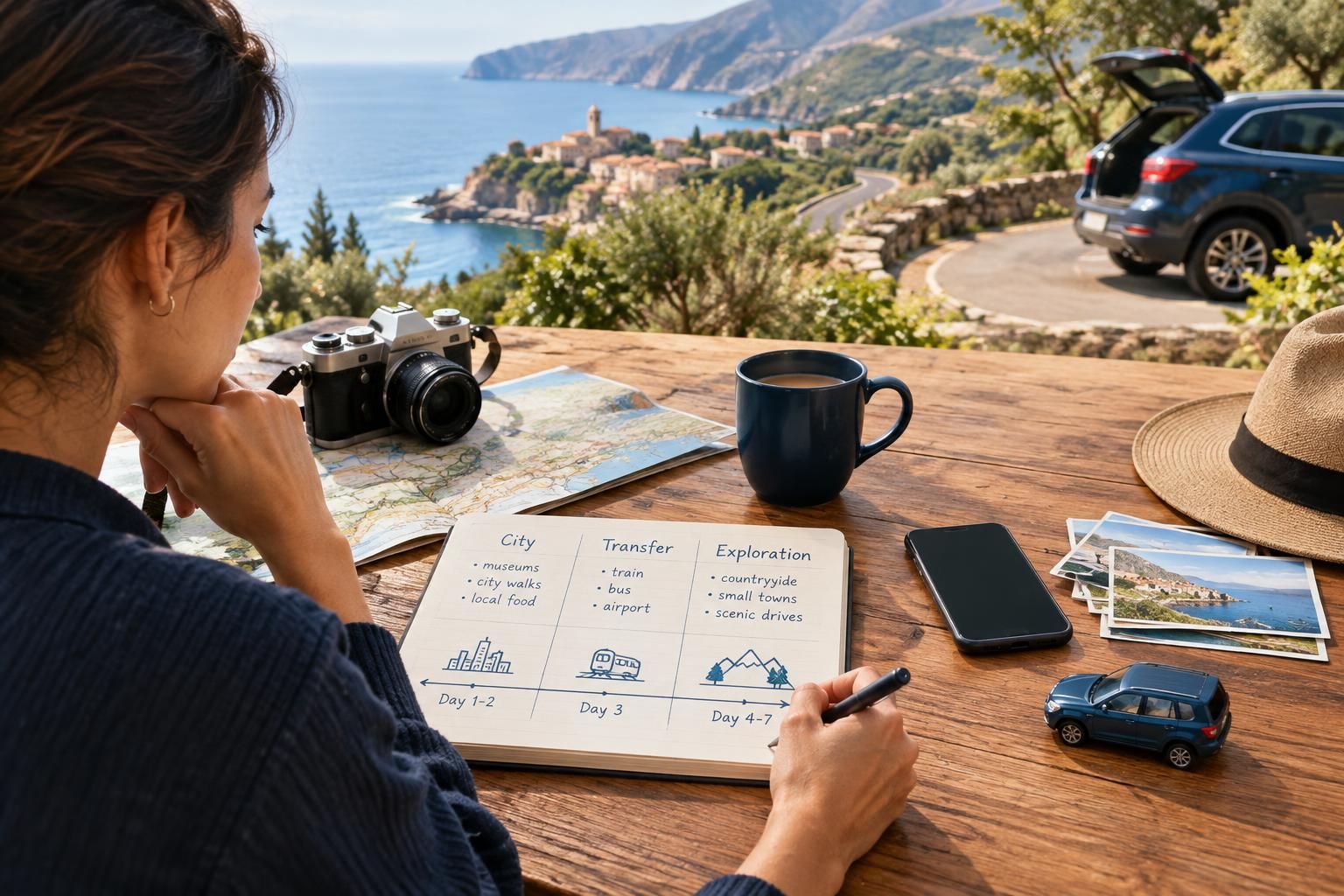
A trip does not have to be entirely car-free or entirely behind the wheel. You might explore a city on foot, take a train to a smaller town, then rent a car for two days of countryside sightseeing. The useful question is not simply whether you need a car, but when it would genuinely improve the journey. By matching transport to each part of your itinerary, you can avoid paying for an unused vehicle while keeping access to places that are awkward to reach without one.
1. Separate the trip into city, transfer and exploration days
Start with a rough itinerary and give each day a purpose. City days involve a compact area or several neighborhoods. Transfer days move you between overnight bases. Exploration days take you to scattered places such as villages, trailheads, beaches or rural accommodation. These categories reveal more than the total length of your holiday.
For a seven-night trip, you might have three city days, one intercity transfer and three days based in a rural area. Rather than renting at the arrival airport automatically, investigate whether the car is useful only for the rural portion. Keep the outline provisional until you compare practical routes.
2. Test the journeys that matter most
Choose two or three experiences that would make the trip worthwhile, then consider how you would reach them with and without a car. Compare the whole journey: getting to a station, waiting between connections, reaching the final destination and returning afterward. A short distance on a map can still involve an inconvenient journey.
Distinguish essential stops from optional ones. A rental may be worthwhile if it makes several important places manageable. If the only difficult journey is a single excursion, compare a guided day trip, a taxi transfer or an overnight stay nearby instead. You do not need a vehicle for a week to solve one afternoon's transport problem.
3. Compare the full rental period, not just the daily rate
Build two simple cost outlines: one with a rental and one without. For the driving option, include the rental charge, fuel or charging, parking, potential road charges and any extras relevant to your plans. Different pickup and return locations can also affect the quote. Use the terms attached to your actual options rather than assuming all rentals work alike.
For the alternative, include public transport, station transfers, occasional taxis and any excursions you would use instead of driving. Compare costs for the whole traveling party. A car shared by several people may produce a different result from the same vehicle used by one traveler. Also note how many rental days would mainly consist of paying to park.
4. Make pickup and return fit the route
Treat collecting and returning the car as itinerary activities, not invisible errands. Reaching the rental location, completing the handover and getting oriented all take time. Compare a city pickup before leaving town with a pickup near the next overnight base. The lowest quote may not be the most convenient option once the extra journeys are included.
A useful sequence is city stay, onward train, rural rental, then return before another urban stay. However, two short rentals can create more administration than one continuous booking. Check whether the savings and convenience justify each handover, and leave breathing room before a flight or other fixed departure.
5. Check whether the accommodation supports driving
A hotel or apartment can look well placed for sightseeing yet be awkward as a driving base. Before choosing it, establish what parking arrangements are offered, whether parking is on site or elsewhere, and how you would move luggage between the vehicle and your room. Do not assume that an accommodation listing's central location means easy vehicle access.
Think about the evenings too. A rural property may suit daytime excursions but require another drive for dinner. A walkable small-town base could let you park after sightseeing and spend the evening on foot. Choose the combination of accommodation and transport together, rather than solving them as separate decisions.
6. Account for effort as well as freedom
Driving adds responsibilities that public transport does not: navigation, unfamiliar junctions, parking searches and decisions about where to stop. Discuss who actually wants to drive and how much driving would feel enjoyable. If only one person will do it, build the route around that person's willingness rather than treating driving time as shared downtime.
Keep the rental segment geographically focused. Two nearby villages and a scenic walk can make a better day than five scattered stops. Leave room for breaks and avoid making a demanding drive the immediate next step after a tiring arrival. For an electric rental, include charging arrangements in the route assessment rather than considering only the vehicle's advertised range.
7. Set a clear threshold for choosing the car
Before booking, write a one-sentence reason for the rental: for example, 'We want two days exploring small villages from one base, with room for walking gear.' If the reason is merely 'We might need it,' revisit the itinerary. A defined purpose makes it easier to choose the rental length and avoid adding unnecessary driving days.
Then review the practical terms of the specific booking, including driver requirements, vehicle capacity, pickup arrangements, fuel or charging expectations, and cancellation conditions. Keep one simpler version of the rental segment in mind, such as fewer stops or a closer base. The car should support the trip, not become the reason the itinerary is complicated.
The best rental period is the one that solves a clear transport need without creating unnecessary work elsewhere. Map the essential journeys, compare complete costs and consider the effort of collecting, parking and driving the vehicle. You may discover that a few carefully chosen car days offer the freedom you want, while trains, local transport and walking suit the rest of the holiday better.
AI-assisted evergreen travel guide. Featured image is an AI-generated illustration, not a specific product or booking.