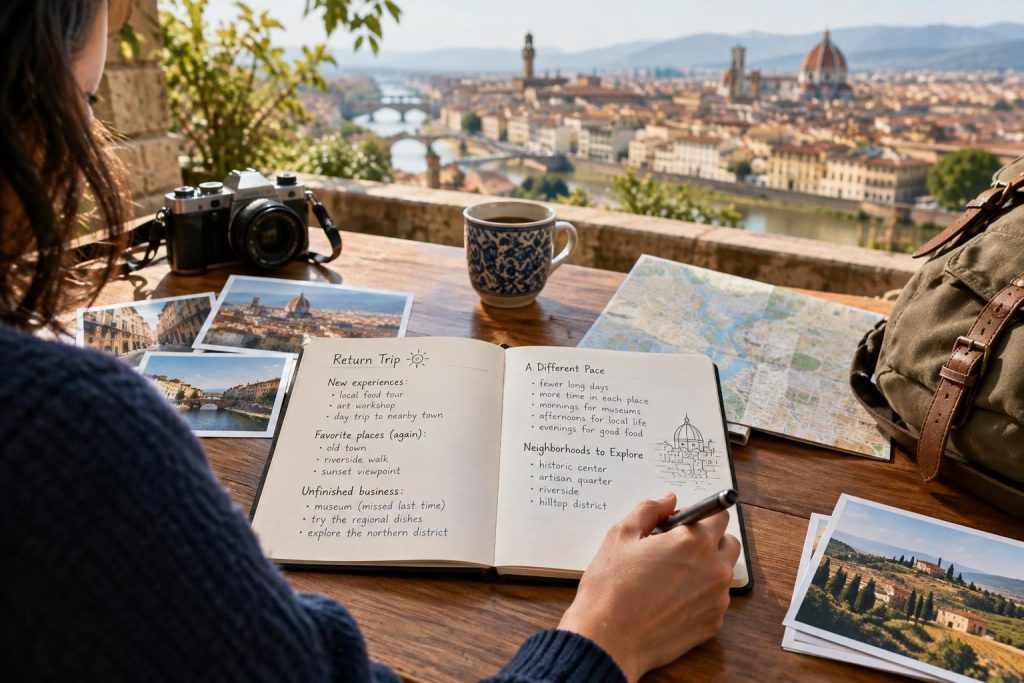
The last day of a trip often falls into an awkward gap: your accommodation needs the room back, but your flight, train or ferry leaves much later. Filling that gap with ambitious sightseeing can create a stressful finish, while heading straight to the terminal may waste hours you could have enjoyed. The solution is to plan backward from departure, settle the luggage question early and choose one satisfying activity that is easy to leave. Treat the day as a smaller travel experience, not a final chance to complete your entire wish list.
Build the day backward from your departure
Start with the point at which you need to be at the airport, station or port, rather than the departure time printed on your ticket. Check the relevant operator’s guidance for your journey, including any check-in, baggage or boarding deadlines. International departures, vehicle crossings and large transport hubs can involve different steps, so avoid relying on a buffer that worked on another trip.
Then work backward through the transfer, luggage collection and any stops needed along the way. Include time to find the correct entrance or platform and deal with an unfamiliar route. The time remaining before that chain begins is your genuine leisure window. If it is short, a relaxed breakfast near your accommodation may be a better choice than crossing the city.
Solve the luggage problem before choosing an activity
A final-day plan becomes much easier once you know where your bags will be. Possible arrangements include storage at your accommodation, a staffed luggage facility or a locker near your departure route. Check whether your chosen option accepts your bag size, when collection is possible and whether you must return to a particular desk or entrance.
Compare the full route, not just the storage location. Leaving bags at the hotel may seem simplest until you realize it requires a long journey back across town. Storage near your onward transport can suit a one-way outing instead. Keep travel documents, essential medication, valuables and anything needed during the day in a small bag that stays with you.
Choose one outing with an easy exit
Good departure-day activities have flexible stopping points. Consider a neighborhood café followed by a short stroll, a compact gallery, a garden or a market where you can browse for as long as time allows. Choose something enjoyable even if you leave earlier than expected, rather than an experience whose value depends on completing every part.
Be cautious with remote excursions, long guided tours, timed experiences and attractions that involve substantial queues or complicated return transport. These are not automatically unsuitable, but they leave fewer options if the day slips. Save your most important experience for an earlier day whenever possible, so a transport concern does not force a disappointing choice.
Use geography to avoid unnecessary backtracking
Sketch a simple sequence: accommodation, luggage storage, final activity, baggage collection and departure point. A useful final outing often sits near one of those places or along a straightforward connection between them. A modest attraction on that route may be more rewarding than a famous sight that adds two extra transfers.
For example, if your bags are stored near the main railway station, explore the surrounding district rather than returning to a distant waterfront. If the airport transfer starts near your accommodation, stay local and collect your bags just before leaving. Also consider the physical effort involved: hills, stairs and crowded interchanges can feel more demanding once you are carrying everything.
Separate room access from the need to rest
A late departure does not always mean you need a room for the whole day. First decide what you actually want: somewhere to sit, a place to change clothes, a shower or a quiet space for a child’s nap. Those are different needs and may lead to different arrangements. Ask your accommodation what, if anything, is possible after checkout rather than assuming facilities remain available.
If private space would materially improve the day, compare the cost and convenience of an agreed late checkout, a day-use room or an additional night. Availability and conditions vary. For an overnight journey, prioritize comfort over squeezing in more sightseeing; a calm meal and an opportunity to freshen up may be worth more than another attraction.
Pack for departure the evening before
Do most of your packing before the final morning. Set aside your departure outfit, toiletries and the items needed for the journey, then make one deliberate sweep of drawers, sockets, bathroom shelves and storage areas. Keep damp clothing and any last-minute purchases separate until you can pack them appropriately.
Prepare a small departure-day kit with a charging cable, a suitable extra layer, tissues and other personal essentials. Decide where receipts, keys and travel documents will go so they do not migrate between bags. If you are traveling with others, agree on the time everyone must be ready to leave, not merely the time checkout ends.
Give the day a clear cutoff and a fallback
Choose a firm time to stop sightseeing and begin the departure sequence. Set a reminder if that helps, and avoid adding spontaneous stops after it. Before heading out, identify a simpler alternative: breakfast close to the hotel, a short local walk or going directly to the transport hub if conditions make the original outing impractical.
Keep meals straightforward, too. Eat before the transfer if that fits comfortably, or carry a suitable snack for the journey where permitted. A final sit-down meal works best when service delays would not threaten your departure plan. The aim is to finish with enough margin that a slow lunch or missed connection does not consume every remaining option.
A well-planned departure day needs a workable sequence, not a packed itinerary. Establish your transport requirements, decide where the bags belong and choose one enjoyable activity that fits around both. With a clear stopping time and a simple fallback, the final hours can feel like a satisfying close to the trip rather than an awkward wait for it to end.
AI-assisted evergreen travel guide. Featured image is an AI-generated illustration, not a specific product or booking.