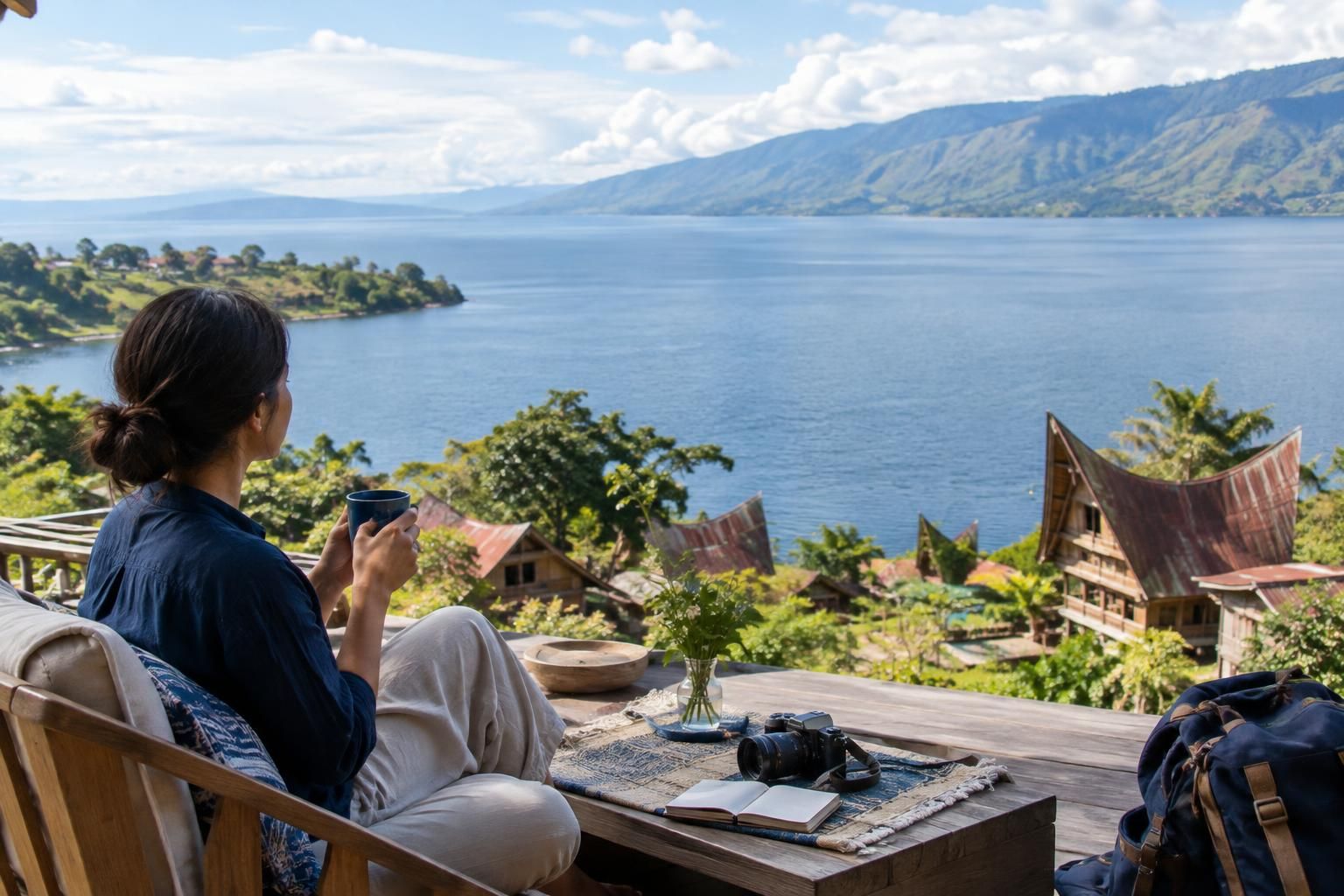
Lake Toba offers a different rhythm from Indonesia’s busy city stops and tightly scheduled island-hopping trips. Set within a vast volcanic landscape in North Sumatra, the lake surrounds Samosir, an island where waterfront villages, cultivated hillsides and Batak heritage give a stay more depth than a scenic overnight stop. The planning challenge is not finding enough landmarks to fill each day. It is allowing for the journey, choosing accommodation that suits how you want to explore and resisting the temptation to treat a large landscape as a quick excursion. A few well-placed nights can turn Lake Toba from a long transfer with a view into a satisfying part of a Sumatra itinerary.
Give the lake enough space in your itinerary
Three or four nights on Samosir is a useful starting point for travelers who want both outings and downtime. With three nights, you can devote one day to nearby villages and cultural stops, then another to a longer landscape excursion. A fourth night creates room for changing weather, an unhurried waterfront morning or an activity arranged locally.
Treat arrival and departure as travel days rather than full sightseeing days. If your wider itinerary includes Medan or other parts of North Sumatra, draw the route on a map before booking accommodation. Distances alone can understate the effort involved when road travel, embarkation and a final transfer to your lodging are combined.
Choose your base for convenience, quiet or independence
Tuk Tuk, a peninsula on Samosir’s eastern side, is a practical area to consider if you value a choice of accommodation and places to eat within a relatively compact area. Even here, check the exact location rather than assuming every property is an easy walk from everything else. A waterfront address may still involve slopes, steps or a longer approach from the road.
Accommodation farther from the main visitor cluster can suit travelers seeking quieter evenings and a stronger sense of rural surroundings. The trade-off is greater dependence on arranged transport and meals at your lodging. Before choosing a secluded property, decide whether you are happy spending an entire afternoon there. Remoteness feels different when it is a deliberate part of the trip rather than an unexpected inconvenience.
Plan the approach as a chain of separate transfers
One approach is to travel from the Medan area toward Parapat and continue across the lake to Samosir. There is also road access to the island via its western side. The most sensible option depends on your starting point, destination on Samosir and preference for fewer changes versus a particular route.
Before committing, establish where the road vehicle drops you, where the boat arrives if you are crossing, and how you will cover the final stretch to your accommodation. Ask about luggage handling and whether your chosen arrival point is convenient for the property. Check current transport arrangements close to departure, and avoid building a plan around the last possible connection. A flexible arrival day is especially valuable after a flight.
Build outings around Batak heritage, not just viewpoints
Samosir rewards attention to its cultural landscape as well as its scenery. Tomok and Ambarita are places to consider for an introduction to local heritage, including historic sites and distinctive architecture. Rather than rushing between photo stops, choose a small number of places and allow time to understand what you are seeing. A local guide can help explain family histories, symbolism and differences between sites.
Remember that villages, houses and burial places are not simply visitor attractions. Ask before photographing people or entering spaces that appear private, and follow guidance at individual sites. For a balanced day, pair a heritage visit with lunch and a short village walk. Leave distant viewpoints for another outing instead of combining every interest into one long circuit.
Match your transport to the terrain and the day
Samosir is large enough that an attractive line on the map can become a substantial excursion. Walking works best for local exploration, while cycling requires a realistic assessment of hills, road conditions and the return journey. Do not assume a lakeside route will remain flat or that two nearby-looking destinations have a direct connection.
An arranged car with a driver can be a practical choice for a longer sightseeing day, especially for travelers who do not want to ride a scooter. Agree on the intended stops, approximate duration and what the arrangement includes before setting off. Cluster stops in one direction rather than zigzagging across the island, and leave space for a pause when a village or view holds your attention.
Book and pack for time beside the lake
Compare accommodation beyond the headline view. Consider covered outdoor seating, room ventilation, steps between buildings and whether meals are available when you prefer not to go out. Travelers with mobility needs should ask specific questions about paths, entrances and bathrooms rather than relying on a general accessibility description.
Pack comfortable shoes with grip, a light layer for cooler or breezier periods, rain protection and a small day bag. Keep essentials accessible during transfers, particularly if your luggage will be stowed separately. Most importantly, leave an unscheduled block in the itinerary: reading under a covered terrace, watching the changing light or taking a short walk can be as worthwhile as another drive.
A rewarding Lake Toba trip depends less on covering all of Samosir than on making a few deliberate choices. Give the transfers their own time, select a base that matches your preferred level of independence and alternate cultural outings with quieter hours by the water. The result is a stay with enough structure to feel straightforward and enough breathing room to appreciate the place.
AI-assisted evergreen travel guide. Featured image is an AI-generated illustration, not a specific product or booking.