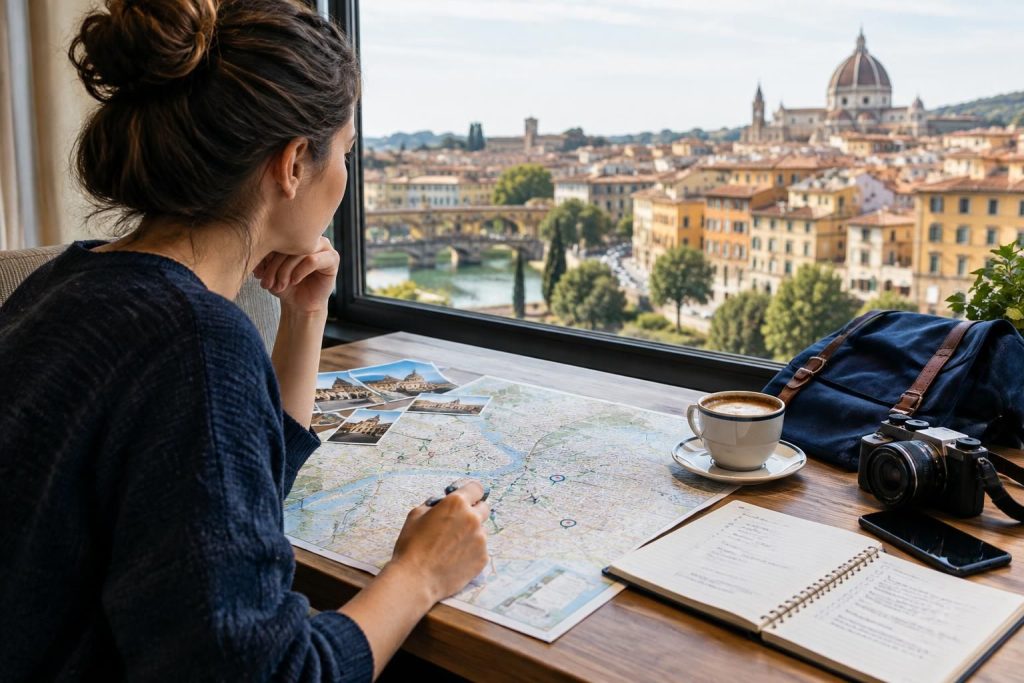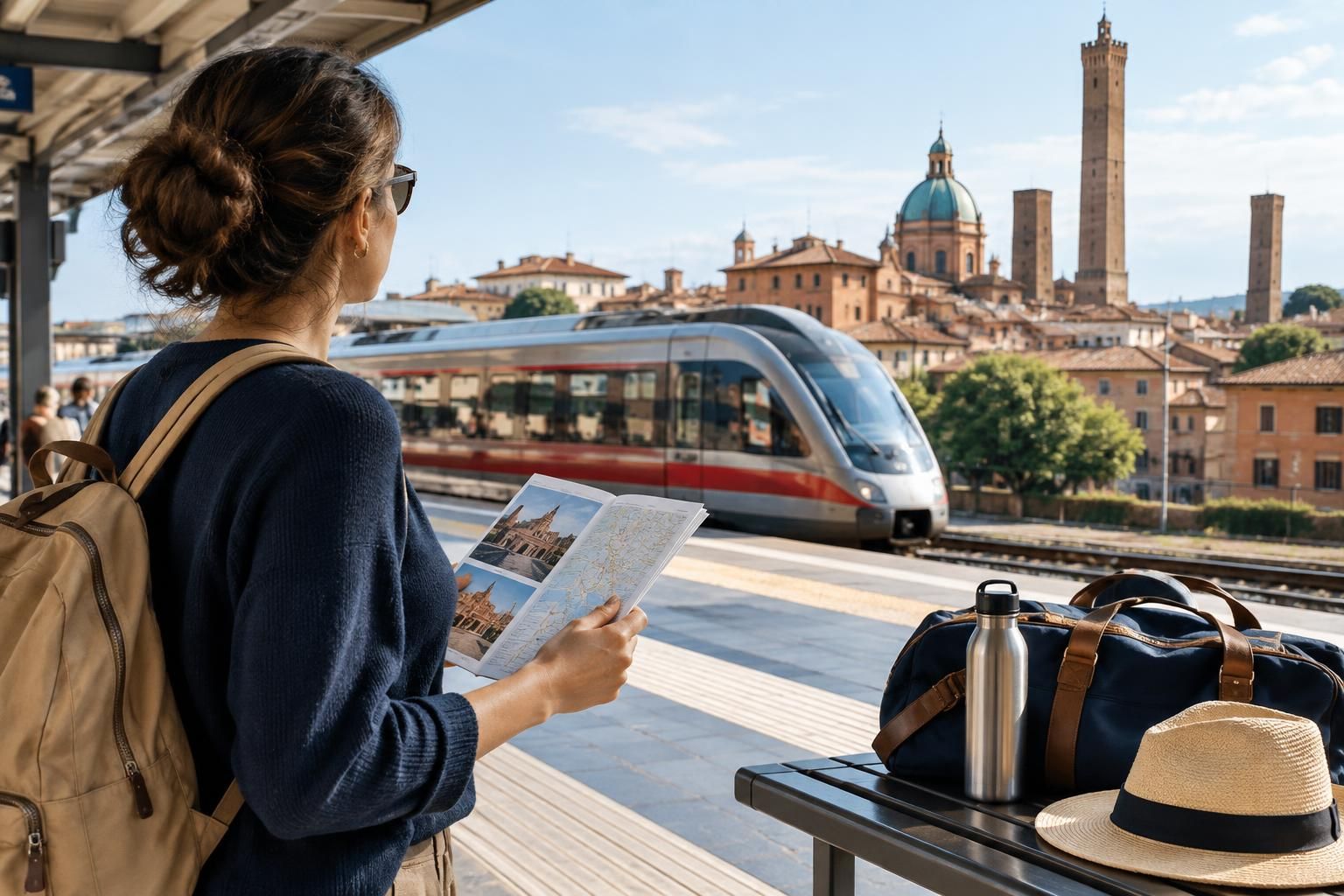
A single-base trip through Emilia-Romagna offers a satisfying alternative to changing hotels every other night. Bologna provides an engaging city setting of porticoes, market streets and generous public squares, while the surrounding region offers contrasting outings focused on food, architecture, mosaics and everyday Italian city life. The key is not to collect as many destinations as possible. Choose a few places that genuinely interest you, understand the station-to-center journey at each end, and give Bologna time of its own. This approach works particularly well for travelers who enjoy exploring on foot but prefer trains to driving between cities.
Build the Trip Around Interests, Not a Checklist
For a stay of five or six nights, consider two full days in Bologna and two or three excursions. Keep the arrival day relatively open: settling into your accommodation, finding a nearby meal and taking a short orientation walk are enough. Alternate outings with local time rather than treating every morning as a race to the station.
Choose destinations with different strengths. Modena suits a day shaped around its cathedral area, market streets and regional food traditions. Parma combines a cathedral quarter with artistic and culinary interests. Ferrara offers a different urban character, with Renaissance streets and city walls. Ravenna makes sense when its celebrated mosaics are a priority. You do not need all four to understand the region.
Choose Accommodation for Your Actual Daily Routine
In Bologna, the most useful accommodation location depends on how often you plan to travel. Somewhere between Bologna Centrale and the historic center can balance station access with evening walks. Staying deeper in the center may feel more atmospheric, but it adds distance to each rail outing. Compare the walking route rather than judging a property only by its straight-line distance from the station.
Look beyond the room photographs. Check whether there is a lift, how arrival access works, whether luggage storage is offered and whether the room faces a busy street or an internal courtyard. For a longer stay, a table, comfortable seating or laundry access may matter more than decorative features. Travelers who need step-free routes should examine both the building entrance and the surrounding streets before booking.
Treat Each Train Journey as a Door-to-Door Outing
A short rail journey does not automatically make a short day trip. Add time for reaching Bologna Centrale, finding the departure platform, walking from the destination station and returning afterward. A city with a slightly longer train ride may still suit you better if its main sights form a compact walking route. Check current connections for your intended dates rather than assuming every journey is direct.
Ticket conditions can differ by train type and purchase method. Before buying, establish whether your ticket is tied to a particular departure and whether any activation or validation step applies. Avoid building a day around the final possible return. Save the accommodation address and your intended stations offline, and keep enough phone battery for tickets and navigation.
Give Each Day Trip One Clear Focus
In Modena, build a relaxed route around Piazza Grande and the cathedral area, adding a market visit or an unhurried meal rather than several unrelated attractions. In Parma, pair the cathedral quarter with one art-focused stop. In Ferrara, combine the historic center with a section of the city walls if the weather and your walking energy suit it.
Ravenna rewards a more focused approach: choose a manageable group of mosaic sites and allow time to look closely rather than rushing between interiors. Check admission arrangements and visiting conditions before committing to a detailed route. Across all four cities, nominate one main attraction, one secondary option and a flexible lunch break. That structure leaves room for an unexpected square, a café stop or a change in weather.
Keep Bologna More Than a Place to Sleep
Bologna deserves time when you are not thinking about the next departure. Organize one day around Piazza Maggiore, nearby historic streets and the market lanes of the Quadrilatero. On another, explore farther under the porticoes, choosing a museum or a longer walk according to your interests. Porticoes provide useful shelter, but routes still include exposed sections and crossings.
Use meals to give the trip variety rather than repeating the same pattern daily. You might choose a substantial lunch on an excursion and a simpler supper back in Bologna, then reverse that balance on a local day. If there is a particular restaurant or food experience you care about, check reservation arrangements ahead. Do not assume rural producers or workshops are conveniently reachable from a city station without additional transport.
Pack for Walking, Weather and Flexible Plans
A small day bag is usually more useful than carrying everything you brought to Italy. Include a refillable water bottle, a compact weather layer, a battery pack and space for purchases. Choose footwear you already find comfortable on hard surfaces. Historic centers can involve uneven paving, and even an art-focused outing often includes more walking than expected.
Leave one day partly uncommitted if your stay allows it. Rain may favor museums or a shorter city route, while pleasant weather may encourage a longer walk in Ferrara or Bologna. Keep your plans realistic by identifying what you would happily skip. Flexibility is easier when each day has a purpose, but not an obligation to complete every possible stop.
Bologna works best as a regional base when the itinerary balances movement with familiarity. Choose a practical place to stay, select contrasting excursions and give each outing a modest focus. With fewer hotel changes and room for ordinary pleasures between major sights, a rail-focused Emilia-Romagna trip can feel varied without becoming a daily exercise in logistics.
AI-assisted evergreen travel guide. Featured image is an AI-generated illustration, not a specific product or booking.