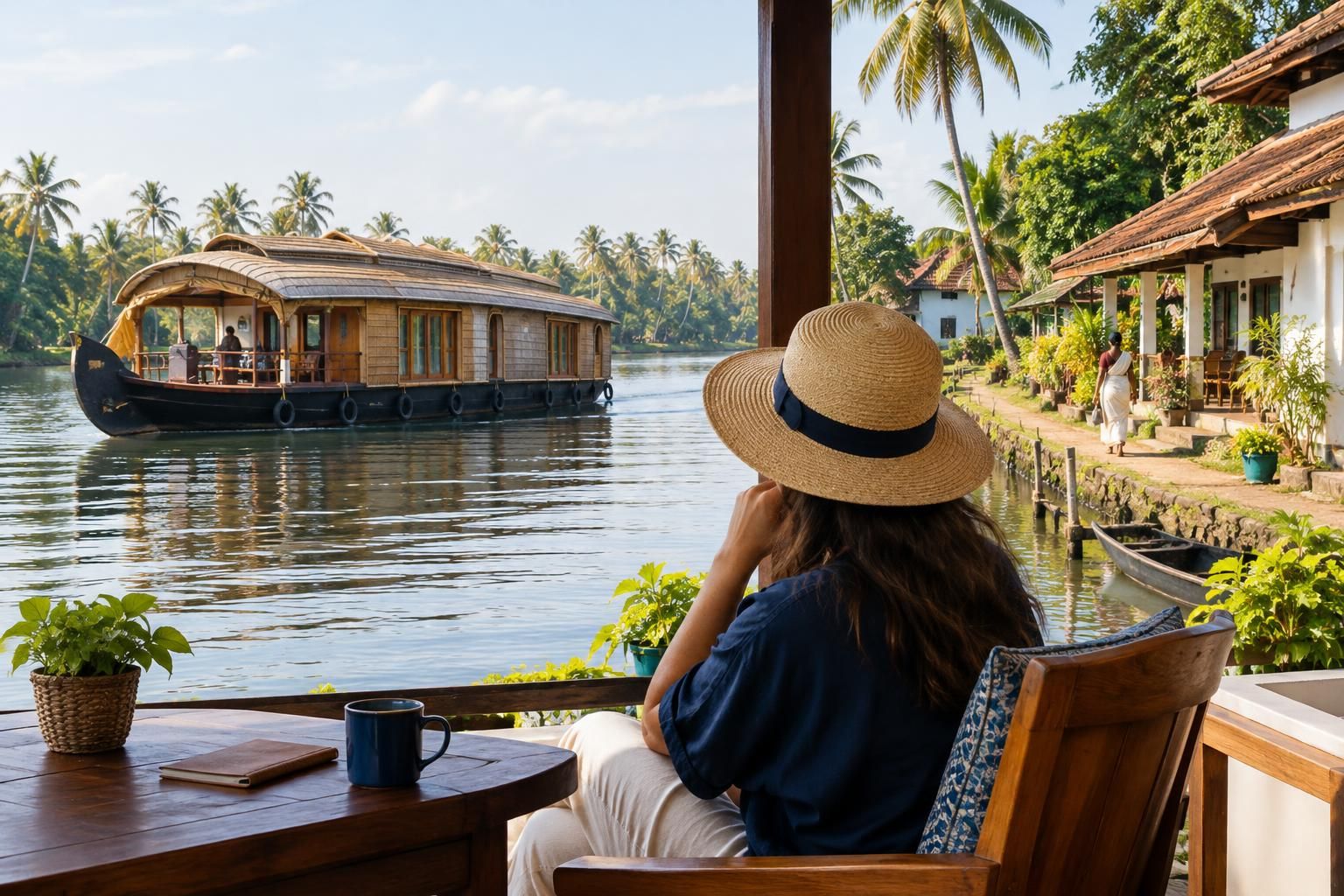
Kerala’s backwaters are not a single attraction with one standard itinerary. They are a network of lakes, canals and rivers, with settlements, farmland and everyday journeys woven through the scenery. Around Alappuzha, also known as Alleppey, and Kumarakom, travelers often face a deceptively simple choice: sleep on a houseboat or stay beside the water. The better option depends less on which sounds more romantic and more on how you want to spend your time. A floating overnight stay emphasizes scenery and meals aboard; a village guesthouse offers a fixed base with more freedom to explore. Here is how to choose without turning a relaxing stop into a complicated detour.
Start with the experience, not the accommodation photograph
Choose a houseboat if the journey itself is your main activity. Much of the appeal comes from sitting on deck, watching the banks change and sharing meals without moving between venues. It suits travelers who enjoy unstructured time and do not need a long list of sights. However, an overnight booking does not necessarily mean continuous cruising: boats may spend a substantial part of the stay moored.
Choose a waterside guesthouse if you prefer walks, independent meal choices and several shorter outings. You can arrange a boat excursion while keeping a conventional bedroom and space ashore. A third option is a daytime cruise followed by a land-based overnight stay. This separates the boating experience from the question of whether you will sleep comfortably aboard.
Understand what location changes
Alappuzha and Kumarakom are useful starting points, but their names alone do not tell you what a property or boat trip will feel like. A room facing broad open water offers a different outlook from one beside a narrow canal. Likewise, a boat route crossing a lake is not interchangeable with a journey through smaller waterways. Ask for a clear description of the setting and proposed route rather than relying on a destination label.
For a guesthouse, establish whether you can walk to meals and local streets or whether every outing requires arranged transport. For a boat, confirm the actual boarding and disembarkation points. A quiet location can be appealing, but it may add road transfers at both ends. Judge remoteness against the length of your stay and your willingness to remain on the property.
Compare comfort details before committing
On a houseboat, clarify which areas are private, whether the booking covers the whole vessel or an individual room, and where the crew will be based. Ask about bathroom arrangements, ventilation, cooling hours and any limits on electricity use. Travelers sensitive to sound should also ask about engines, generators and the overnight mooring setting. Photographs of a bedroom cannot answer these questions.
At a guesthouse, check the same fundamentals you would for any rural stay: bathroom setup, steps, access paths, cooling and the distance between your room and shared spaces. Anyone with mobility requirements should request specific descriptions of boarding steps or uneven ground. A smaller boat is not automatically easier to enter, and a ground-floor room is not necessarily step-free.
Build a short stay around one main outing
With one night, keep the plan simple. For a houseboat stay, leave the boarding afternoon and departure morning free of ambitious sightseeing. For a guesthouse stay, choose one meaningful water excursion rather than several similar trips. A shaded meal, a canal-side walk and time watching local activity can provide more variety than another long stretch aboard.
With two nights, a land-based stay gives you room to vary the pace. One day might include a guided paddle or small-boat outing, while the other focuses on village lanes, regional cooking or reading beside the water. Match each activity to your interests and physical comfort. If you want to paddle, ask about the craft, supervision, conditions and what happens if the planned outing cannot proceed.
Plan meals, weather and packing together
Houseboat meals are part of the experience, so discuss dietary preferences before booking. Ask what is included, whether menus are fixed and which drinks or snacks need separate arrangements. At a more secluded guesthouse, find out whether advance meal orders are needed. Travelers with allergies should explain their requirements directly and assess whether the provider can accommodate them.
Pack for warmth, humidity and possible rain rather than for a polished resort setting. Lightweight clothes, sun protection, insect repellent, a rain layer and a protective pouch for electronics are useful. Bring only what you can comfortably manage across boarding points or narrow paths. Keep an accessible change of clothes instead of burying everything in a large suitcase.
Leave room for transfers and everyday life
Treat your backwater stay as a distinct stop, not something to squeeze between tightly timed connections. Road access, boarding arrangements and the distance to your next destination all matter. Before pairing a cruise departure with a train or flight, work backward from the onward journey and allow a generous margin. If the connection is important, a final night ashore may make the plan simpler.
Remember that the waterways are also residential spaces. Ask before photographing people, avoid peering into homes and keep music low. When comparing operators, ask how they handle rubbish and wastewater; practical answers are more useful than vague environmental language. Carry a refillable bottle where suitable drinking water is available, and take your own litter away from smaller landing places.
A houseboat is a good fit when you want your accommodation, meals and scenery bundled into one slow journey. A village stay works better when you value flexibility, walks and a conventional room; a daytime cruise can bridge the two. Choose the format first, then compare the exact location, comfort arrangements and transfers. That approach keeps the backwaters focused on what makes them rewarding: time to notice the landscape and the daily life around it.
AI-assisted evergreen travel guide. Featured image is an AI-generated illustration, not a specific product or booking.