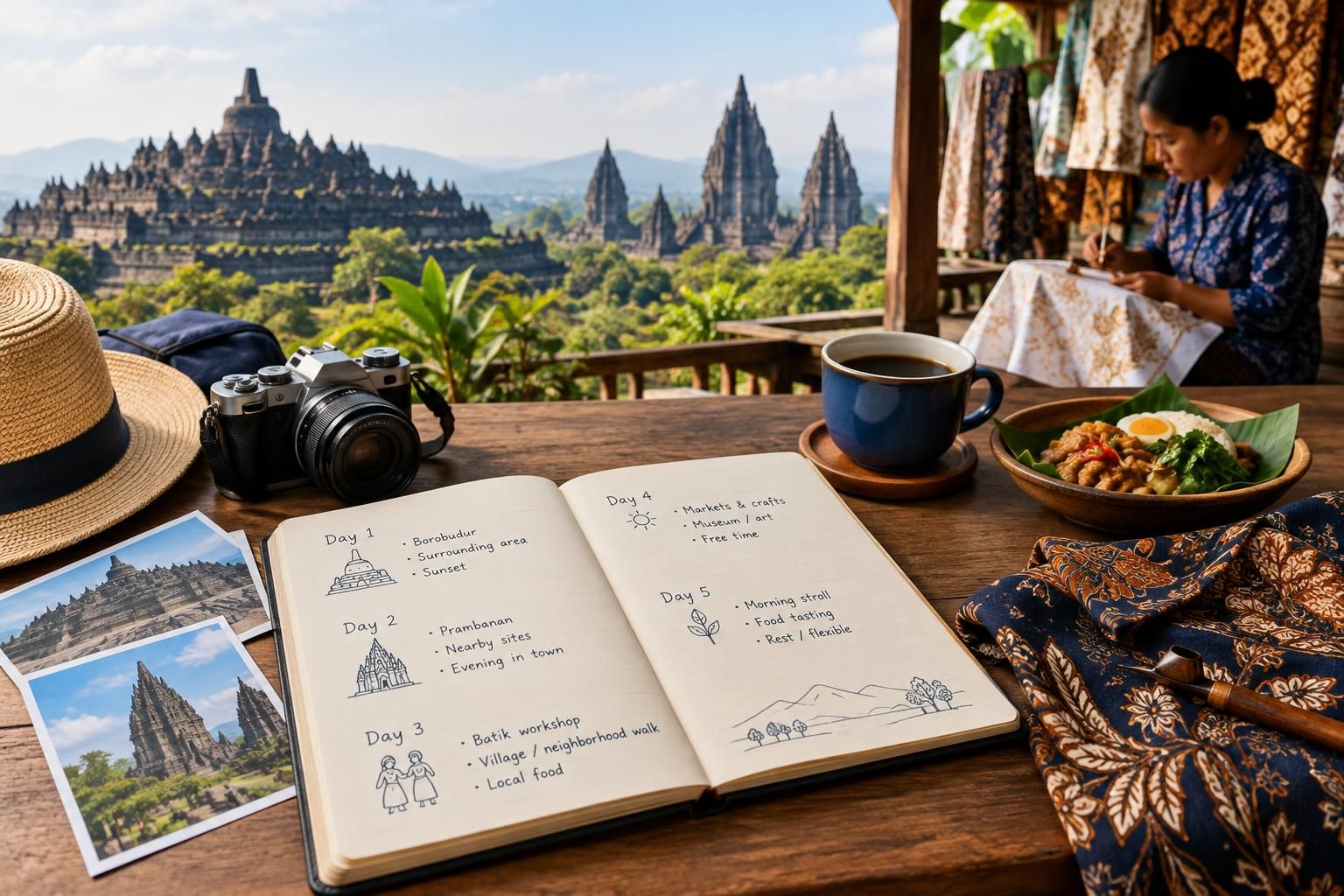
Yogyakarta rewards travelers who leave room between its headline sights. Java’s celebrated temple complexes are a major draw, but the city also offers Javanese court culture, batik workshops, food stalls and neighborhoods best explored without a deadline. The planning challenge is balancing trips beyond the city with enough time to enjoy what is close at hand. A four-night stay makes a useful starting point: two substantial excursions, one city-focused day and some flexibility around arrival and departure. Rather than treating every attraction as another stop on a driving route, organize the trip around the experiences you most want to linger over.
Give Borobudur and Prambanan Separate Space
Borobudur and Prambanan offer different experiences, not interchangeable temple visits. Borobudur is a Buddhist monument northwest of Yogyakarta, with reliefs and a layered architectural form that invite close attention. Prambanan, east of the city, is a Hindu temple complex whose towers make a striking contrast. Travelers interested in history or photography can reasonably give each its own excursion rather than combining both into one long day.
A combined outing may suit someone with limited time, but it involves substantial travel and repeated exposure to heat. Before committing, compare the full door-to-door itinerary, not just the time at each monument. Check the visit options and access conditions for your dates, particularly if ascending Borobudur is important to you; do not assume every admission arrangement includes the same areas.
Choose Accommodation for the Evenings You Want
For a first visit, choose accommodation according to what you want within easy reach after an excursion. The Malioboro area can suit travelers who prefer a busy central setting and street activity. Around Prawirotaman, look for smaller-scale accommodation and places to eat. Staying near the Kraton area can help you build a city day around palace-related heritage and nearby neighborhoods.
Look beyond the neighborhood label. A room on a busy road and one down a quieter lane can offer very different stays. Check recent descriptions of street noise, the approach to the property, air-conditioning and access for vehicle pickups. If you expect afternoon breaks, prioritize a comfortable room over decorative extras. For a short trip, one city base usually means less packing and fewer transfers than splitting nights between town and the temple areas.
Plan Transport Around Whole Excursions
Separate your transport decisions into airport or station transfers, city outings and temple excursions. For arrival, use the exact airport or station named on your booking when estimating the journey to your accommodation. A transfer is not spare sightseeing time: luggage collection, finding the pickup point and traffic can absorb the energy you had reserved for an ambitious first afternoon.
For temple days, compare an organized excursion, a vehicle with a driver and independent transport according to your priorities. A group outing reduces planning but follows a shared pace. A private arrangement can offer more control over breaks and departure times. If arranging a driver, agree on the route, waiting time, pickup location and what is included. Avoid adding distant attractions simply because they appear possible on a map.
Make One Day About Living Culture
Reserve a city day for the Kraton area, Taman Sari and the surrounding streets, choosing a manageable combination rather than a rapid circuit. These places provide context for Yogyakarta’s identity beyond its ancient monuments. Check visiting arrangements before setting out, and leave space for a meal or a shaded pause between stops.
A batik workshop gives the trip a different rhythm. Choose between a short introductory activity and a longer session involving more of the process. Ask what participants actually do, how much assistance is provided and whether the finished piece will be ready before departure. Travelers who prefer watching to making can instead seek a demonstration or browse textiles slowly, asking about materials and production methods without assuming every item is handmade.
Build Days Around Heat, Food and Recovery
Keep the most exposed sightseeing for a part of the day that suits the conditions, and avoid scheduling every afternoon outdoors. Pack breathable clothing, sun protection, a refillable water bottle and a light rain layer. Comfortable footwear matters on uneven surfaces, while clothing suitable for religious and cultural sites saves an extra change. Check site-specific expectations rather than relying on one rule for every visit.
Use meals as pauses, not additional appointments. Gudeg, associated with Yogyakarta, is a jackfruit-based dish often served with accompaniments that can include animal products. Travelers with dietary restrictions should ask about the whole plate, including sauces and side dishes. Plan one food-focused evening if that interests you, but keep other dinners convenient to your accommodation so a tiring excursion does not become another cross-city journey.
Use a Four-Night Outline Without Filling Every Gap
On arrival day, settle in and explore close to your accommodation. Use the first full day for whichever temple is your priority, the next for city heritage and batik, and the third for the other temple complex. This alternating pattern breaks up road travel and gives you a lower-pressure day between substantial excursions. Keep departure morning simple unless your onward journey genuinely leaves ample time.
With only three nights, select your essential experiences before booking transport: both temples and a little city time, or one temple with a deeper cultural day. With five nights, add unstructured neighborhood time before adding another distant outing. An overnight near Borobudur is worth considering if the surrounding setting itself appeals to you, but account for the accommodation change and onward transfer.
The strongest Yogyakarta itinerary gives its different experiences room to stand apart: monumental temples, Javanese heritage, hands-on craft and everyday meals. Choose a practical base, judge excursions by their full travel demands and protect some time when nothing needs to happen. You will have a more varied trip without turning each day into a test of how many sights you can reach.
AI-assisted evergreen travel guide. Featured image is an AI-generated illustration, not a specific product or booking.