Malta rewards travelers who resist treating a small map as an invitation to see everything. Historic streets, fortified harbors, archaeological sites and rocky bays can fill a week, but short distances do not always mean quick journeys. A car-free holiday works best when accommodation and daily plans follow the transport network rather than a checklist. Dividing seven nights between Malta and Gozo offers two contrasting rhythms: a harbor-based stay for architecture and urban wandering, followed by a quieter base for village squares, coastal views and unhurried afternoons.
Divide the week according to your priorities
A useful starting point is four nights on Malta and three on Gozo. This gives the larger island enough attention without reducing Gozo to a rushed excursion. If museums, architecture and evening dining matter most, consider five nights on Malta and two on Gozo instead. Travelers drawn to smaller settlements and landscape-focused days may prefer the original split.
Decide the order around your arrival and departure arrangements. Ending on Malta can reduce the number of transport links involved before a flight. If you stay on Gozo last, think carefully about the consequences of a delayed crossing or missed connection. Treat the island transfer as part of the holiday, not an empty gap into which another major sightseeing stop must fit.
Choose accommodation for the journeys you will actually make
On Malta, Valletta suits travelers who want historic surroundings and easy access to the main bus hub outside the city entrance. Sliema offers a contrasting waterfront setting and can work for travelers interested in harbor views and a broader urban atmosphere. The Three Cities appeal for their lanes and waterside character, but compare the practical journey from a particular property to your planned outings before choosing.
On Gozo, Victoria is a practical starting point for a bus-based stay because routes focus on the island’s main town. A coastal village may feel more like a retreat, but journeys elsewhere can involve returning through Victoria. Choose that trade-off deliberately rather than assuming every coastal base is equally convenient.
Look beyond photographs of balconies and stone interiors. Check for steps, lifts, cooling, street noise and the walking route from the stop or ferry landing. A charming address up a steep lane can become less appealing with luggage. For self-catering, confirm whether the kitchen supports simple meals rather than just drinks and snacks.
Build days around clusters, not cross-island zigzags
Keep Valletta as a day in its own right: combine its streets, gardens and harbor viewpoints with one substantial indoor visit. Give the Three Cities a separate, slower outing if they interest you. Mdina and neighboring Rabat form another logical pairing, allowing time for lanes, architecture and a leisurely lunch without adding a distant beach afterward.
On Gozo, pair Victoria’s citadel and town streets with a relaxed afternoon, then use another day for one coastal area. The Xlendi area, Marsalforn or the landscapes around Dwejra offer different settings; there is no need to combine them all. Pick places for what you want to do there, whether that means sitting beside the water, taking photographs or following a short walk.
For each day, identify one main objective and one optional addition. This makes a missed bus or a longer-than-expected lunch an inconvenience rather than the collapse of an elaborate itinerary.
Approach buses and ferries as separate planning tasks
Before committing to accommodation, compare the actual route between each base and your highest-priority sights. A destination may be geographically close yet require a change of bus. Check current routes, service patterns, ticket arrangements and return options nearer departure, especially for evenings and quieter travel periods.
There are different ways to approach the crossing between Malta and Gozo, including services associated with the main harbor area and the northern crossing. Compare the complete door-to-door journey rather than the boat portion alone. Your accommodation location, luggage and onward connection on Gozo can matter more than the apparent simplicity of a crossing.
Leave flexibility around boat travel because weather can affect operations. Keep essentials accessible rather than buried in a suitcase, and avoid planning a timed attraction immediately after arrival. If considering an occasional taxi, allow for it in the budget instead of relying on an unplanned rescue.
Match coastal plans to the setting and season
Malta and Gozo offer sandy beaches, rocky shorelines and exposed coastal landscapes, but these are different experiences. A sandy beach suits a long, low-effort stay; a rocky waterfront may appeal more for views and a café stop. Do not assume every attractive bay has straightforward water access, shade or facilities.
In warmer weather, favor earlier walks and reserve the middle of the day for lunch, indoor visits or rest. In cooler periods, give greater weight to towns, archaeology and sheltered outings. For any coastal walk, check the route, terrain and forecast, carry water and wear footwear suited to uneven ground. Make swimming an optional activity based on local conditions, not the essential purpose of every coastal excursion.
Pack lightly and leave space for ordinary pleasures
Two islands mean at least one accommodation change, so manageable luggage pays off. Pack comfortable shoes for stone streets, a layer for breezy crossings, sun protection and a small day bag. If you hope to visit religious sites, bring clothing that can meet any posted dress expectations.
Avoid filling every evening with another journey. A nearby meal, a waterfront stroll or time in a village square can provide the contrast that makes daytime sightseeing enjoyable. Keep one half-day unassigned for a favorite neighborhood, a weather-delayed outing or simply doing less.
A successful car-free week in Malta and Gozo depends less on covering distance than on choosing useful bases and grouping outings sensibly. Give each island time, keep transfer days light and distinguish between a coastal visit and a full beach day. With those decisions made, the holiday can move comfortably between harbor cities, old stone towns and open island landscapes.
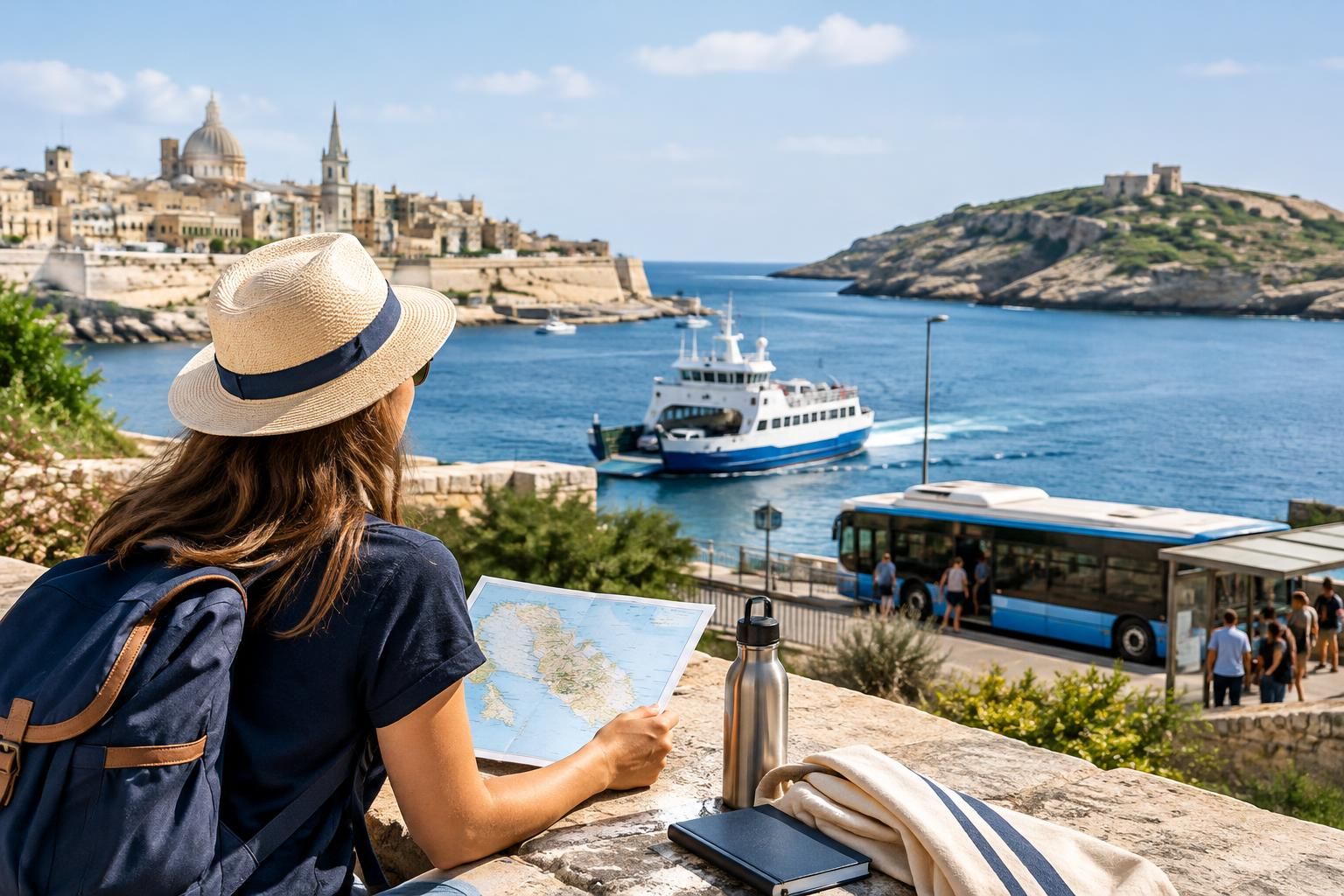
AI-assisted evergreen travel guide. Featured image is an AI-generated illustration, not a specific product or booking.