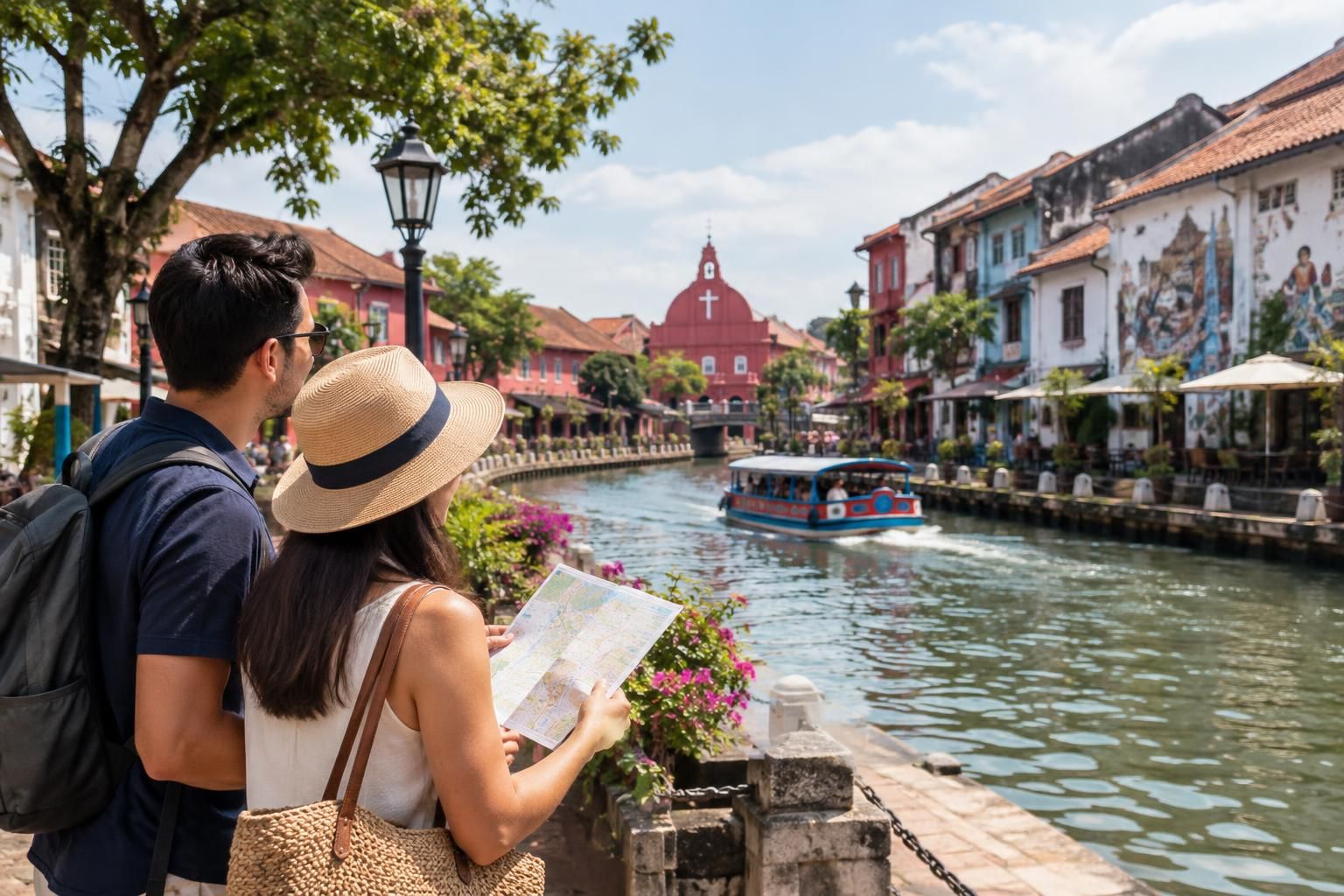
Melaka suits travelers who enjoy discovering a city through its streets rather than working through a long attraction list. On Malaysia’s west coast, its historic center brings together shophouses, places of worship, museums and a winding river in a relatively compact area. Two nights give you room to explore beyond a rushed stopover, particularly if you value quieter mornings and time indoors during the hottest part of the day. The key is to choose a convenient base, account for the road journey into town and resist filling every hour.
Decide whether Melaka fits your wider route
Melaka makes particular sense as a short contrast to Kuala Lumpur: a smaller-scale stay focused on heritage streets and riverside wandering rather than another stretch of big-city sightseeing. It can also fit into a longer overland journey through Peninsular Malaysia, but compare the full transfer effort before treating it as an effortless stop between destinations.
For planning purposes, allow for a road leg into the city. If you are considering rail for part of the journey, check where the station actually sits relative to your accommodation and what the onward transfer involves. Compare coaches and private transfers by total door-to-door time, not just the main journey. A cheaper arrival can lose its appeal if it requires awkward connections with luggage.
Choose your accommodation by street, not just neighborhood
For a first visit, look around the historic core near Jonker Street, the river or the streets leading toward Dutch Square. These areas put much of the central sightseeing within walking reach. However, a central address does not necessarily mean a restful room: proximity to restaurants, traffic and evening activity can matter as much as distance from landmarks.
A converted shophouse can add character, but check practical details such as windows, stairs, bathroom layout and room position. A rear room may suit a light sleeper better than one facing a busy street. Travelers who prioritize lifts, straightforward vehicle access or more predictable room layouts may prefer a purpose-built hotel near the edge of the center. If walking is difficult, examine the actual approach to the property rather than relying on a map’s short distance.
Build two days around different kinds of exploring
Use your arrival afternoon for orientation rather than a packed sightseeing circuit. After checking in, take a short river walk and identify a few useful routes between your accommodation, places to eat and the historic center. Keep dinner nearby so that a delayed journey does not unravel the evening.
Devote one morning to the Dutch Square area, nearby historic landmarks and, if it interests you, the climb toward St. Paul’s Hill. Spend the next morning among the shophouse streets around Jonker Street and Jalan Tun Tan Cheng Lock, leaving time for a museum or a closer look at architectural details. This division gives each day a clear focus without turning the city into a checklist. Keep any departure-day activity short and close to your luggage.
Use heritage visits to add context
Melaka’s appeal lies partly in the layers of its trading history and the communities that shaped it. Rather than entering every museum or photographing every facade, choose one or two visits that help explain what you see outside. A house museum can illuminate domestic life and design; a broader historical collection can help organize the city’s different periods.
Balance those interiors with attentive street walking. Look for covered walkways, courtyard arrangements and the relationship between shops and living spaces. Around places of worship, follow posted guidance on clothing, photography and visitor access. These are living religious and neighborhood spaces, not simply architectural stops, so be prepared to change your plan if a visit is inappropriate at that moment.
Make meals part of the route
Food can structure a Melaka visit without becoming a competitive eating itinerary. Nyonya cooking, associated with Peranakan communities, offers one useful focus; chicken rice balls and cendol are other recognizable possibilities. Choose a few dishes you genuinely want to try, then leave room for an ordinary breakfast or an unplanned meal near your accommodation.
Avoid crossing town repeatedly for individual dishes. Instead, mark a small cluster of meal options near each morning’s walk and keep an alternative in mind. If you have dietary requirements, ask about ingredients rather than relying on a dish name: broths, sauces and garnishes may be less obvious than the main component. Treat any evening market as an optional addition after checking whether it operates during your stay.
Plan for heat, rain and uneven walking conditions
A compact center can still feel tiring in tropical heat. Put your longest outdoor walk early in the day, then use the afternoon for a museum, a leisurely lunch or a break at your accommodation. Carry water, sun protection and a small rain layer or umbrella, while keeping your day bag light enough for repeated short walks.
Do not assume every route has continuous, level pavement or shade. Comfortable footwear matters, and travelers using a wheelchair or stroller should investigate access to specific buildings and routes. During rain, swap a hill walk or exposed riverside stretch for an indoor visit rather than trying to preserve the original order.
A rewarding Melaka stay needs less scheduling than thoughtful positioning. Choose a room that supports both walking and rest, allow enough time for arrival and departure, and give each morning one main area to explore. With meals nearby and flexible afternoons, two nights can offer a satisfying introduction without reducing the city to a hurried circuit of landmarks.
AI-assisted evergreen travel guide. Featured image is an AI-generated illustration, not a specific product or booking.