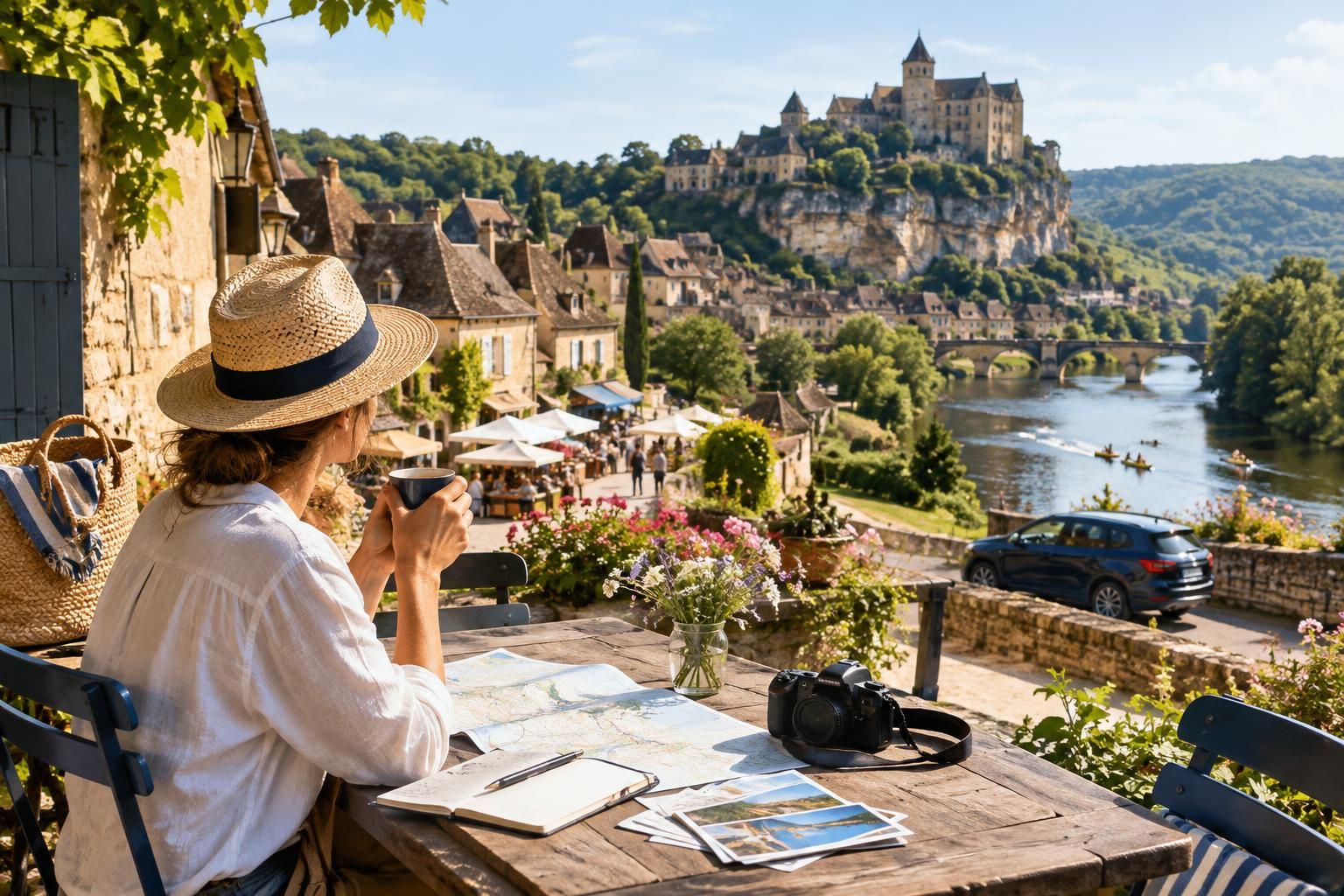
The Dordogne rewards a holiday built around small distances rather than a long list of landmarks. A morning market, a limestone village and a leisurely lunch can fill a day without needing another major attraction. The planning challenge is that the region’s pleasures are scattered, and a beautiful rental property can leave you driving farther than expected. For a first week, concentrate on the Dordogne valley around Sarlat-la-Canéda, Beynac-et-Cazenac and Domme, adding the Vézère valley only when it fits comfortably. One carefully chosen base gives you time for castles, prehistoric heritage, river scenery and ordinary village life.
1. Choose a compact area before choosing a property
Start by marking the places you most want to visit, then look for accommodation near their center. Sarlat-la-Canéda suits travelers who want a historic town, restaurant choices and evenings on foot. Beynac-et-Cazenac and nearby riverside villages favor scenery and access to the valley’s castles. Domme offers a hilltop setting, but its elevation matters if you imagine walking casually between your accommodation and the river.
If prehistoric sites are your main interest, consider Les Eyzies or another base in the Vézère valley instead. Trying to give equal attention to every corner of the wider Dordogne can turn a restful week into repeated cross-country drives. Choose one core area and treat more distant places as optional excursions, not essential stops.
2. Decide what your accommodation must make easy
A village apartment and a rural house create different holidays. An apartment can make it easier to buy breakfast and walk to dinner, while a countryside rental offers space and quieter evenings but usually means driving for supplies. Before booking, check the actual location rather than relying on a village name in the listing. A property associated with a town may sit well outside its walkable center.
Look closely at parking, steps, outdoor shade and bedroom layout. Historic buildings may have steep internal stairs, and hill villages can involve an uphill return after dinner. For self-catering, prioritize a usable kitchen and somewhere comfortable to eat over decorative extras. If a pool is important, check its stated seasonal availability and access arrangements rather than assuming it will suit every stay.
3. Treat the car as a tool, not the center of the trip
A rental car is a practical choice for combining small villages, countryside accommodation and scattered sights. Compare arrival options by the whole journey: onward driving, collection arrangements and how tired you may be after traveling. Reaching a regional rail station before collecting a car may suit some itineraries better than starting a long drive immediately after a flight.
Plan routes using driving times rather than map distances alone. Rural roads, village approaches and the search for parking can make a short-looking journey occupy much of a morning. Where parking is available outside a historic center, it can be simpler than navigating narrow streets. Confirm your accommodation’s access instructions, and choose a vehicle that fits both your luggage and the parking space provided.
4. Build each day around one main experience
Use a simple daily pattern: one substantial visit, one nearby place to wander and time left unassigned. A castle visit near Beynac might pair with a riverside lunch rather than another castle across the region. A morning exploring Sarlat can lead into shopping for supper and an afternoon at your accommodation. This gives each day variety without constant departures.
For a seven-night stay, a useful framework is two village-and-castle days, one prehistoric heritage day, one river-focused day and one deliberately light day. Keep arrival and departure days modest. You do not need to fill every remaining gap: a return visit to a favorite village often adds more pleasure than another unfamiliar stop.
5. Give markets, caves and river outings different kinds of planning
Markets work best as the focus of a morning, not as a quick stop between timed visits. Confirm the relevant market day for your dates, arrive with a short shopping list and buy quantities you can use. Bread, fruit, cheese and a few picnic ingredients can support a self-catering stay without leaving you with a refrigerator full of ambitious purchases.
Cave visits and prehistoric attractions need more advance thought. Distinguish between original sites, reproductions and interpretive museums so that you book the experience you actually want. Check reservation requirements, tour language, visit length and access details. For canoeing or another river outing, ask the operator about conditions, route demands, equipment and return transport; keep an alternative plan rather than making the whole day depend on it.
6. Leave room for weather and unstructured evenings
Match the day’s shape to the weather rather than assuming every activity is interchangeable. Exposed village walks may be more appealing earlier on a hot day, while a museum can provide a change of pace in wet weather. Underground attractions are not automatically easy fallback options, because entry arrangements and access demands still matter.
Pack comfortable footwear for uneven paving, a light layer for cooler interiors and reusable bags for food shopping. Keep one easy meal at your accommodation for an evening when nobody wants to go out. Before choosing a remote rental, decide whether peaceful nights are genuinely part of the appeal or whether you would miss being able to stroll out for dinner.
A satisfying Dordogne week depends less on covering the region than on choosing a base that supports your preferred daily rhythm. Keep your main sights close together, make accommodation logistics explicit and reserve only the experiences that need structure. With space for markets, slow lunches and repeat visits, the landscape becomes somewhere to spend time rather than a backdrop to a driving itinerary.
AI-assisted evergreen travel guide. Featured image is an AI-generated illustration, not a specific product or booking.