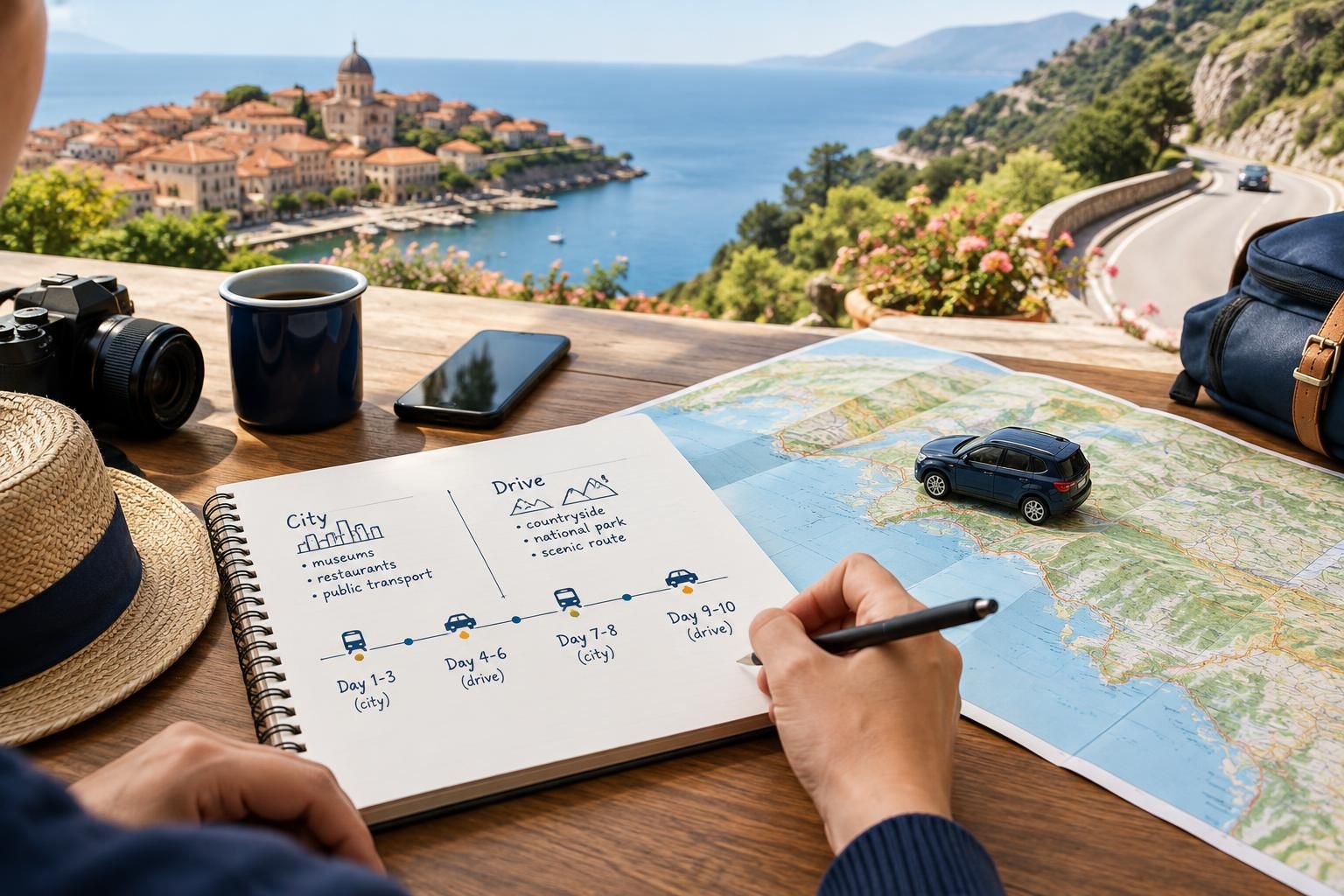
A trip does not have to be entirely car-free or entirely built around driving. You might spend several days exploring a city on foot and by public transport, then rent a car for a countryside stay, a coastal loop or a series of scattered villages. The planning challenge is deciding where the car genuinely helps and where it becomes another thing to manage. By grouping driving days together and treating pickup and return as part of the itinerary, you can enjoy the flexibility without paying for a vehicle that spends much of the trip parked.
1. Identify the days that actually benefit from a car
Start with the places you want to visit, rather than a rental search. Divide them into three groups: places easily reached without a car, places where driving offers a meaningful advantage, and places you would only include if transport works out. This keeps an appealing but awkward stop from determining the logistics of the whole holiday.
A car is often most useful when several stops are spread across a rural area, your accommodation is far from transport connections, or you want to carry bulky equipment between locations. It may add little during days spent in a compact historic center. Compare the complete outing, including walking to a station or retrieving a parked car, rather than assuming driving is automatically quicker.
2. Build a car-free block and a driving block
Once you know which days benefit from driving, place them next to each other where possible. A simple structure might be three city nights, followed by a car pickup and four nights in the countryside. Another option is a short driving loop between two stays in the same city. The aim is to avoid repeatedly collecting and returning vehicles.
Resist the temptation to scatter rural day trips throughout a city stay if that means renting for the entire week. Rearranging two outings may remove several unused rental days. However, do not force every remote attraction into one exhausting circuit just to shorten the rental. A smaller route with time to stop is usually more rewarding than a long checklist.
3. Choose pickup and return points around the route
The most obvious rental location is not always the most practical. An airport pickup may suit a trip that immediately leaves the city, while a city-edge location could make more sense after an urban stay. Compare how you would reach each location with luggage, and whether the first part of the drive leads toward your destination or through traffic you hoped to avoid.
Allow time for collection, checking the vehicle, loading bags and getting comfortable with the controls. On the return day, account for refueling or charging arrangements, unloading and the onward journey. Confirm location-specific opening times and return procedures before booking. If returning somewhere different, compare that option with a loop route using the full quoted cost and the time each requires.
4. Compare the total cost, not just the rental rate
Create two simple transport budgets for the same itinerary. For the driving version, include the rental quote, any selected extras, fuel or charging, parking, tolls and transport to or from the rental location. For the alternative, include intercity tickets, local journeys, occasional taxis and any guided excursion you would use instead. Also note whether accommodation choices change the calculation.
Keep money and convenience as separate comparisons. A car shared by several travelers may look economical, but somebody still has to drive, navigate and find parking. A train journey may cost more yet give everyone a break. Check the booking terms for deposits, payment arrangements, mileage limits and cancellation conditions so the apparent saving does not depend on assumptions.
5. Make accommodation work with the transport change
Choose each stay for the way you will travel while based there. During the car-free portion, useful qualities might include a manageable walk from a station, nearby food options and straightforward local connections. During the driving portion, consider parking arrangements, access with luggage and how easily you can leave for the next day's outing.
Do not assume that accommodation described as having parking offers a space beside the entrance or one included in the room cost. Clarify the details that matter to you. If your route returns to the same city, compare staying in one neighborhood both times with choosing a final-night location that makes departure simpler. Avoid moving hotels solely to save a modest transfer if the move creates more work.
6. Keep the handover days deliberately light
Treat the change between transport modes as a small travel day. After collecting the car, choose one main stop or head directly to your next base rather than stacking up timed visits. Before returning it, avoid a distant final attraction that leaves little room for a slower journey. Keep essential belongings together so they are easy to transfer between the car, accommodation and onward transport.
Before committing, test one alternative: what would the trip look like with one fewer driving day, or no car at all? Perhaps a single organized excursion replaces an awkward rental, or an extra countryside night makes the driving worthwhile. The best arrangement is the one that serves your chosen experiences, not the one that uses the greatest number of transport options.
Renting a car for only part of a trip works best when the itinerary has a clear transition: city exploration first, driving days together, then a straightforward return. Compare full costs, give pickup and drop-off enough time, and choose accommodation that suits each stage. You can then use the car where its flexibility matters and leave it out where it would simply be waiting for you.
AI-assisted evergreen travel guide. Featured image is an AI-generated illustration, not a specific product or booking.