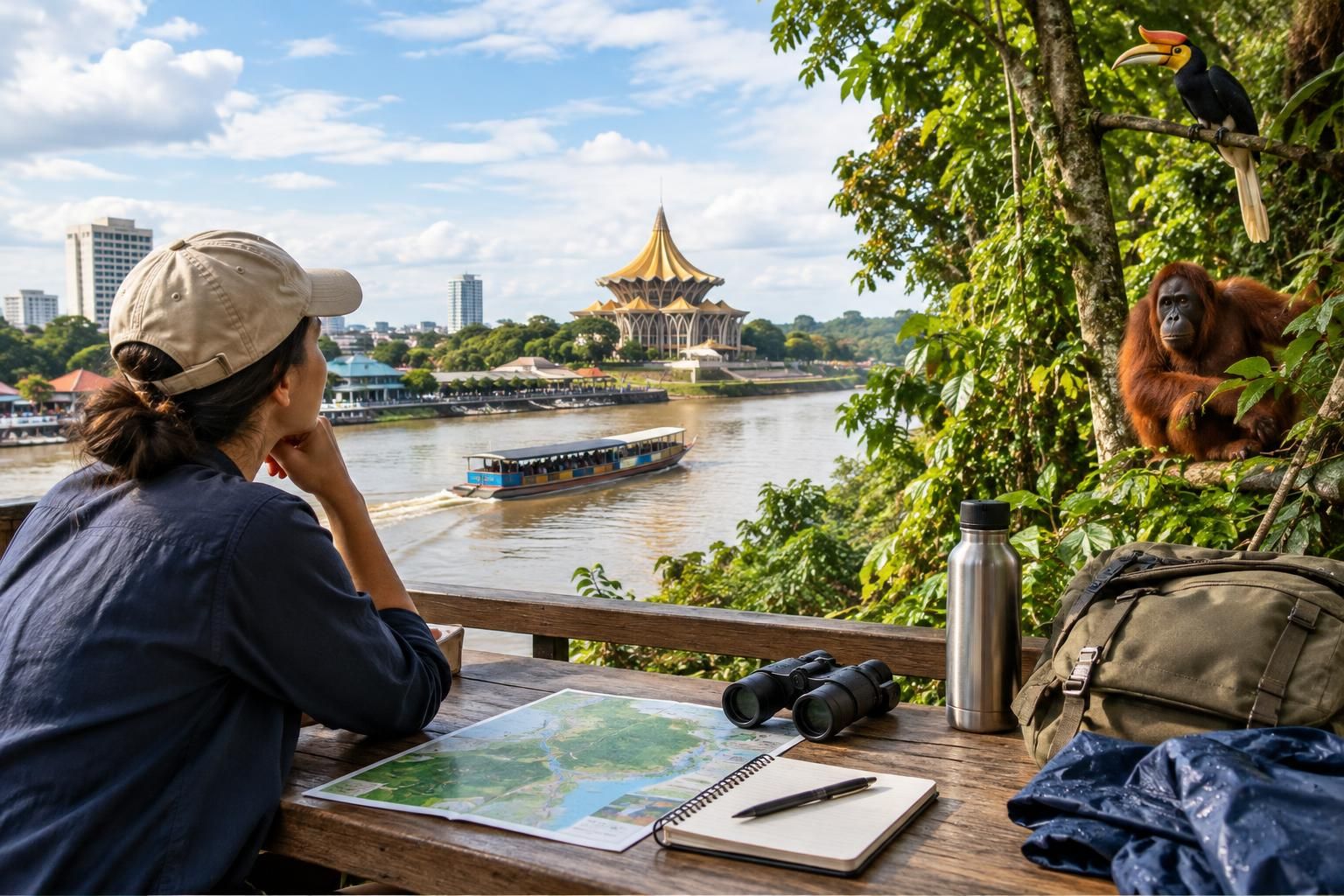
Kuching, in Malaysian Borneo’s Sarawak region, suits travelers who want forest experiences without moving accommodation every night. A stay can combine riverside walks, regional food and museums with outings beyond the city. The planning challenge is not finding enough to do, but distinguishing a relaxed excursion from a demanding day involving road transfers, boats and humid trails. Four or five nights gives you room to choose a few contrasting experiences while keeping time for the city itself. Think of Kuching as a comfortable base with access to nature, rather than a place from which every major Borneo experience is within easy reach.
Build the stay around two outings, not a daily checklist
For a first visit, choose one forest-focused day and one wildlife or cultural outing, then fit city time between them. Bako National Park and the Semenggoh orangutan rehabilitation setting offer different experiences: the former centers on a coastal forest landscape and trails, while the latter is a managed visit where animals may or may not appear. Neither should be treated as a guaranteed wildlife show.
A four-night outline could include an arrival afternoon by the river, a forest day, a city day and a second excursion before departure. With five nights, add flexibility rather than immediately adding another distant destination. Keeping an uncommitted day makes it easier to respond to heavy rain, tired legs or a discovery that deserves more time.
Choose accommodation for everyday comfort
A central base near the historic riverfront makes it easier to combine meals, short walks and indoor breaks without arranging transport for every movement. Compare the actual approach to a property, not just its distance from the waterfront. A short route with awkward crossings, exposed pavement or steps can feel less convenient in humid weather than a slightly longer, simpler walk.
Prioritize reliable cooling, somewhere to dry damp clothing and enough space to organize a small daypack. Light sleepers should ask about road noise and nearby activity. If you expect early excursion departures, clarify breakfast arrangements and vehicle pickup access before booking. Travelers with mobility needs should ask specific questions about entrances, lifts and bathrooms rather than relying on a broad accessibility label.
Treat forest transport as part of the excursion
A forest outing can involve more than the drive shown on a map. For Bako, planning also involves a boat transfer, with conditions affecting how the journey works. Before committing, establish the meeting point, transfer arrangements, return plan and what happens if conditions disrupt access. Avoid scheduling a flight or another inflexible connection immediately after a boat-dependent day.
Choose a trail according to terrain, exposure and your comfort in humidity, not distance alone. Roots, mud and repeated small climbs can make a short walk feel substantial. Ask about suitable routes and guiding arrangements for your intended visit. If you prefer less coordination, an organized excursion may be worth considering, but compare walking expectations, group size and included transfers rather than selecting on headline duration.
Set realistic expectations for wildlife
Decide whether your priority is seeing a particular animal or spending time in its wider environment. These are different goals. A forest walk can be rewarding for vegetation, coastal scenery, insects and bird calls even when larger animals remain hidden. At a rehabilitation setting such as Semenggoh, animal movements and natural food availability can influence what visitors see.
Look for experiences that explain observation boundaries and do not promise touching, feeding or staged animal encounters. Follow staff directions, keep food packed away and give animals space rather than moving closer for a photograph. Binoculars can be more useful than relying on a phone camera. Children may enjoy the visit more if they understand beforehand that waiting quietly is part of wildlife watching.
Give Kuching its own place in the itinerary
Use a city day to explore the riverfront, old commercial streets and a museum rather than treating it only as recovery time. The Borneo Cultures Museum is one option for adding context to the region’s communities and landscapes; check visit arrangements when shaping your day. Select one substantial indoor stop, then leave space for wandering instead of trying to cover every cultural attraction.
Food can provide a simple structure without becoming a rigid eating schedule. Sarawak laksa and kolo mee are useful starting points, with portions shared where practical so that meals do not crowd out everything else. Travelers with dietary restrictions should ask about broth, toppings and sauces individually. A familiar dish name does not necessarily reveal every ingredient or preparation method.
Pack for moisture and keep a workable backup plan
Bring lightweight clothing, a rain layer, sun protection and footwear with dependable grip. A small waterproof liner inside your daypack helps protect a phone, documents and spare clothing. Carry drinking water and insect repellent, and keep one dry outfit for the return journey. For boat-linked outings, pack compactly and ask the operator about boarding conditions and luggage protection.
Rain need not cancel the entire day, but it can change which activities make sense. Keep an indoor alternative and avoid relying on one final afternoon for your only forest visit. Before each excursion, confirm access arrangements, expected walking conditions and the return transfer. Save the accommodation location offline, and leave enough flexibility to shorten a day without feeling that the trip has failed.
The strongest Kuching itinerary balances access to nature with the pleasures of staying put. Choose a practical city base, give each major outing enough time and let wildlife remain unpredictable. With two well-matched excursions and room for food, museums and riverside wandering, a short stay can feel varied without becoming a sequence of transfers.
AI-assisted evergreen travel guide. Featured image is an AI-generated illustration, not a specific product or booking.