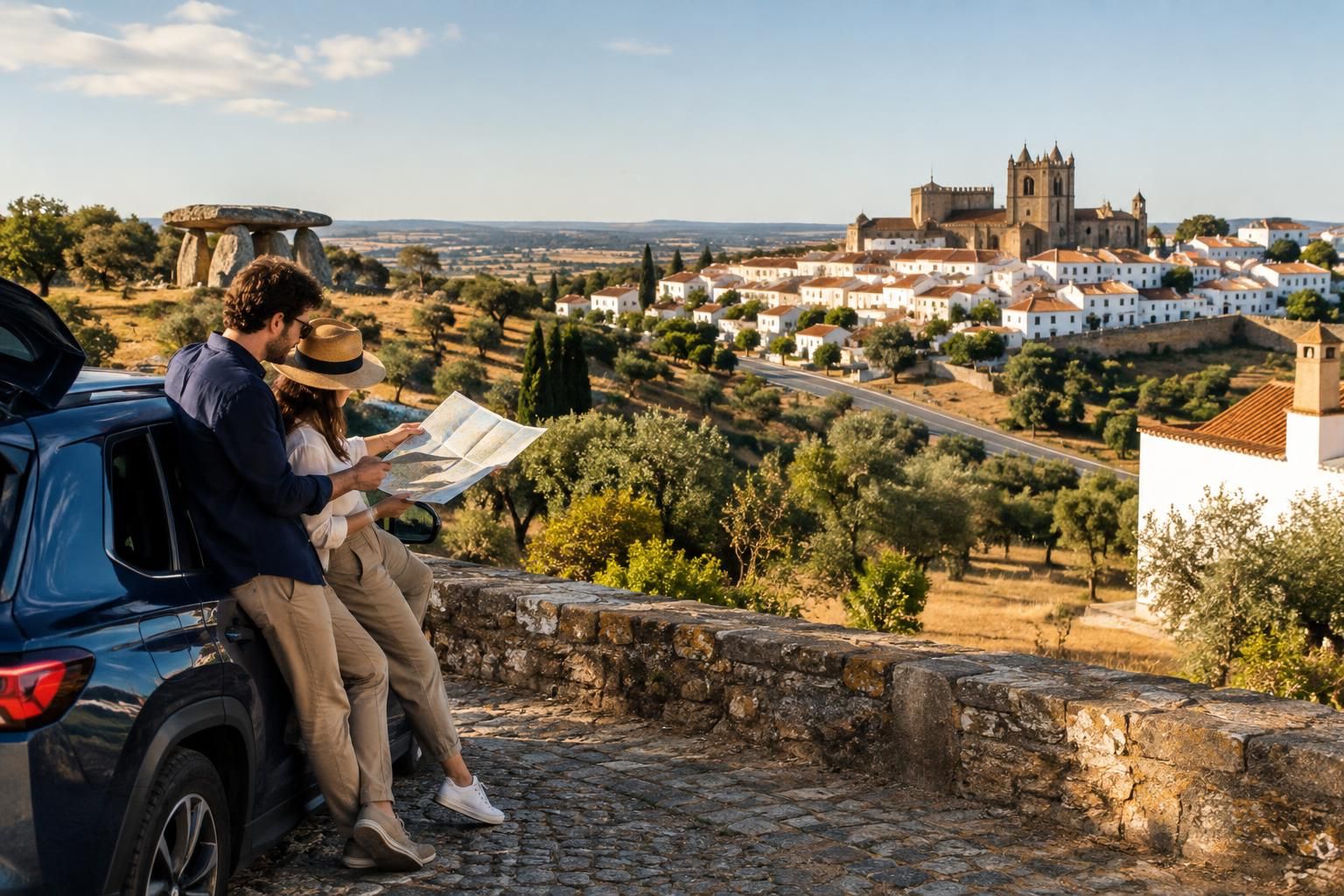
Portugal’s Alentejo rewards a different rhythm from a coastal resort holiday or a fast-moving city tour. Its appeal lies in the space between places: cork oaks, open farmland, whitewashed streets and hilltop towns that invite an unhurried wander. A car makes those connections easier, but the best itinerary does not spend every day behind the wheel. For a first visit, divide seven nights between Évora and Castelo de Vide. This gives you a substantial historic city, smaller northern towns and enough flexibility to leave an afternoon deliberately empty.
Give two bases different jobs
Start with four nights in Évora and finish with three in Castelo de Vide. Évora suits the more structured half of the trip: Roman remains, a cathedral, museums and streets where sightseeing can alternate with café stops. Castelo de Vide offers a smaller-scale finish, with lanes, viewpoints and excursions into the hillier landscape near the Spanish border.
Reverse the order if it makes your arrival and onward journey simpler. Before committing, compare the complete driving route, including vehicle collection and return, rather than looking only at the distance between hotels. If you have five nights rather than seven, choose one base and reduce your geographical ambitions instead of compressing both halves.
Choose accommodation around parking and evenings
In Évora, the main decision is whether to sleep within the historic centre or on its edge. A central room puts evening walks and dinner close at hand, while an edge-of-centre property may simplify parking and luggage handling. Do not assume that an address inside old walls comes with straightforward vehicle access. Ask where guests actually park and how far bags must be carried.
Around Castelo de Vide, choose between a town stay and a rural property. Staying in town supports spontaneous walks and meals without another drive. A countryside stay makes more sense if outdoor space and quiet afternoons are priorities. Check practical details such as kitchen equipment, heating or cooling, stairs and the approach road. Atmospheric photographs reveal little about those everyday trade-offs.
Build the Évora days around contrasts
Use your first full day for Évora itself. Combine a few historic landmarks with time to understand the street pattern, find somewhere for breakfast and browse ordinary shops. The Roman temple and cathedral area provide a useful starting point, but resist treating every interior as compulsory. One substantial visit can give the day enough focus.
For another day, consider the megalithic landscape west of the city, with the Almendres area as a possible focus. Confirm access arrangements and route conditions before setting out, particularly for rural approaches. Pair this with a village stop or an easy afternoon back in Évora, rather than adding several distant monuments.
Keep the remaining day flexible. Arraiolos offers a town-based outing associated with a long carpet-making tradition; a countryside excursion offers a different change of scene. Choose according to your interests, not because every direction needs coverage. Travellers who enjoy drawing, photography or slow lunches may prefer another day without moving the car.
Make the transfer day a journey, not a checklist
The move north is a good opportunity to stop in Estremoz, whose hilltop old town contrasts with the lower town below. Allow time for the change in level and for simply exploring. If you want to add Vila Viçosa or another town, treat it as an alternative focus rather than an automatic extra.
A useful transfer-day rule is one main stop and one optional stop. You still need time to check out, load the car, find parking, eat and settle into the next accommodation. Arriving in Castelo de Vide with energy for a first evening walk is usually more rewarding than reaching it after a string of hurried visits.
Use Castelo de Vide for short, satisfying excursions
Give Castelo de Vide itself a generous half-day or longer. Its steep lanes, former Jewish quarter and castle area suit exploration on foot, with pauses built in for gradients and uneven surfaces. Choose footwear for stone streets rather than packing only for warm weather.
Marvão makes a natural separate outing: a fortified hilltop settlement with broad views across the surrounding landscape. Plan it as a place to explore slowly, not just a viewpoint to photograph. Exposed sections can feel very different depending on wind, sun and cloud, so retain some flexibility over which day you visit.
For your remaining time, choose between another small town, a countryside walk or a quiet afternoon at your accommodation. The Serra de São Mamede landscape gives this northern portion of the trip a different character from the plains around Évora. Select walks using current local route information and realistic expectations about terrain, shade and daylight.
Let the season shape your daily routine
Summer can bring strong inland heat, making early exploration and a long midday pause appealing. Spring and autumn can suit longer outdoor days, though rain may change rural plans. Winter shifts the balance towards town walks, indoor visits and accommodation that feels comfortable after dark.
Pack layers, sun protection, comfortable walking shoes and a compact rain layer. Keep water and a simple snack in the car, download useful maps and avoid relying entirely on rural mobile reception. Check the details that affect your chosen activities before travelling, especially monument access, restaurant service days and any countryside visits that require arrangements.
A satisfying Alentejo week needs fewer stops than the map might suggest. Let Évora provide the historic depth, use the journey north for one well-chosen town, and finish with Castelo de Vide and Marvão at an easier pace. Two practical bases and a few open afternoons leave room for the region’s strongest attraction: time to notice the landscape and everyday life between the landmarks.
AI-assisted evergreen travel guide. Featured image is an AI-generated illustration, not a specific product or booking.