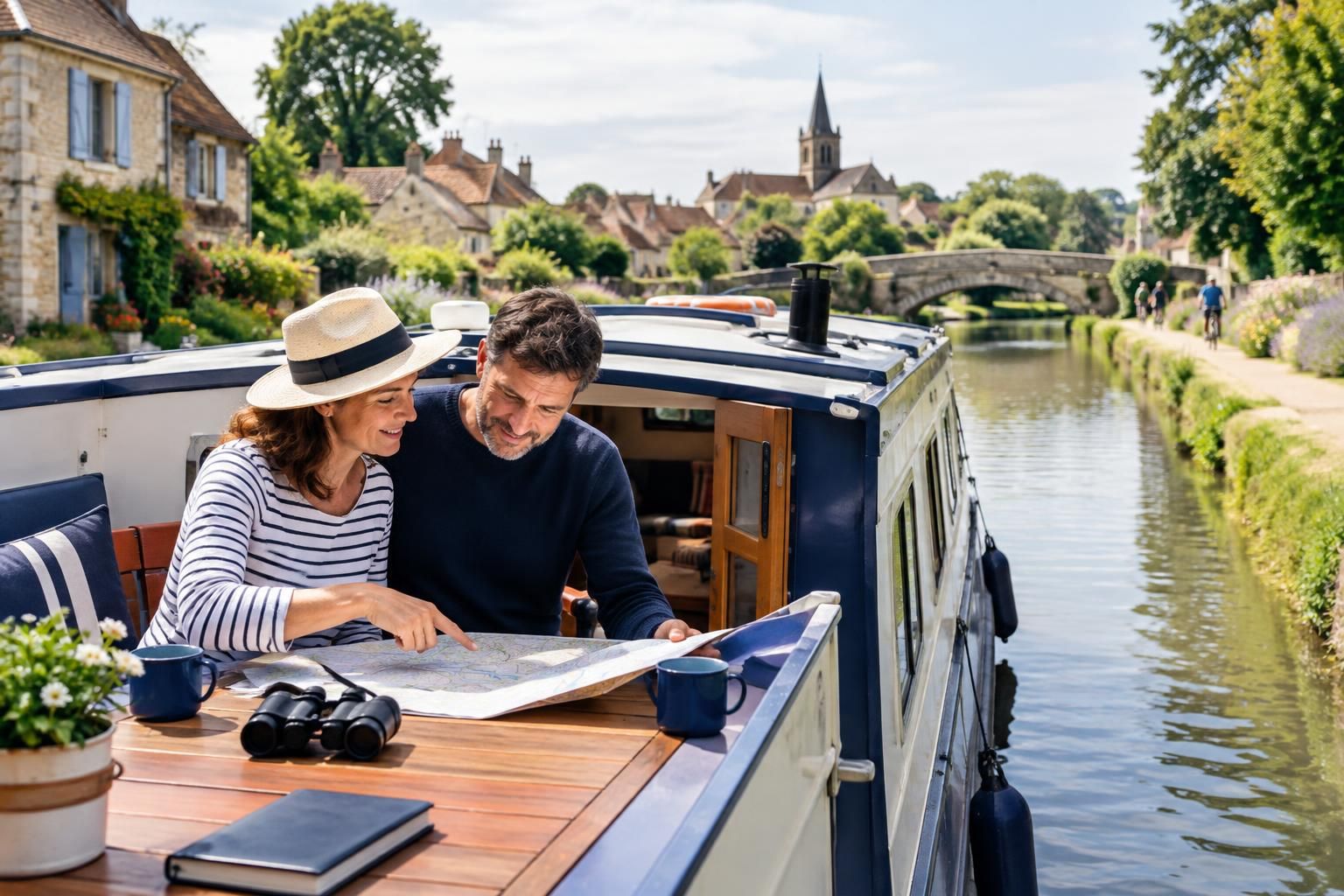
A self-drive canal boat offers a different way to explore France: your accommodation travels with you, lunch can become the main event, and a small village may be a more satisfying destination than a famous city. The appeal is not covering ground quickly but spending time between places. For a first trip, the most important decisions are practical ones: how much handling the group wants to do, how comfortable everyone will be in a compact space, and whether the route leaves room for unplanned stops. Start with those questions rather than a long list of towns.
Choose a waterway for its character and workload
French waterways vary considerably. Burgundy is a useful starting point for travelers drawn to rural landscapes, villages and food-focused stops, although its individual canals differ in gradient and lock frequency. The Canal du Midi offers a southern setting with historic engineering and towns such as Castelnaudary and Carcassonne along its wider corridor. Neither region should be treated as one uniform cruising experience.
Compare specific stretches rather than choosing solely by regional reputation. Ask the operator about the number and type of locks, tunnels, busier sections, distance between stopping places and likely handling demands. A scenic route with frequent locks may be more active than a longer-looking stretch with fewer interruptions. Confirm that the proposed itinerary suits beginners and the people actually traveling.
Decide between an out-and-back trip and a one-way journey
An out-and-back itinerary simplifies the land arrangements because you return to the same departure point. Retracing a canal is not necessarily repetitive: villages look different from the opposite direction, and you can save selected stops for the return. It also gives you a clear turning-point decision if the group prefers a slower pace.
A one-way journey offers more variety but adds a transport puzzle. Compare the complete trip, including arrival at the first base and departure from the second, rather than boat hire alone. For either format, avoid a distant fixed reservation that forces several long cruising days. Build the route around a manageable core, with optional extensions rather than compulsory mileage.
Choose the boat by everyday comfort, not just berth count
A boat advertised for six people may use the dining area as a sleeping space. That can work for a flexible group, but it changes mornings, evenings and privacy. Look at the floor plan and identify permanent beds, bathroom arrangements, storage and seating for everyone when the weather keeps you inside.
Consider how the boat will feel during ordinary tasks. Can someone prepare breakfast while others move around? Is there a shaded outdoor place to sit? How are heating, ventilation, hot water and device charging provided? Tell the operator about mobility limitations and ask about steps, access points and handling responsibilities. Do not assume a larger boat automatically makes life easier.
Build days around time on the water, not map distance
Canal distances are deceptive because locks, maneuvering and stopping all take time. For an initial plan, imagine a few hours of cruising with a generous break, then check that rhythm against the operator’s route guidance. A short stretch with several locks may fill the same part of the day as a much longer uninterrupted reach.
Give the first full day a modest objective so everyone can learn the boat without also chasing a destination. Share tasks according to the handover instructions and each person’s abilities. Later in the week, alternate more active cruising days with shorter moves or a stationary day. Keep the final approach comfortably within reach of the return base rather than leaving the longest stage until last.
Make shore stops part of the itinerary
The best canal holidays are not spent entirely aboard. Choose a few places where you would enjoy lingering: a market town, a village with a pleasant square, or a larger stop with museums and shops. In the Canal du Midi corridor, for example, a visit to Carcassonne needs its own shore-time allowance rather than being squeezed between cruising stages.
Check how far each intended attraction lies from a suitable stopping place. A name beside the canal on a map does not guarantee a convenient walk to the center. Bicycles can extend your range, but they also require storage and handling. Leave some stops undecided so you can stay longer somewhere appealing without undoing the whole itinerary.
Plan provisions and costs beyond the hire price
Bring enough food for the opening stretch without filling every cupboard. Compact staples, simple breakfasts and ingredients for a few easy dinners are more useful than an elaborate meal plan. Shopping ashore can become part of the pleasure, but confirm opportunities along the route rather than assuming every village has convenient supplies.
When comparing quotes, ask what is included and what is charged separately. Relevant items may include fuel, deposits, bedding, towels, cleaning, parking, bicycles and one-way arrangements. Clarify how water refilling, waste facilities, electricity connections and overnight stopping costs work on the proposed route. A clear understanding of these details makes the choice easier than comparing headline prices.
Pack for compact living and changing weather
Soft bags are easier to stow than rigid suitcases. Favor layers, a waterproof outer layer, sun protection and footwear suited to moving around the boat and walking ashore. Bring only the kitchen extras you genuinely need after checking the inventory; storage and worktop space are limited.
Keep travel documents, charging essentials and a change of clothes accessible for the handover day. Download useful journey information before leaving, while retaining the operator’s navigation materials and instructions as your onboard reference. Allow breathing room around collection and return, especially when connecting with a train or flight.
A rewarding first canal holiday needs fewer fixed targets than a conventional touring trip. Choose a manageable waterway, a boat that suits daily life and a route with space to pause. The result is a journey where cruising, shopping for dinner and exploring a quiet town all belong equally to the holiday.
AI-assisted evergreen travel guide. Featured image is an AI-generated illustration, not a specific product or booking.