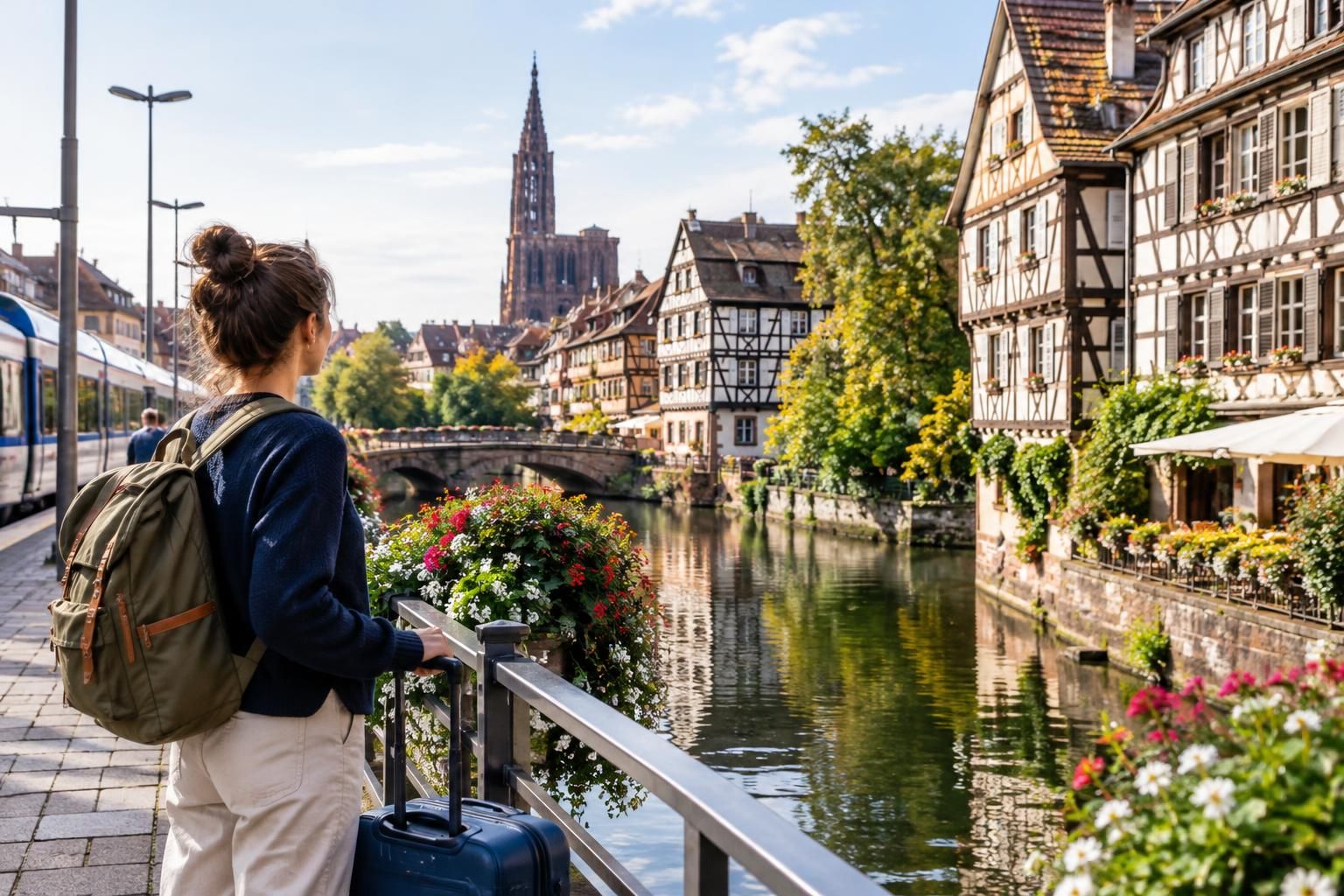
Alsace rewards travelers who enjoy exploring at street level: canal-side walks, timber-framed houses, neighborhood bakeries and long lunches. In this part of eastern France, Strasbourg and Colmar make a useful pairing for a trip without a rental car. The key is to distinguish the easy urban portion from countryside excursions that need more planning. Rather than trying to collect every picturesque village, build your trip around two walkable bases, one carefully chosen outing and enough unplanned time to enjoy the region beyond its postcard views.
Choose your bases around the trip you actually want
For five to seven nights, dividing your stay between Strasbourg and Colmar gives each place room to become more than a day trip. Strasbourg suits travelers who want a larger city, substantial cultural sights and varied neighborhoods. Colmar offers a smaller-scale setting for wandering, photography and a slower finish. Allow at least two full days in Strasbourg and one full day in Colmar before adding countryside plans.
A single base is better if unpacking once matters more than evening variety. Strasbourg makes sense when city experiences lead your priorities; Colmar is worth considering when your focus is southern Alsace. Compare the complete journey from your accommodation to each planned outing, not simply the rail journey between stations. Repeated walks, waits and connections can make an apparently compact itinerary tiring.
Treat arrival day and moving day as part of the holiday
Plan your arrival around the station you will actually use, then map the last stretch to your accommodation. A central address can still involve cobbles, stairs or a longer walk than expected with luggage. If arriving after a long journey, keep the first afternoon simple: check in when permitted, find a meal and take a short orientation walk rather than committing to a timed attraction.
When changing bases, use the transfer as a deliberately light day. Have breakfast, travel, leave your bags if the property permits it and explore nearby. Avoid inserting a village stop with all your luggage unless you have confirmed suitable storage and transport. Before purchasing rail tickets, check the applicable ticket conditions, connections and departure details for your chosen date.
Balance major sights with ordinary streets
In Strasbourg, organize one day around the historic center and cathedral area, then give another day a different character. That might mean a museum, a canal-side walk or time in the Neustadt district, whose broad streets contrast with the older center. Group activities geographically so that you are not crossing the city repeatedly to satisfy a checklist.
In Colmar, the waterways and timber-framed streets invite slow exploration, but leave space for something beyond photographs. Choose a museum that fits your interests, browse food shops or settle into a café away from the busiest lanes. For either city, one substantial indoor visit and one loosely planned walking area make a manageable daily structure. Check opening information before anchoring a day around a particular attraction.
Choose countryside outings by access, not fame
Alsatian villages such as Eguisheim, Riquewihr and Kaysersberg are appealing possibilities, but proximity on a map does not guarantee a straightforward car-free visit. For each candidate, investigate the full outward and return journey for your travel date, including the distance between the arrival point and the village center. Pay particular attention to weekends and the final return option.
Choose one village you can enjoy properly instead of attempting several with awkward connections. If independent transport does not suit your plans, compare an organized excursion or a prearranged transfer, looking at pickup points, walking demands and time at each stop. Cycling is another option only when the route, distance, weather and your riding confidence align. Do not assume every vineyard road provides a comfortable cycling route.
Book accommodation for access and comfort
Look for accommodation that balances station access with the streets where you expect to spend your evenings. Staying directly in a historic quarter can be atmospheric, while somewhere between the station and center may simplify arrival and departure. Read the property description for lift access, stairs, room location and luggage arrangements rather than relying on the address alone.
Older buildings can have layouts that matter more than decorative charm: narrow staircases, sloping ceilings or rooms facing lively streets. Travelers with mobility needs should ask specific questions about entrances, bathrooms and the route from public transport. An apartment can suit longer stays and simple meals, while a hotel may offer convenient luggage handling. Compare the total cost, including any mandatory charges, before deciding.
Leave room for weather, meals and seasonal differences
Pack for walking rather than dressing for a single forecast. Comfortable shoes with grip, layers and a compact waterproof are useful foundations; a small bag makes sightseeing easier than carrying everything for the day in coat pockets. Keep luggage manageable enough that you can handle it yourself through stations and along uneven streets.
Give each day a weather alternative: a museum instead of an extended walk, or an unhurried meal instead of a countryside excursion. Regional dishes can be hearty, so alternate substantial restaurant meals with lighter choices that suit your appetite. Travelers with dietary requirements should check menus and discuss ingredients rather than assuming traditional dishes can be adapted. If seasonal markets or vineyard activities are central to your trip, verify their dates separately and expect them to change the atmosphere and accommodation demand.
A satisfying car-free Alsace trip depends less on covering distance than on choosing well-connected bases and resisting unnecessary moves. Give Strasbourg and Colmar their own time, select countryside outings only after checking access, and keep a little flexibility in every day. The result is a trip with room for both the region’s distinctive streetscapes and the small pleasures between planned sights.
AI-assisted evergreen travel guide. Featured image is an AI-generated illustration, not a specific product or booking.