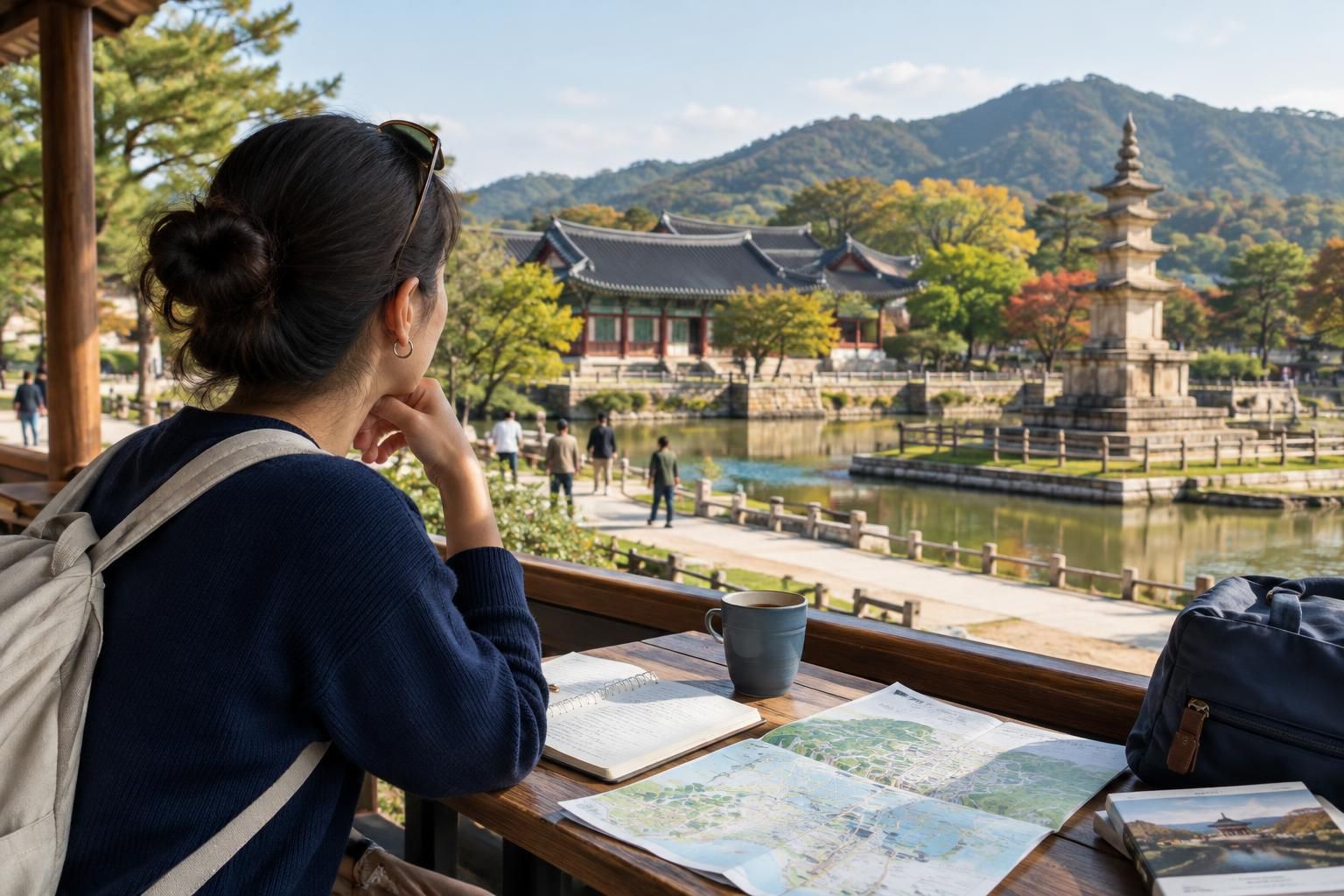
Gyeongju offers a different rhythm from South Korea’s larger cities: grassy royal burial mounds, traces of an ancient capital and low-rise neighborhoods where a sightseeing walk can become a long café break. Once the capital of the Silla kingdom, it rewards travelers who want historical context without spending every day indoors. The planning challenge is geography. Some major sights sit close together in the historic center, while others require a separate journey into the surrounding countryside. Three nights gives you two full days to explore both settings without treating every temple, pond and museum as another deadline.
Choose a central base before adding attractions
For a first visit without a car, start your accommodation search around the historic center and Hwangnidan-gil, the neighborhood known for cafés, restaurants and traditional-style buildings. Being able to walk back after dinner is particularly useful here. Look beyond the most photographed streets: a room on a quieter lane may offer better rest while keeping the burial-mound parks within an easy outing.
Bomun Lake offers a different experience, with larger accommodation properties and a more resort-oriented setting. It can suit travelers who prioritize hotel facilities and lakeside downtime, but it adds transport to central sightseeing and meals. If choosing a hanok-style stay, check whether the room has a bed or floor bedding, a private bathroom, and convenient access with luggage. Traditional appearance alone does not tell you how the room functions.
Build the visit around two geographic clusters
Think of Gyeongju as a central walking area plus separate outlying excursions. Daereungwon’s royal tomb landscape, Cheomseongdae observatory, the Gyochon area and Woljeonggyo Bridge can form the backbone of a central day. You do not need to visit them in a rigid sequence. Choose a route that avoids retracing your steps, then leave room for lunch and an unplanned stop.
Bulguksa Temple and Seokguram Grotto belong to a different planning cluster on the slopes of Mount Toham. They are not casual extensions of a downtown walk, and the journey between them needs its own consideration. Treat this as a substantial half-day or longer rather than a quick detour. If your main interest is the temple complex, visiting Bulguksa alone can be more satisfying than adding the grotto simply to complete a list.
Use three nights to separate arrival, walking and an excursion
On arrival day, settle in and take a short orientation walk near your accommodation. If arriving by intercity rail, remember that the railway station serving Gyeongju is outside the historic center; include the onward transfer when comparing travel options. Keep the first evening simple with dinner and a nearby stroll rather than a timed sightseeing commitment.
Use the first full day for the central sights, allowing time to appreciate the burial-mound landscape rather than moving straight from entrance to entrance. Give the second full day to Bulguksa, with Seokguram as an optional addition. Gyeongju National Museum makes a strong alternative when weather or energy discourages a longer excursion. Departure morning is best reserved for breakfast, packing and perhaps one nearby stop that does not jeopardize your connection.
Combine walking with selective buses and taxis
Walking works well within the historic core, but distances accumulate across broad parks and between neighborhoods. Measure the entire day’s route, not just the gap between two attractions. A pleasant outward walk can become a tiring return after several hours on your feet. Renting a bicycle is another option for suitable routes, although it introduces parking, navigation and weather considerations.
For outlying sights, compare public transport with a taxi based on your group size and tolerance for waiting. Check routes, stops and return options close to travel, and save destinations in Korean as well as English. A useful compromise is public transport in one direction and a taxi for a less convenient segment, provided you have checked how to arrange the return. Do not assume taxis will be waiting at every attraction.
Give the history context and leave space for ordinary meals
A little context makes Gyeongju more rewarding. Read a short overview of Silla before visiting, or place the national museum early in your stay if artifacts help you understand archaeological landscapes. Not every mound or foundation will explain itself visually. Choose a few places to explore carefully, paying attention to their interpretation, instead of expecting constant architectural spectacle.
Balance sightseeing with meals outside the busiest café stretches. Ssambap, a meal built around wrapping rice and accompaniments in leaves, is one option to look for; Gyeongju’s small filled pastries can serve as a snack rather than a meal replacement. Check menus and explain dietary needs clearly instead of assuming a vegetable-heavy spread contains no meat or seafood. Leave at least one meal undecided so that hunger and location, rather than a reservation, can shape the day.
Plan for exposed walks and a flexible second day
Much of Gyeongju’s appeal is outdoors, and open archaeological areas can offer limited shade or shelter. Carry water, sun protection and a compact rain layer, with shoes comfortable for gravel and uneven surfaces. Seasonal scenery can be a bonus, but avoid building the whole trip around blossom or foliage timing. A museum visit, leisurely lunch or shorter neighborhood loop can make a useful weather adjustment.
Travelers with limited mobility should assess each attraction separately. A generally level central route does not mean every tomb interior, traditional building or hillside site will be equally accessible. Check entrance arrangements and walking surfaces before committing. Keep luggage out of sightseeing plans where possible, and confirm storage with your accommodation rather than assuming it is available.
The most manageable Gyeongju trip pairs a central base with one walking-focused day and one selective excursion. Let the museum provide context, use transport where it saves effort, and keep evenings close to your accommodation. Three nights need not cover every historic site to leave a rich impression of the former Silla capital.
AI-assisted evergreen travel guide. Featured image is an AI-generated illustration, not a specific product or booking.