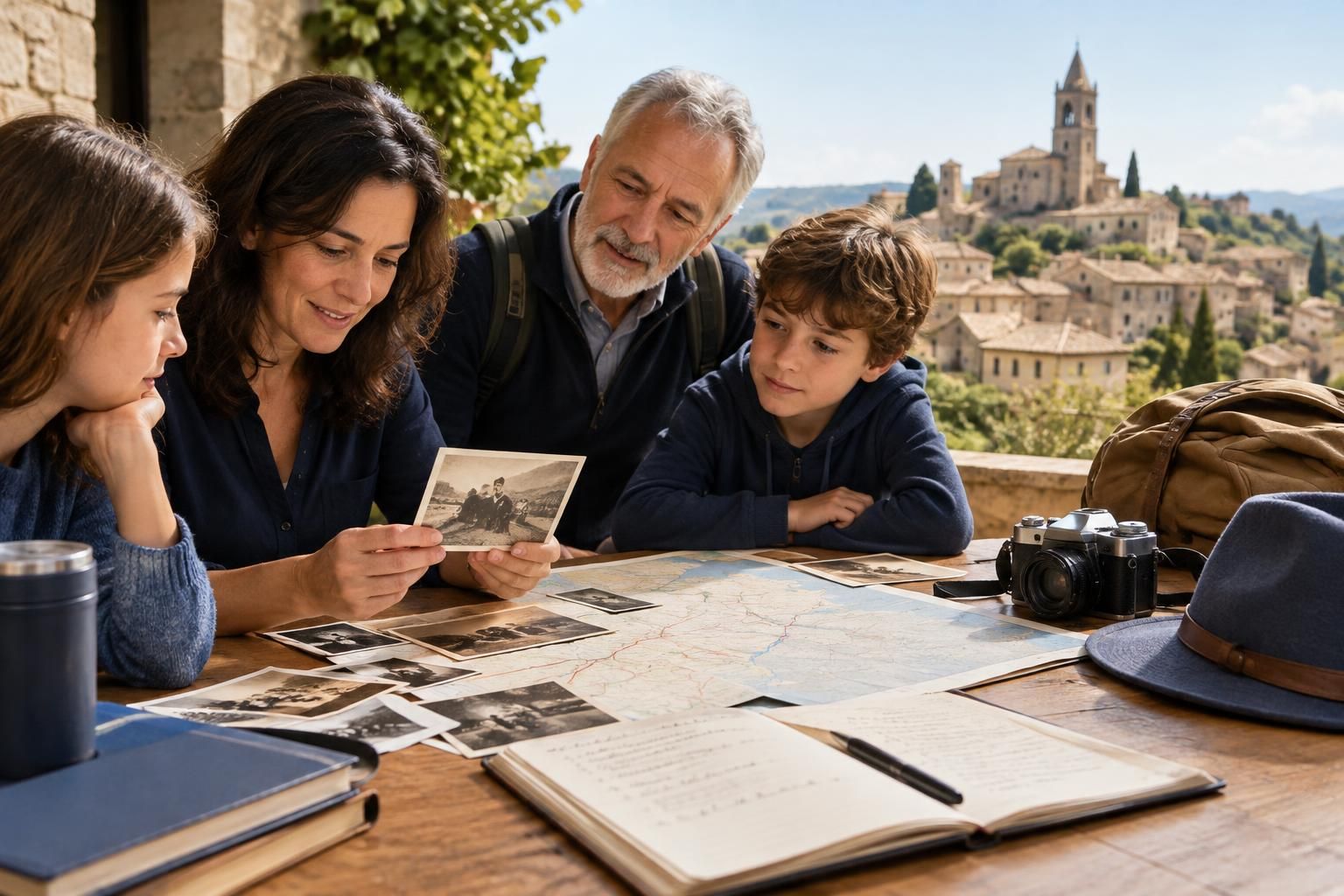
A family heritage trip can begin with something small: a village name on a document, a photograph of an unfamiliar street or a story repeated at family gatherings. Following that connection can give a journey unusual depth, but it can also create an endless list of questions to answer before departure. The most satisfying plan does not depend on finding every record or locating every ancestral home. Instead, it combines a few achievable discoveries with time to experience the place itself. Here is how to build a trip that serves both your curiosity and your holiday.
Choose one question to shape the journey
Start by deciding what you most want to understand. Perhaps you want to see the landscape where a grandparent grew up, trace one branch of the family through two towns or explore the trade that brought relatives to a particular city. A focused question helps distinguish meaningful stops from places that are connected only by a distant surname.
Write a simple definition of success that does not require a breakthrough. For example: visit the village, walk through the old town and spend an afternoon learning about local working life. Treat finding a specific record or meeting a relative as a possible bonus. This keeps the trip worthwhile even if an address has disappeared or a family story proves difficult to confirm.
Turn your clues into a small, usable travel file
Gather relevant names, approximate dates, place names and copies of useful photographs or documents. Separate established details from family recollections and unanswered questions. A note saying “possibly born near this town” is more useful than allowing an uncertain location to become the foundation of an expensive detour.
Keep the travel version compact. A short timeline, a map of likely locations and a few clearly labeled images are easier to use than an entire family archive. Record alternate spellings where you already know them, and retain the original wording of old addresses. Carry copies rather than irreplaceable originals, and keep sensitive information about living relatives out of anything you might casually share.
Build the route around meaningful clusters
Plot your strongest connections before choosing accommodation. Several locations may form a useful cluster around one town, while a single outlying village could require a separate overnight stay. Compare the effort of reaching each place with what you hope to do there. Seeing a landscape may justify a short visit; working through unfamiliar records may need a much larger time allowance.
Choose a base that supports ordinary travel needs as well as heritage stops. Somewhere with convenient meals and manageable onward transport can be more practical than staying beside one ancestral address. If a rural location is central to the trip, investigate how you would reach it and return, including the final stretch from a station or bus stop. Avoid building a day around an unconfirmed connection.
Give research visits a clear purpose and a time limit
If you hope to use an archive, library, local history collection or religious institution, establish what you need to ask before committing a large part of the itinerary. Check directly about access arrangements, appointments, relevant holdings and any requirements for using materials. Do not assume a building welcomes casual research visits simply because it appears on a map.
Prepare a concise request using the names, dates and locations you already have. Then give the visit a defined place in your schedule: perhaps one morning, followed by an afternoon with no research obligations. Leave space afterward to organize notes while the details are fresh. A photograph of a document is less useful later if you cannot remember what it was or why it mattered.
Connect family history with the destination today
Balance personal stops with experiences that help you understand the wider setting. A regional museum, a walk through former industrial streets, a market visit or an afternoon in the surrounding countryside can add context without requiring another genealogical discovery. Choose experiences that interest you in their own right, rather than treating the destination only as evidence of the past.
If you are traveling with others, explain which heritage stops matter most and agree on a reasonable amount of shared time. One person might spend a morning researching while another explores independently, with everyone meeting for lunch. Children or less invested companions may connect more readily with an old family recipe, a landscape or a neighborhood walk than with a long sequence of names and dates.
Leave room for uncertainty, privacy and emotion
Family places do not always resemble the stories attached to them. Houses may have changed, communities may feel unfamiliar and records may raise questions rather than settle them. Avoid scheduling your most emotionally significant visit between two tight commitments. A quiet walk or unplanned evening afterward gives you room to absorb the experience without needing to produce an immediate conclusion.
Treat present-day residents and possible relatives as people with their own boundaries. An ancestral connection is not permission to enter private property, photograph personal spaces or expect a meeting. Make any approach courteously and accept a refusal. Before sharing discoveries publicly, consider whose personal information or family story would become visible, especially when living people are involved.
Plan a family heritage trip around a handful of meaningful places, not a promise to solve the entire past. Keep your evidence organized, your research ambitions bounded and your route comfortable enough to enjoy. You may return with a new document or a clearer family timeline, but the journey can be equally valuable for the landscape, context and perspective it gives to stories you already know.
AI-assisted evergreen travel guide. Featured image is an AI-generated illustration, not a specific product or booking.