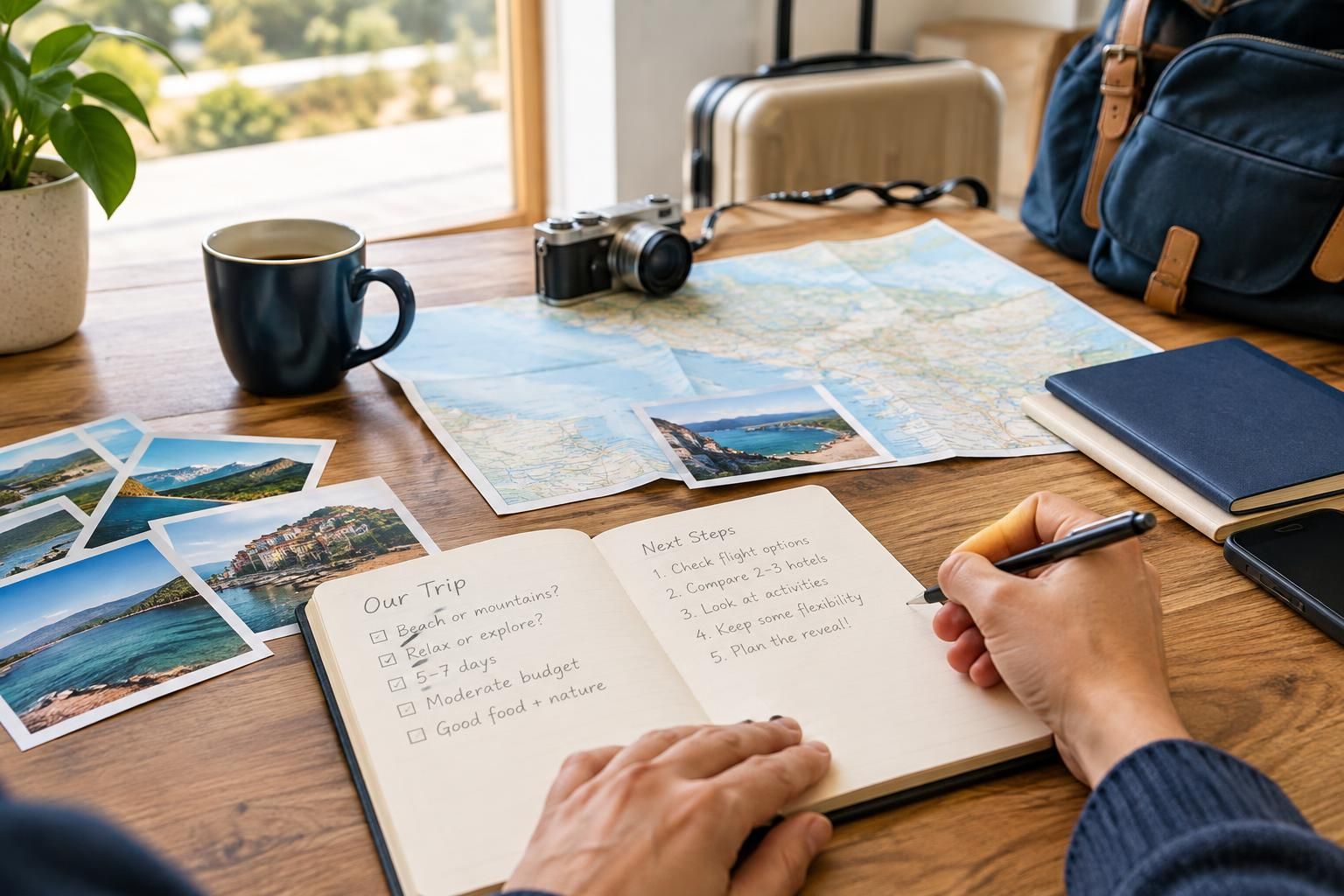
A surprise trip works best when the destination is unexpected but the experience still fits the traveler. Someone might love discovering a coastal town yet dislike learning, at the last minute, that they need to pack for hiking or take extra time off work. The planning challenge is to preserve the pleasure of discovery without hiding decisions that affect their comfort, money or responsibilities. Start by deciding what can genuinely remain a surprise, then build the trip around preferences you know rather than reactions you hope to get.
Agree on the boundaries before choosing the destination
You can ask permission for a surprise without revealing the trip itself. Establish a date window, maximum time away and an acceptable journey length. Ask whether the traveler would enjoy a mystery weekend, a hidden destination within an agreed country, or simply an undisclosed activity during a trip they already know about. These are different levels of surprise, and none is inherently better.
Keep work commitments, caring responsibilities and spending expectations outside the secret. If the trip is a gift, clarify what you will cover and whether the recipient would need money for meals or activities. Do not assume that an apparently free trip has no cost to them. Leave room for them to decline or suggest another date without feeling that they have spoiled your effort.
Choose from established preferences, not an imagined reaction
Build a short preference profile using things the person has actually enjoyed: compact cities, long lunches, swimming, independent bookshops, gentle walks or staying somewhere with a good view. Separate dependable preferences from passing comments. Saying that a mountain landscape looks beautiful does not necessarily mean someone wants a strenuous walking holiday.
Then shortlist two or three destinations that fit the same brief. For example, a traveler who enjoys browsing markets and lingering in cafés might appreciate a walkable town with several indoor alternatives. Compare the ordinary hours of each option, not just its standout attraction. Ask what you would do after breakfast, between activities and on a rainy afternoon. A destination that suits those unremarkable moments is a stronger choice than one built around a single dramatic reveal.
Make the logistics less surprising than the destination
Favor a journey with few moving parts, especially for a short break. A modest destination reached directly may feel more generous than an ambitious one involving several transfers. Count the full journey from home to accommodation, including waiting, luggage handling and the final connection. Avoid making a tightly timed arrival the foundation of the gift.
Choose accommodation around known needs: separate beds if preferred, a quiet sleeping environment, manageable access and a location that supports the intended pace. If any requirement is uncertain, ask directly rather than guessing. For an international trip, the traveler should personally check their documents and applicable entry requirements before nonrefundable commitments. Destination secrecy is not worth putting essential preparation out of their control.
Protect flexibility where uncertainty remains
Before paying, read the cancellation and change conditions for each booking. Distinguish between getting money back, receiving credit and being allowed to change dates at an additional cost. Keep a simple note of the relevant deadlines. Where a key preference is still unknown, consider leaving that part unbooked rather than paying to preserve the surprise.
Keep the itinerary light enough for the recipient to shape it. One planned highlight can give the trip a sense of occasion; a fully prepaid schedule can make it feel like an obligation. A useful pattern is a booked place to stay, a straightforward journey and one optional focal experience. Leave meals and smaller outings open unless advance arrangements are important to the trip.
Reveal practical information in stages
Give the traveler enough notice to prepare, even if you withhold the destination. A useful early briefing includes the dates, expected conditions, luggage space, walking demands and whether any particular clothing is needed. Say explicitly what they do not need to bring. Keep this information straightforward rather than turning every packing instruction into a clue.
Choose the final reveal point according to the person's temperament. Someone who enjoys planning may appreciate learning the destination a week ahead and choosing a few activities. Another traveler may enjoy discovering it on departure day, provided the necessary preparation is already complete. Do not disguise essential information about demanding activities or unusual accommodation as part of the entertainment.
Hand over ownership once the surprise is revealed
After the reveal, share the actual bookings, addresses and journey details. Both travelers should be able to access essential information independently. Explain which arrangements are fixed and which are merely suggestions. This turns the recipient from a passenger in your plan into a participant in the trip.
Invite one meaningful choice early: the first afternoon's activity, a restaurant style or whether to spend a morning exploring or resting. If their enthusiasm centers on something different from your original highlight, adapt where practical. The point is not to deliver a perfectly controlled sequence of reactions. It is to create time away that they can genuinely enjoy.
The most successful surprise trips hide a delightful detail, not the decisions someone needs to make for themselves. Agree on the boundaries, plan around reliable preferences and reveal enough for comfortable preparation. That leaves room for the destination to be unexpected while the experience feels thoughtfully chosen.
AI-assisted evergreen travel guide. Featured image is an AI-generated illustration, not a specific product or booking.