Jeju rewards travelers who enjoy volcanic landscapes, seaside walks and time between sightseeing stops. But its attractions are spread across a large island, so visiting without a rental car requires a different approach from a compact Korean city break. The solution is not to recreate a driving itinerary using buses. Instead, choose a small number of areas, stay near useful transport connections, and group experiences geographically. With five or six nights, two thoughtfully chosen bases can provide variety without turning every day into a transfer.
Choose an island area before choosing attractions
Begin with the kind of Jeju experience you want. The north offers the convenience of Jeju City, with urban dining and shopping alongside access to the island’s main arrival point. The south, centered on Seogwipo, suits travelers who want a town base with coastal scenery. Eastern Jeju appeals to those drawn to volcanic landscapes and seaside villages, while the west offers beaches and coastal settlements that can support a slower stay.
Pick two priorities rather than trying to cover every region. A trip built around Seogwipo and the east will feel different from one focused on western beaches and Jeju City. Neither needs to include an excursion to the opposite coast. On a car-free trip, leaving something out is often what makes the remaining days enjoyable.
Use one or two bases with useful surroundings
For a first visit, compare a stay entirely in Seogwipo with a split between Seogwipo and Jeju City. One base eliminates repacking, but it can create repeated long journeys if your interests are scattered. Two bases make sense when each supports several nearby experiences, not simply because changing hotels seems like the best way to see more.
Look beyond a property’s sea view. Check the actual walking route to bus stops, restaurants and a convenience shop, including slopes and major road crossings. A waterfront guesthouse can be atmospheric yet awkward for daily departures. If choosing a rural stay, ask how guests without cars usually arrive, find dinner and arrange onward transport. For an early departure, consider spending the final night somewhere that simplifies the journey rather than preserving a remote setting.
Treat buses as the framework, not the whole plan
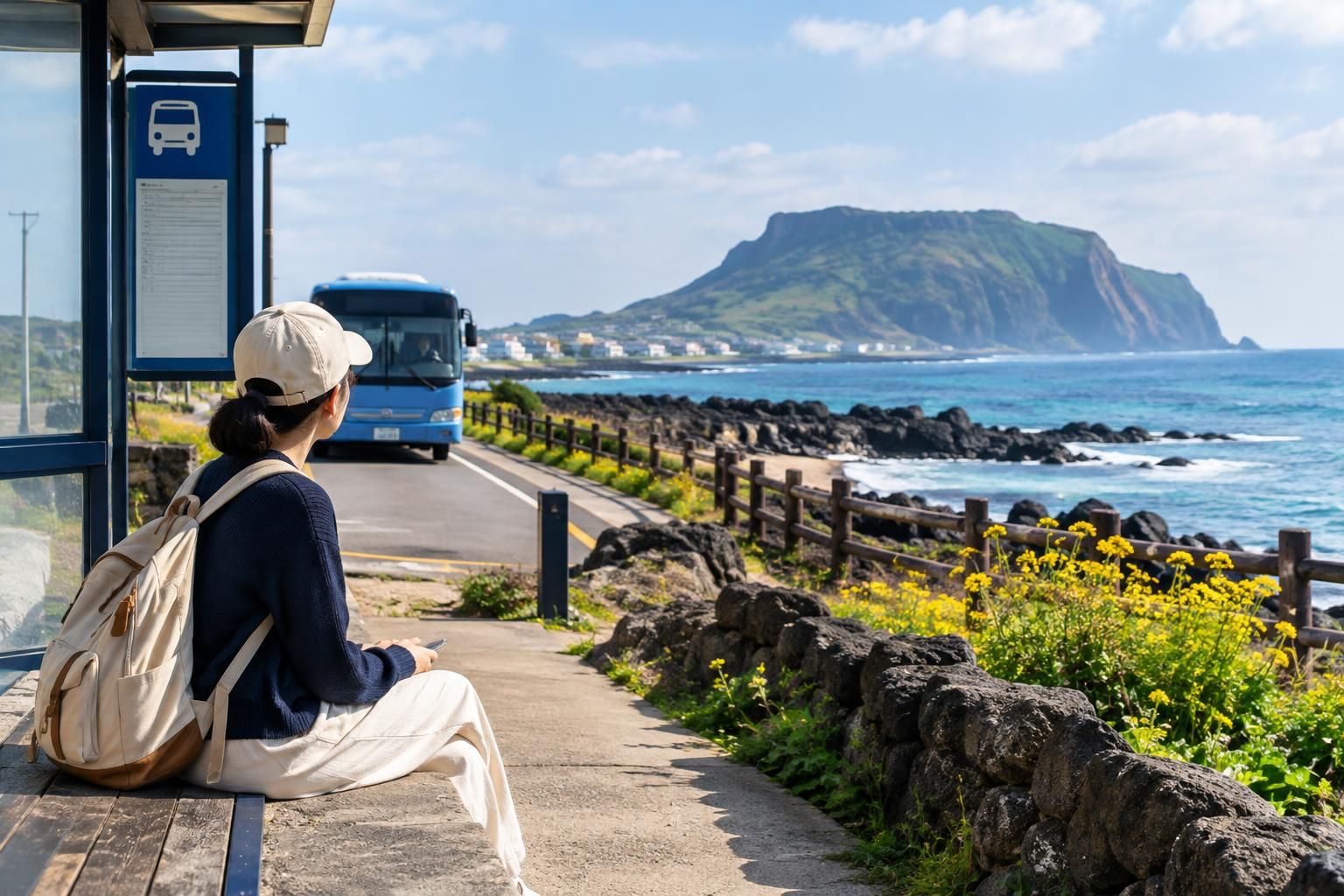
Build each outing around one main destination and, at most, one nearby addition. Before committing, compare the whole journey: walking to the stop, transfers, the walk from the final stop and the return options. Two places that look close on a map may be inconvenient to combine by public transport. Check current routes and departure information when planning each day.
Allow a budget for occasional taxis, particularly for a final connection or a return journey after a long walk. Confirm the destination clearly, ideally with its Korean name and map location, and establish how you will make the return trip before heading somewhere isolated. A taxi is most useful when it removes a specific transport difficulty, rather than becoming an expensive substitute for an island-wide driving tour.
Plan coastal walks with an exit strategy
Jeju’s Olle walking routes offer a way to experience the coast at a slower pace, but completing an entire route is not essential. Choose a manageable section based on terrain, distance and transport at both ends. A short walk linked to lunch in a village can be more satisfying than a long route completed while worrying about the journey back.
Coastal walking does not always mean flat pavement. Expect the possibility of uneven volcanic surfaces, exposed stretches, steps and limited shade. Carry water, a snack, sun protection and a weather-resistant layer. Check local conditions and any access notices before setting out. Where possible, finish near a settlement with several transport options rather than relying on a remote pickup point.
Give weather a meaningful role in the itinerary
Wind, rain and low cloud can change the appeal of an outdoor day. Avoid assigning every scenic outing to a fixed date before arrival. Keep a clear-weather option, such as a longer coastal walk, alongside a lower-effort alternative involving a museum, market or extended meal near your base. Indoor alternatives still need transport planning; they are not automatically convenient just because they are sheltered.
Treat a Hallasan hike as a separate planning decision, not a casual addition between coastal sights. Route choice, physical demands, equipment, access arrangements and weather all deserve attention. If a mountain day is central to your trip, give it adequate preparation and flexibility. If it is not, there is no need to force it into an otherwise relaxed seaside itinerary.
Build a five-night trip around a few satisfying days
One workable structure is three nights in Seogwipo followed by two in Jeju City. Use the first afternoon to settle in and explore locally. Devote one full day to nearby coastal scenery and another to a carefully selected excursion. On the hotel-change day, transfer directly or make only a luggage-friendly stop; dragging bags between scattered sights rarely improves the day.
Use the northern stay for a city-focused day and one outing that fits your interests and the available connections. Keep meals geographically simple: breakfast near your accommodation, lunch near the main outing and dinner within an easy return journey. Travelers who prefer eastern or western Jeju can substitute that region for one base, while keeping the same principle of fewer transfers and locally grouped days.
A successful car-free Jeju trip depends more on geography than on the number of sights you include. Choose accommodation with useful surroundings, plan complete return journeys and reserve some flexibility for weather. With a few well-matched outings and room for unplanned coastal stops, traveling without a rental car can support a slower, more focused island stay.
AI-assisted evergreen travel guide. Featured image is an AI-generated illustration, not a specific product or booking.