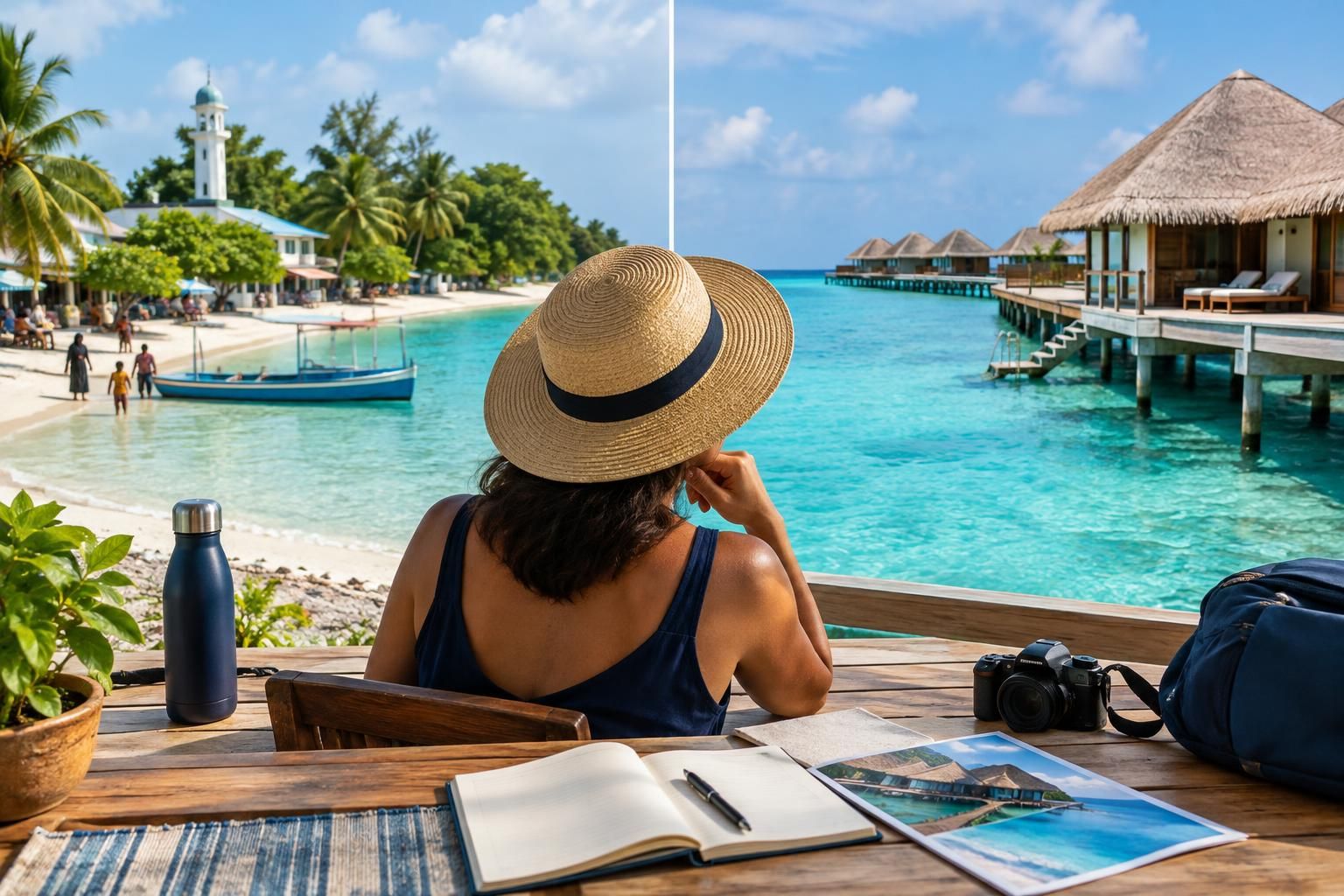
The Maldives can offer very different holidays within the same island landscape. A guesthouse on an inhabited island puts you close to everyday community life, while a resort generally organizes accommodation, dining and recreation around a self-contained island setting. Neither is automatically the better choice. The useful question is how you want your days to work: where you will swim, how you will eat, how much independence you want and what happens between landing and reaching your room. Start with those practical details, and the choice becomes clearer than a comparison of beach photographs.
Choose the daily atmosphere before the accommodation
A local-island stay suits travelers who enjoy walking through a lived-in place, choosing between small restaurants and seeing fishing boats, shops and residential streets alongside the beach. Tourism shares space with ordinary routines. Expect the experience to depend on the particular island rather than assuming every guesthouse destination has the same atmosphere.
A resort is a stronger match when you want most decisions contained within one property: meals, beach time, excursions and quiet evenings. That convenience can be especially appealing for a short break. Before choosing, consider whether you prefer a compact island where everything is close or a larger property where room location and internal distances matter.
Treat the island transfer as part of the itinerary
The international flight is only one stage of arrival. Depending on the island, onward travel may involve a boat, a domestic flight, a seaplane or a combination. Compare the complete journey rather than choosing a room first and investigating access afterward. A more distant island can be worthwhile, but it may be a poor fit for a brief stay.
Ask how transfers connect with your expected arrival and departure times, who organizes them, where you wait and what happens if a connection is disrupted. Establish any baggage conditions directly with the operator. Leave your arrival day free of essential activities, and assess whether your flight timing could make an overnight near the airport more practical than an immediate island transfer.
Understand what beach access means for your stay
On inhabited islands, visitor beach areas and expectations around swimwear can differ from those at resorts. Ask the accommodation to explain the current arrangements, including the walk from your room to the beach and the expectations elsewhere on the island. Pack clothing suited to community spaces rather than assuming beachwear works everywhere.
At either type of stay, look beyond the phrase beachfront. Ask whether the shore near your room suits swimming, whether access involves steps or uneven ground, and whether boats use the same stretch of water. Travelers hoping to snorkel from shore should ask specifically about entry points and local guidance. Attractive water views do not necessarily mean easy access for every swimmer.
Compare the whole-stay budget, not the nightly rate
Build a simple comparison that includes accommodation, transfers, meals, drinks, excursions and any compulsory charges shown in the booking terms. A lower room rate can lose its advantage if reaching the island is expensive or every planned activity requires a separate outing. Equally, a meal package offers limited value if its inclusions do not match how you actually eat.
For a resort, compare meal plans using realistic habits: whether you want lunch daily, which venues are included and what is charged separately. For a local island, check whether meals are available at your guesthouse and how much dining choice exists nearby. Allow for flexibility rather than budgeting every evening around one particular restaurant.
Plan water activities around interests, not a checklist
Choose one or two priorities before comparing islands. Someone wanting relaxed swimming and occasional snorkeling needs a different setup from a traveler planning several days of diving. Ask whether activities start from the island, require boat trips or depend on minimum group sizes. For diving, discuss experience requirements and suitable options with the operator before committing.
Keep excursions flexible because wind, sea conditions and visibility can affect plans in any season. Wildlife sightings should be treated as possibilities, not promised encounters. Favor operators that explain their approach to wildlife and reef care, and avoid touching coral, pursuing animals or selecting experiences primarily for close-contact photographs.
Decide whether two islands justify the extra move
Combining a local island with a resort can reveal two sides of the Maldives, but moving between islands is not necessarily a direct journey. Transfers may route through a transport hub, adding waiting time and cost. Map the actual connection before dividing your nights, and avoid using distance on a map as a substitute for transfer information.
For a short holiday, one well-chosen base often provides more useful beach time than a split stay. With a longer trip, two bases can make sense if they serve distinct purposes, such as several excursion-focused days followed by a quieter retreat. Pack a small, accessible bag for transfer days, keep important belongings with you and leave room in the plan for unstructured time.
The best Maldives stay is the one whose everyday arrangements match your idea of a holiday. Choose a local island for community context and a less self-contained experience; consider a resort for a stay organized largely in one place. Then test that choice against transfers, beach access, food and the activities you genuinely want. Those details do more to shape a satisfying trip than the room photograph alone.
AI-assisted evergreen travel guide. Featured image is an AI-generated illustration, not a specific product or booking.