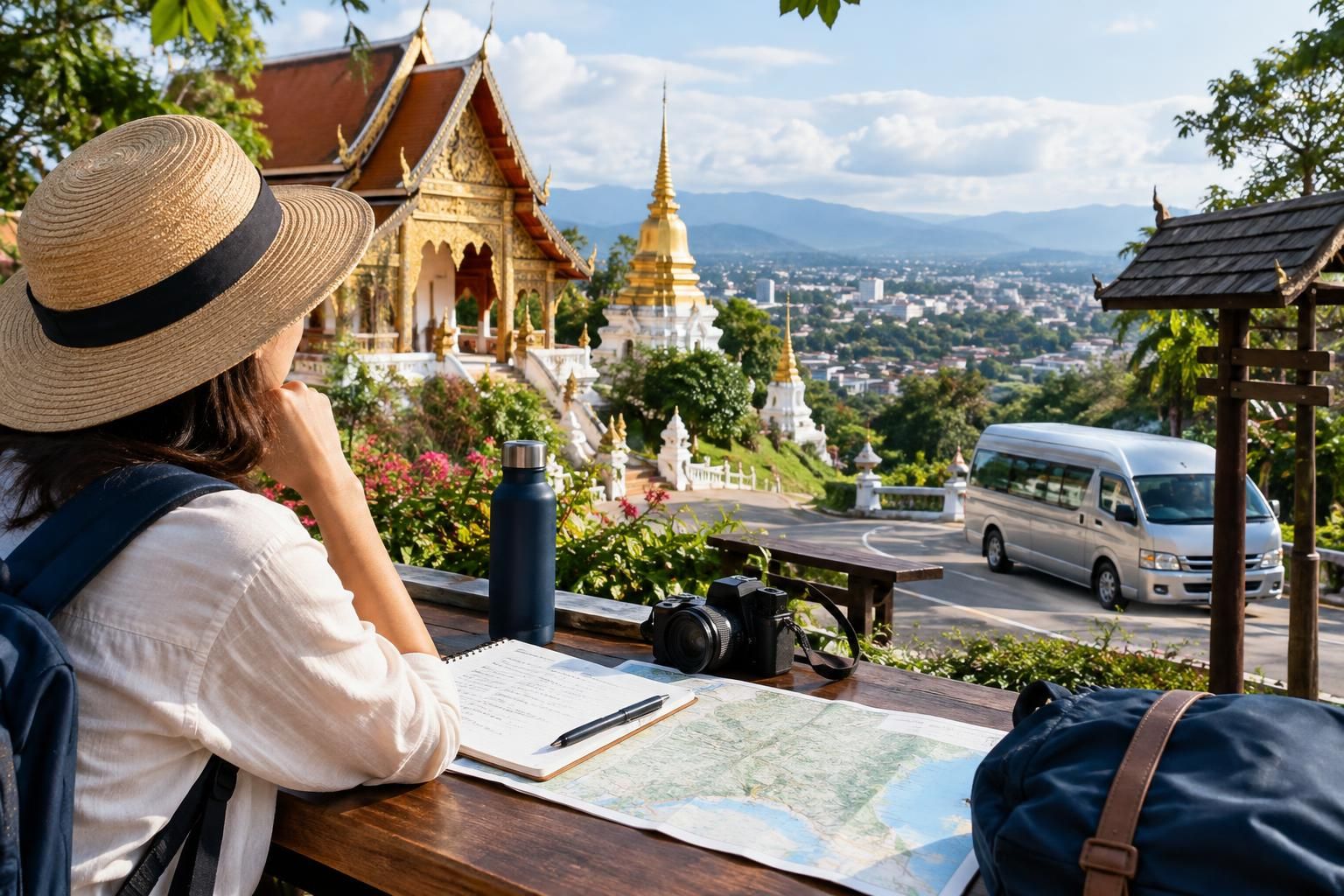
Northern Thailand offers more than a checklist of temples: there are neighborhood markets, mountain landscapes, craft traditions and plenty of reasons to spend an afternoon doing very little. You do not need to ride a scooter to build a rewarding trip, but your accommodation location and transport choices matter. A two-base journey through Chiang Mai and Chiang Rai works best when you separate easy urban exploring from excursions that need a vehicle. Rather than trying to reach every viewpoint, plan around a few meaningful outings and leave room for the places between them.
1. Decide whether you need one base or two
Chiang Mai suits travelers who want variety without changing accommodation frequently. Its old-city streets, temples, food options and organized excursions can support a full stay. Chiang Rai adds a smaller-city atmosphere and a different collection of architectural and countryside attractions, but reaching it requires a substantial overland transfer rather than a quick hop.
For a shorter visit, staying entirely in Chiang Mai can be more satisfying than squeezing in both cities. With roughly a week, consider four nights in Chiang Mai and three in Chiang Rai, adjusting for your arrival and departure arrangements. Treat the move between them as a travel day with a simple evening afterward, not as an opportunity to stack several major sights.
2. Choose accommodation for the journey outside your door
In Chiang Mai, the old city is a useful starting point for temple-focused wandering, while areas around Tha Phae Gate can suit travelers who want access to both old-city streets and eastern neighborhoods. Nimman may appeal more if cafes and contemporary shops are priorities. These are different experiences, so choose according to how you want to spend ordinary mornings, not just the appearance of the room.
In Chiang Rai, a central location near the main market and bus-station area can simplify meals and departure logistics. Before booking in either city, inspect the immediate surroundings on a map: a property described as central may still involve busy road crossings or an awkward final stretch on foot. Ask about vehicle pickup access, luggage storage and potential noise if those details affect your plans.
3. Match each journey to the right transport
Think in three transport layers. Walk within compact neighborhoods, use a locally available taxi or ride-booking option for urban gaps, and arrange a separate vehicle or excursion for distant sights. Shared local vehicles can also be useful, but clarify the destination, whether the trip is shared, and the fare basis before setting off.
For the Chiang Mai–Chiang Rai transfer, compare an intercity coach with a private transfer according to budget, luggage and tolerance for winding roads. Check the actual departure and arrival points rather than assuming every service uses the same terminal. If considering stops along the way, account for luggage security, waiting time and the possibility that extra sightseeing will make an already substantial journey feel much longer.
4. Group sights by geography, not popularity
A manageable Chiang Mai day might combine a small cluster of old-city temples with lunch and an unstructured afternoon. Keep a mountain outing, such as a visit toward Doi Suthep, separate from a long cross-city list. In Chiang Rai, do not assume the White Temple, Blue Temple and Black House form a compact walking circuit; plan transport between dispersed attractions.
For each excursion, choose one main reason to go and perhaps one nearby addition. A shared tour can reduce organizational effort, while a private driver offers more control over pace. In either case, establish which stops are included, how much time you have at each, and whether the itinerary contains shopping visits. Fewer stops often leave more time to appreciate what you came to see.
5. Give food and hands-on experiences their own time
Northern Thai dishes such as khao soi and regional chili dips provide an easy starting point for food exploration. Instead of crossing the city for every meal, pick a neighborhood with several options and compare menus as you wander. Market visits are easier to enjoy when they are not squeezed between vehicle pickups; confirm market days before making one the centerpiece of an evening.
A cooking class, craft workshop or guided neighborhood walk can add depth without another long drive. Compare the amount of participation with demonstration time, the group size and transport arrangements. If considering an animal-related experience, look beyond reassuring labels and ask specifically about riding, performances, handling and visitor contact before deciding whether it fits your values.
6. Build flexibility around weather and comfort
Northern Thailand is not equally comfortable in every season. Heat, rain, cooler upland conditions and periods of poor air quality can change the appeal of outdoor plans. Check conditions for your dates before committing to countryside excursions, and keep an indoor or low-effort alternative available. Flexible bookings are particularly useful when the landscape itself is the main attraction.
Pack comfortable walking shoes, a light rain layer, sun protection and clothing suitable for temple visits. A light extra layer can be useful for air-conditioned vehicles or cooler elevations. Carry a small day bag and keep larger luggage manageable for station transfers. Finally, leave some evenings unplanned: a nearby dinner and an early night may improve the next day more than another outing.
A scooter-free northern Thailand trip works best with central accommodation, deliberate transport choices and realistic sightseeing clusters. Use Chiang Mai for variety, add Chiang Rai when your timetable allows, and give longer journeys the space they need. The goal is not to replace every scooter ride with a complicated workaround, but to design a trip that feels comfortable without one.
AI-assisted evergreen travel guide. Featured image is an AI-generated illustration, not a specific product or booking.