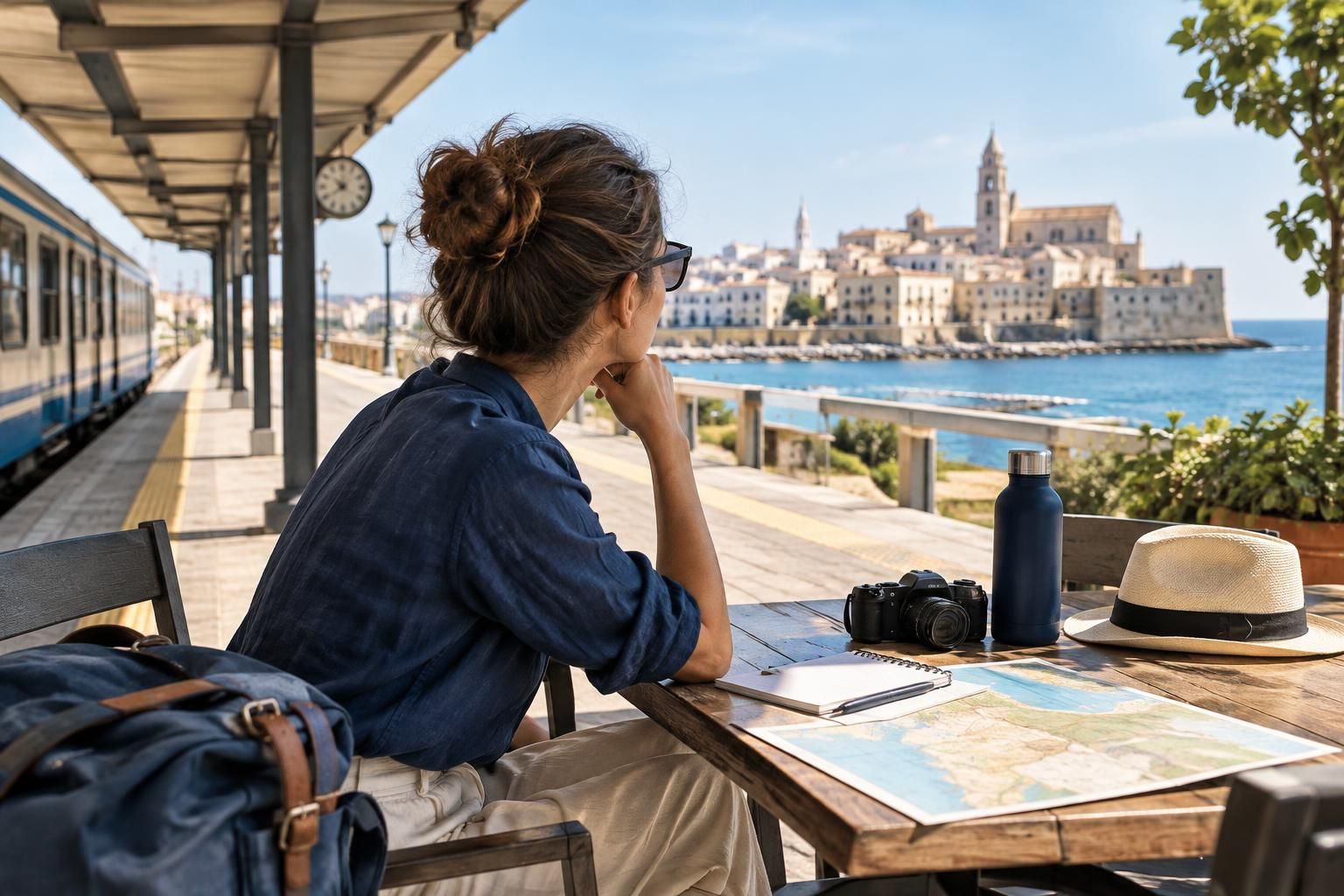
Puglia looks compact on a map, but a car-free holiday works best when you resist treating every famous town as an easy day trip. Coastal railway lines, inland branches and the final journey from a station to a beach create very different travel days. For a first visit, Bari and Lecce make a useful two-base combination: one introduces the region’s Adriatic waterfront and old-town lanes, while the other offers an architectural contrast in the Salento peninsula. Give the journey a week, choose a few outings carefully and let the places where you sleep become part of the holiday rather than just departure points.
Build the week around two contrasting bases
A practical starting framework is three nights in Bari followed by four in Lecce. This gives you two full days around Bari, a transfer day and three full days around Lecce. Reverse the order if your arrival and departure arrangements make that simpler. Avoid adding a third overnight stop unless it solves a genuine transport problem or lets you stay somewhere you particularly want to experience after day visitors leave.
Give each base at least one day of its own. Bari rewards unhurried wandering between its old town, waterfront and more regular streets south of the historic center. Lecce is better approached through short walks between ornate church facades, squares and quiet lanes than through a race to collect monuments. A holiday filled entirely with excursions misses the main advantage of staying in these cities.
Choose accommodation for the walk you will actually make
In Bari, compare accommodation near the main station with places closer to the old town. Station proximity helps with several rail outings, while an old-town address may better suit evenings spent wandering and eating nearby. Check the actual walking route rather than judging distance from a map pin; luggage feels different on uneven paving and narrow streets.
Apply the same thinking in Lecce, where the station and historic center are separate considerations. An address on the station-facing side of the center can balance sightseeing with departures. For either base, check stairs, lift access, cooling arrangements and potential street noise. An apartment with laundry can make a two-base trip easier, while a hotel may suit travelers who value luggage storage and a simpler arrival.
Use Bari for straightforward coastal outings
Polignano a Mare and Monopoli are natural candidates for the Bari portion of the trip because both sit on the coastal railway corridor. Choose Polignano for dramatic coastal views and a compact old town; choose Monopoli for harbor scenes, lanes and a more spread-out wander. Either can fill a relaxed day when you include lunch and time by the water.
Visiting both in one day is possible as an itinerary concept, but it changes the rhythm. You will spend more time orienting yourself, returning to stations and watching departure times. Pick one if swimming, photography or a long meal matters to you. Remember that reaching a coastal town by train does not mean every beach around it is accessible on foot.
Treat inland towns as separate planning decisions
Alberobello, famous for its trulli, is not simply another stop along the main coastal line. Inland journeys can involve a different operator, changes or replacement arrangements. Before committing, examine the complete outward and return journey for your intended date, including the walk from the arrival point to the area you want to explore.
The same principle applies to combining several inland towns in a day. Alberobello, Locorotondo and Martina Franca may appear close together, but geographical proximity is not the same as convenient public transport. Choose one priority town, or consider a small-group excursion if seeing several places matters more than traveling independently. Compare the full day’s effort, not just the headline fare.
Let Lecce be more than a launchpad for the coast
Begin with a full Lecce day before planning a longer excursion. Explore the historic center in two shorter sessions, leaving the middle of the day for lunch, a rest or an indoor visit. This also gives you a flexible day that can absorb tiredness or poor weather without disrupting a chain of reservations.
Otranto or Gallipoli can provide a contrasting coastal outing, but neither should be assumed to be a quick extension of Lecce sightseeing. Check the relevant rail or bus connections and the return options before choosing. Select one coast rather than trying to cross the peninsula in a single day. If a particular beach is the main objective, investigate its final connection separately from the journey to the nearest town.
Plan transport details without overbooking the holiday
For every excursion, note the departure station, operator, any changes and a workable return option. Ticket purchase and validation procedures can differ, so read the instructions attached to the ticket you buy rather than assuming one method applies across the region. Keep essential journey information available offline, and avoid building a day around the last possible connection.
Pack for repeated station walks: manageable luggage, comfortable shoes, sun protection, a refillable water bottle and a light layer for breezy waterfronts. For budgeting, separate intercity travel from local journeys and allow for the occasional taxi or organized outing where public transport is awkward. Keep your transfer day lightly planned, and leave the final evening free of a distant excursion, especially before an onward journey.
A successful rail-based Puglia holiday is selective rather than exhaustive. Bari and Lecce offer enough contrast for a week, with coastal outings and one carefully chosen inland visit adding variety. Build each day around the whole journey, including station walks and the return, and you can enjoy the region without turning every morning into a transport puzzle.
AI-assisted evergreen travel guide. Featured image is an AI-generated illustration, not a specific product or booking.