A car-free Lake District holiday works best when you stop trying to see the whole national park. Lakes that look close on a map can sit in different valleys, and reaching a trailhead may take more planning than the walk itself. For a five-night stay, one well-chosen town and a small collection of outings usually offer more freedom than an ambitious circuit. The reward is a holiday shaped by lakeside paths, stone-built villages, woodland and time to watch the weather move across the fells. Start with the practical question of where you want to spend your evenings, then choose walks and excursions that fit that base.
Choose a base for both your days and your evenings
Windermere, Ambleside and Keswick offer three useful starting points. Windermere has a railway station, making it a straightforward choice if you want to reduce arrival-day transfers. However, Windermere town is not directly on the lakeshore: nearby Bowness-on-Windermere is a separate settlement downhill. Check the location of any accommodation rather than assuming that a Windermere address means lake views or a short, level walk to the water.
Ambleside suits travelers who want a compact town, access to several walking directions and evenings without another journey. Keswick is a strong alternative for a northern Lakes stay, with Derwentwater and surrounding valleys shaping the itinerary. It requires an onward road connection from a railway gateway such as Penrith. Neither town is automatically the best choice; compare the journeys for two or three outings you genuinely want before deciding.
Treat the arrival journey as part of the itinerary
Plan from your home station to the accommodation door, not just to the nearest railway stop. Count transfers, the final walk and any uphill section with luggage. A slightly longer mainline journey can be worthwhile if it produces a simpler final connection. Check current timetables and booking conditions before committing, particularly if your arrival depends on a specific onward bus.
Keep the first afternoon deliberately light. Check in, buy picnic supplies and take a short orientation walk rather than heading straight for a fell. For departure, favor a connection with some margin instead of combining a remote morning outing with a tightly timed train. Pack luggage you can comfortably manage yourself, since station changes and the walk to your lodging may involve stairs, uneven surfaces or limited space.
Book accommodation that supports a walking holiday
A central guesthouse, small hotel or apartment can be more useful than a remote property with a dramatic view. Look at the walking route to bus stops, food shops and places to eat. A short distance on a map may still involve a steep road or an awkward pedestrian route, so inspect the setting as carefully as the room.
For a five-night stay, practical facilities matter. Somewhere to dry damp clothing, space for boots and a flexible breakfast arrangement can make mornings easier. Self-catering gives you control over picnic preparation and quieter evenings, while a guesthouse may reduce shopping and cooking. If steps or steep approaches are difficult for you, ask about the specific entrance, room and bathroom layout rather than relying on broad accessibility descriptions.
Build each walking day around one manageable route
Choose walks by distance, ascent, surface and exposure, not by distance alone. A short fell climb can demand more effort than a longer valley path. Around Windermere, Orrest Head offers an example of a compact uphill outing; around Keswick, the Derwentwater shore provides options for shorter sections rather than an automatic commitment to a complete circuit. Near Ambleside, investigate lower-level woodland and valley routes alongside hill options.
For every walk, identify the actual start, the return arrangement and a shorter alternative. Do not assume that an entire lakeshore is publicly walkable or that a path is level because it follows water. Carry suitable mapping and check local route conditions. Footwear with grip, waterproof layers and spare insulation deserve space even when the morning looks bright. A lower route is a worthwhile choice in its own right, not merely a consolation.
Use buses and boats selectively, not as a daily puzzle
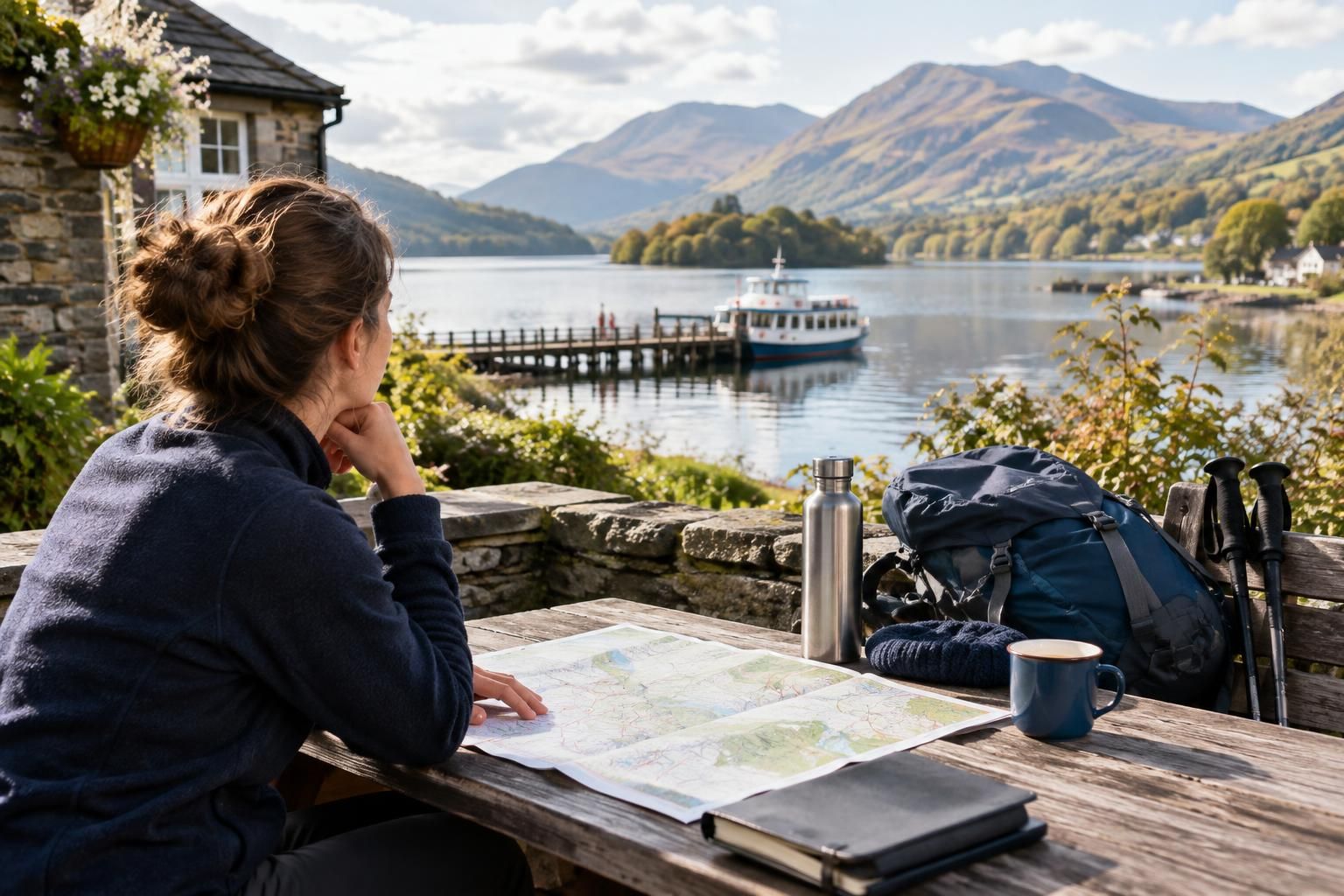
Public transport is most useful when it simplifies the day. A bus to the start of a walk followed by a return on foot can be easier to manage than finishing at a remote stop with few alternatives. Where passenger boats suit your chosen lake and dates, they can add a different perspective or shorten an outing, but check landing points, seasonal operation and ticket arrangements before building a day around them.
Keep a list of two or three trips rather than a rigid daily sequence. You might pair an Ambleside stay with an outing toward Grasmere, or a Keswick stay with time around Borrowdale. Test each plan against current services and the last practical return. Do not assume you can board the final departure; leave room for an earlier return if weather, fatigue or capacity changes your plans.
Give five nights a flexible rhythm
A balanced stay might include an arrival stroll, two main walking days, one village-and-lake day and one flexible day. Use the clearest suitable weather for the outing where views matter most. Save indoor interests, a leisurely meal or a shorter sheltered walk for less inviting conditions. Avoid reserving every day for a different distant valley.
Budget for more than accommodation and rail travel. Local transport, occasional taxis, boat trips and bought lunches can affect the total, especially for a group. Compare the convenience of your lodging with the transfers it creates. Paying more to stay near useful connections may be worthwhile, but the goal is not to eliminate every transport expense; it is to spend where it makes the holiday simpler.
The strongest car-free Lake District itinerary is modest on the map and generous with time. Choose a base that works after the walks are finished, plan a handful of realistic outings and leave room to change their order. Five nights can then feel like a stay in the landscape rather than a succession of connections.
AI-assisted evergreen travel guide. Featured image is an AI-generated illustration, not a specific product or booking.