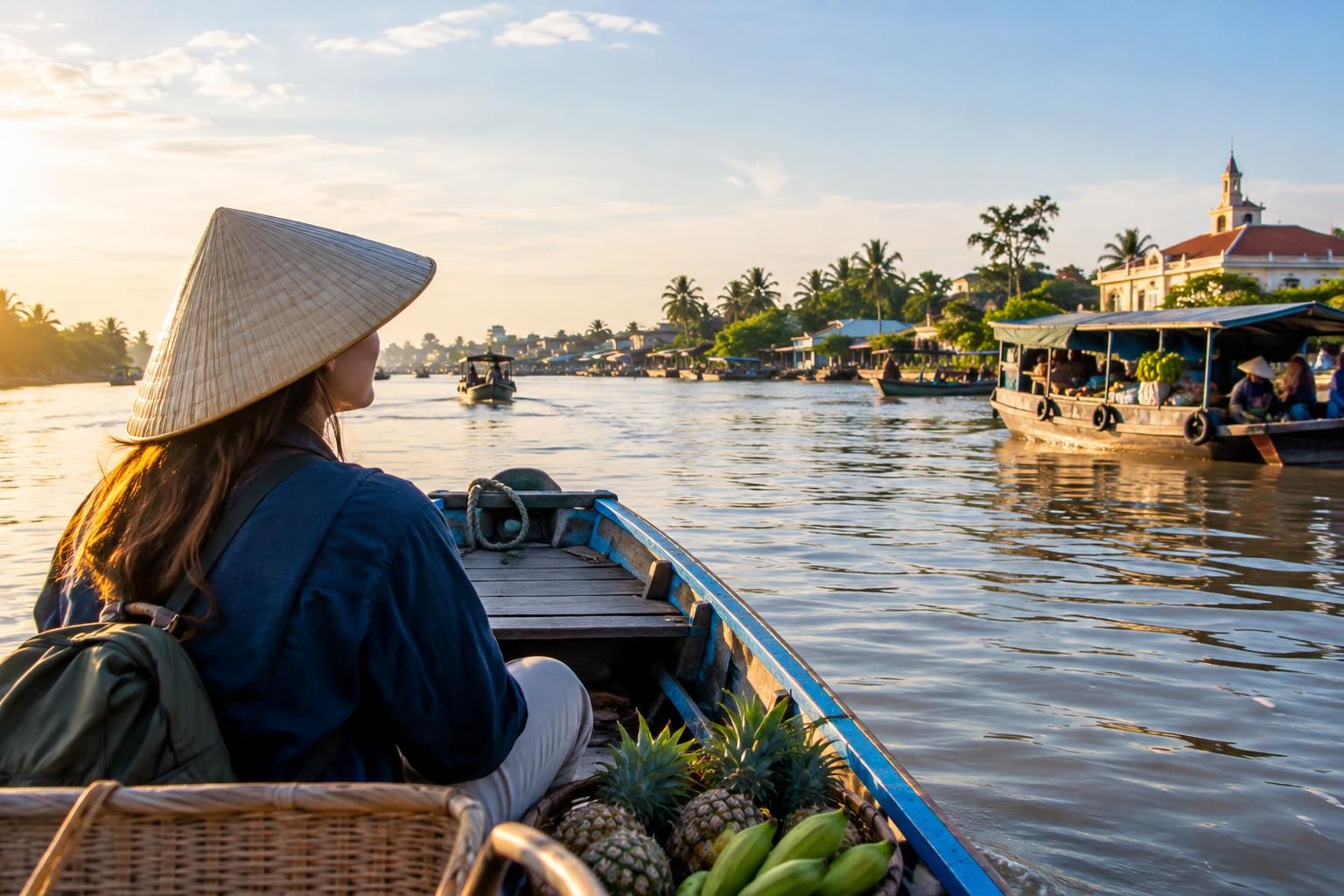
Vietnam’s Mekong Delta makes more sense when you leave room for ordinary life: produce moving along waterways, meals built around local ingredients and quiet stretches between busy riverfronts. A day excursion can introduce the landscape, but two nights around Can Tho give you more flexibility without requiring a complicated regional itinerary. The key is to choose your base carefully and treat a boat outing as one part of the visit, rather than the entire reason to go.
Decide what you want from an overnight delta visit
Can Tho suits travelers who want a working city alongside access to waterways and agricultural landscapes. It is not a secluded village, and the broader delta is not one continuous scene of narrow canals and palm trees. Urban streets, major roads, broad rivers and quieter backwaters all belong to the experience. Expect that variety rather than a uniformly rural escape.
Two nights create one full day between arrival and departure. That is enough for a river outing, a relaxed meal and either countryside time or independent city exploration. Choose three nights if you want a slower rural stay, need recovery time after a long journey or prefer not to combine an early start with another activity. Avoid adding distant delta towns simply to collect more stops.
Choose between a city base and a countryside stay
A central Can Tho base works well if you value restaurant choice, independent evening walks and straightforward access to urban services. Accommodation near the Ninh Kieu waterfront can put you close to the riverfront atmosphere, although room position matters. Ask about street noise, nearby activity and whether a river-view room actually faces the water.
A countryside guesthouse or lodge offers a different rhythm: more time on the property, fewer spontaneous dining options and greater dependence on arranged transport. Before booking, establish how you reach the entrance with luggage, whether meals need advance notice and how boat trips depart. A rural address does not automatically mean silence; ask about nearby roads, boat traffic and construction. For only two nights, pick one base rather than moving between city and countryside.
Build your transport plan around the whole journey
If you are arriving from Ho Chi Minh City, compare a coach journey with an arranged car transfer according to your group size, luggage and tolerance for transfers. Look beyond the main journey: the departure point, arrival terminal and final ride to your accommodation can affect how tiring the day feels. Confirm those details before committing.
Keep arrival day lightly scheduled. A meal and a short orientation walk are more useful than a prepaid excursion that depends on an uncertain arrival time. For onward travel, check the actual connection you intend to use rather than assuming every delta destination links conveniently with the next. Returning through a larger transport hub may be simpler than forcing a continuous loop.
Choose a boat outing for its route, not just its headline
Cai Rang floating market is a familiar reason to visit Can Tho, but it is a working trading environment, not a fixed performance. Activity varies, and your experience may differ from photographs showing densely packed boats. Ask an operator what the proposed departure time and route are intended to show, how long you will spend traveling and which stops are included.
Compare the balance between broad river travel, market observation and smaller waterways. A longer excursion is not necessarily more rewarding if much of it involves retracing the same route. Ask about seating, shade, boarding arrangements, flotation equipment and toilet access, especially if traveling with children or anyone with limited mobility. Make clear whether you want optional shopping stops, and ask permission before photographing people at close range.
Leave the afternoon open for a different perspective
After an early river trip, plan breakfast and a proper break rather than immediately starting another tour. Later, choose one contrasting activity: a guided countryside walk, a cooking session or time exploring Can Tho’s streets and food. Ask what a workshop involves so you can distinguish hands-on participation from a demonstration followed by shopping.
Cycling can be appealing around rural accommodation, but assess the proposed route rather than judging it from a scenic photograph. Ask about road surfaces, traffic, bridges, shade and the availability of suitable bicycles and helmets. If riding does not appeal, a short walk with someone who can explain the surrounding farms and waterways may offer more than a long, uncomfortable circuit.
Pack for water, weather and an early start
Bring lightweight clothing, sun protection, insect repellent and a compact rain layer. Footwear should stay secure when stepping between a bank, landing and boat. A water-resistant pouch is useful for a phone and essential documents; keep larger luggage at your accommodation during excursions.
Rain and heat can reshape the day, so avoid making every activity nonrefundable or tightly timed. Ask your accommodation which plans can shift with conditions. Keep a small amount of easily accessible cash for incidental purchases, and carry water without overloading yourself. If your outing starts early, organize clothes and your day bag the night before.
A rewarding Can Tho visit needs fewer commitments than you might expect: one well-chosen base, a thoughtfully planned river outing and time to see something beyond the water. Two nights let you separate travel from exploration, while a flexible afternoon keeps the trip from becoming a sequence of transfers and stops. Choose arrangements that match your comfort and interests, rather than trying to reproduce a particular market photograph.
AI-assisted evergreen travel guide. Featured image is an AI-generated illustration, not a specific product or booking.