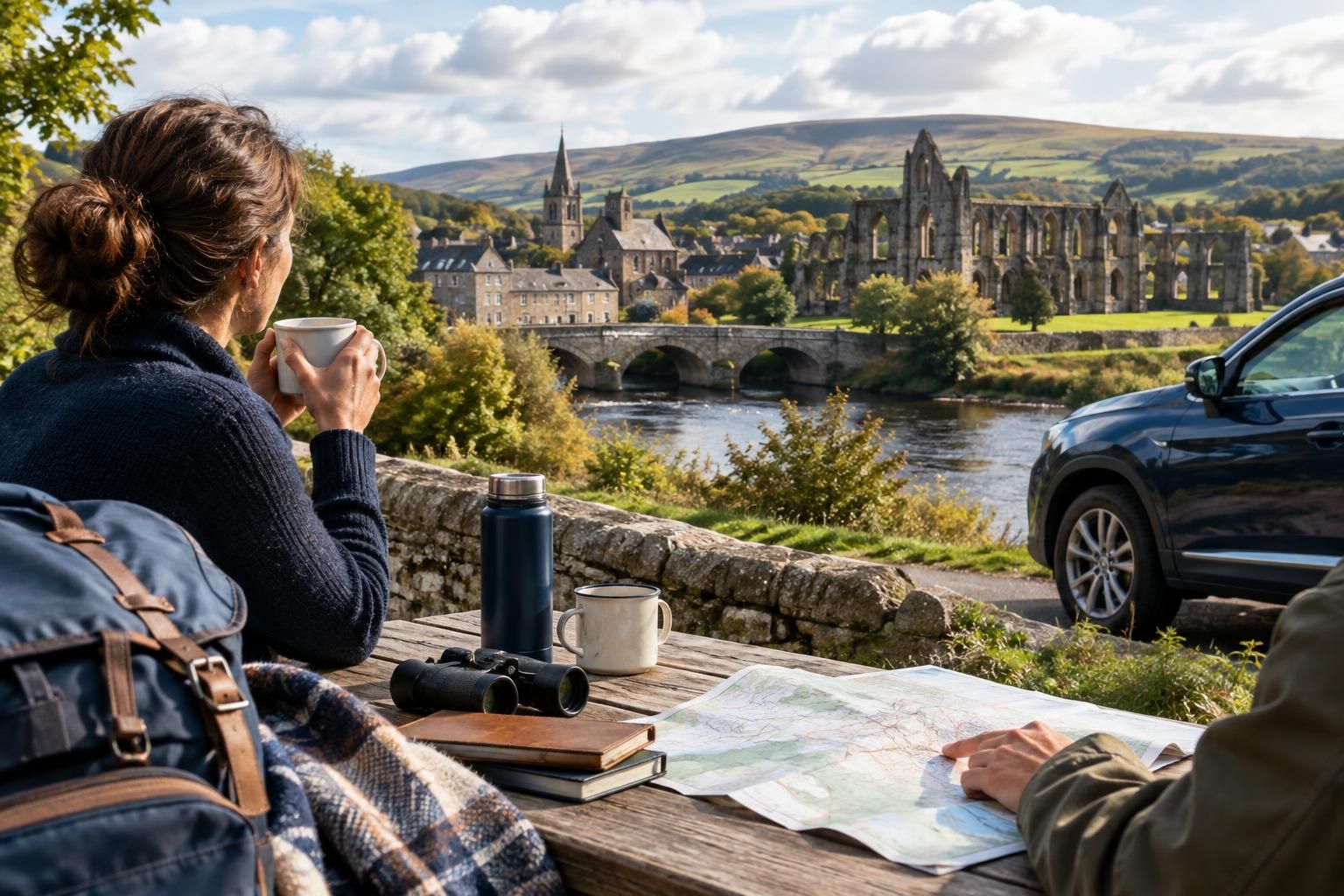
The Scottish Borders suits travelers who prefer a market square and a riverside walk to a checklist of major attractions. South of Edinburgh, the region brings together ruined abbeys, rounded hills, textile heritage and towns with distinct personalities. A five-night stay gives you time to notice those differences without turning every day into a long drive. The key is to choose one compact area rather than treating the whole Borders as a single sightseeing circuit. For a first visit, the towns around Melrose, Kelso and Jedburgh make a useful focus, with a western excursion only if it genuinely appeals.
Choose a base for your evenings, not just your driving map
Melrose is a natural starting point if you want abbey history, access to walks and a compact town setting. Kelso offers a different emphasis, with its broad square and position beside the Tweed and Teviot. Jedburgh is worth considering if its historic streets and abbey are central to your plans. Rather than choosing by map position alone, picture the end of each day: would you rather walk out for dinner or retreat to a quiet rural property?
For five nights, one base usually makes more sense than two. A countryside cottage can provide space and somewhere to dry wet clothing, but it also means driving for more meals and errands. A town guesthouse or small hotel may simplify evenings. Check parking arrangements, stairs, cooking facilities and the actual walking route into town; a short distance on a map does not necessarily mean a pleasant walk.
Build the trip around three contrasting days
Think in day types rather than a rigid sequence. Plan one abbey-and-town day, one landscape-and-walking day, and one day devoted to a personal interest such as textiles, gardens or a historic house. Leave the remaining full day flexible. This structure gives the trip variety while allowing you to move outdoor plans when the weather changes.
A workable outline is an arrival evening in your base, a day pairing Melrose with nearby countryside, a Kelso-focused day, and a Jedburgh-focused day. Use the final full day for something you have discovered along the way or, if you enjoy driving, an excursion toward Peebles and the western Borders. Do not add that western outing merely to complete a map: a second relaxed afternoon near your base can be more rewarding.
Give the abbeys context without collecting every ruin
Melrose, Dryburgh, Jedburgh and Kelso offer different settings for exploring the region’s monastic past. Choose two that fit your route and interests rather than assuming all four belong on the itinerary. At one, concentrate on architectural details and the surviving structure; at another, give more attention to the landscape and the relationship between the abbey and its surroundings.
Access to historic ruins can be affected by conservation work, so check arrangements before committing a day to a particular interior or viewpoint. Have a nearby alternative, such as a town walk or a longer lunch, that does not depend on admission. Pair an abbey with an unhurried look around its town rather than immediately driving to the next monument.
Match walks to conditions and the whole group
The Eildon Hills provide an obvious landscape focus near Melrose, but a hill walk should be a deliberate choice rather than an automatic afternoon extra. Consider ascent, underfoot conditions, visibility and everyone’s energy. A route that looks short can still feel demanding on a windy or wet day. Carry suitable layers and footwear, and use a detailed route description rather than relying solely on a general map.
For a gentler day, look for a riverside route along the Tweed or a shorter town-and-countryside circuit. Check whether the route involves muddy sections, steps, stiles or livestock, especially when traveling with children, dogs or anyone with limited mobility. Agree on a turnaround point before setting off. A satisfying short walk followed by time in town often fits this region better than an ambitious route completed in a hurry.
Keep driving modest and leave room to stop
A car is useful for combining smaller settlements, rural accommodation and scattered attractions, but it need not dominate the holiday. Organize each day around one town and one nearby stop. When comparing routes, consider road type as well as distance: rural roads, unfamiliar junctions and finding parking can make a short journey take more attention than expected.
Avoid building a day that zigzags between Melrose, Peebles, Jedburgh and distant countryside stops. Instead, group places geographically and park once when exploring a town. If arriving through Edinburgh, decide whether you actually need the car during any city stay; collecting it when leaving the city can remove unnecessary urban driving. Confirm collection arrangements and accommodation parking before settling the itinerary.
Make weather and local interests part of the plan
Pack for alternating indoor and outdoor time: a waterproof outer layer, adaptable clothing, comfortable walking shoes and a small day bag are more useful than separate outfits for every activity. A spare pair of shoes is helpful after a muddy walk. Keep the arrival day light, particularly after a long journey, and leave enough flexibility to swap a hill outing for a town-based day.
For an indoor counterpoint, explore the Borders’ textile associations, particularly around towns such as Hawick and Galashiels, or choose a local museum that matches your interests. Check visitor access rather than assuming a working mill welcomes drop-ins. Self-catering travelers should also plan the first evening’s food, so a late arrival does not become an unwanted shopping expedition.
A successful Scottish Borders break depends less on covering the region than on finding a comfortable rhythm within it. Choose a base you will enjoy returning to, combine a few historic visits with walks suited to the conditions, and keep most days geographically compact. Five nights can then feel like a proper stay: enough time for abbey architecture, river landscapes and small-town life, without spending the holiday watching the road.
AI-assisted evergreen travel guide. Featured image is an AI-generated illustration, not a specific product or booking.