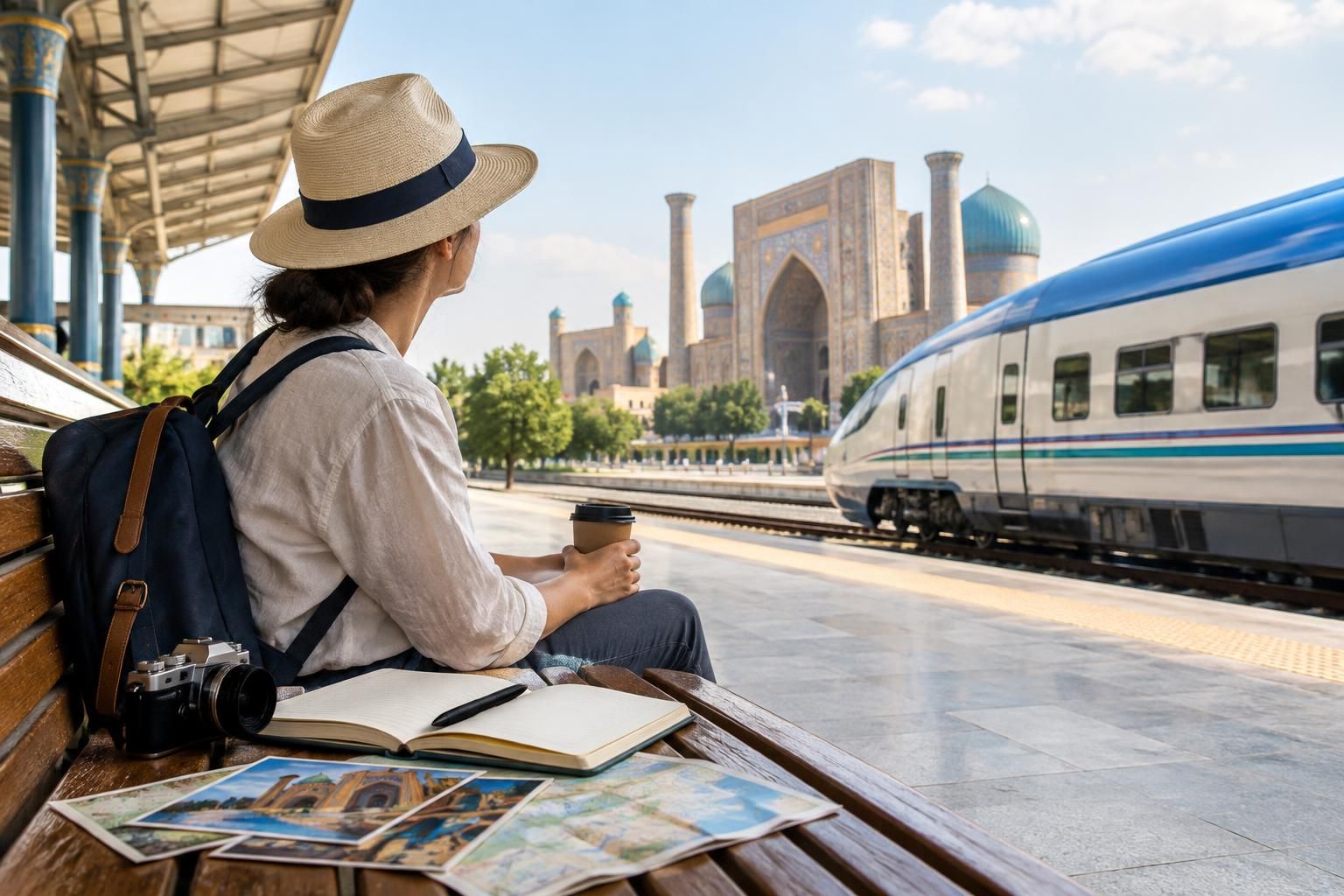
Uzbekistan’s architecture makes a compelling case for visiting, but the shape of your itinerary determines how much you enjoy it. Tashkent, Samarkand and Bukhara offer a satisfying introduction: a capital with markets and broad avenues, a city of monumental ensembles, and an old urban center suited to wandering. Linking them by rail creates a clear route without the added complexity of driving. The key is to treat each stop as a place to stay rather than a collection of sights to complete, and to leave enough room for station transfers, warm afternoons and ordinary daily life.
Choose three bases before adding a fourth
For a first visit, roughly eight to ten nights gives these three cities room to feel distinct. One possible split is two nights in Tashkent, three in Samarkand and three in Bukhara, with any remaining night placed where it simplifies your international journey. This is a planning framework, not a minimum requirement: travelers who enjoy museums or architectural photography may prefer longer.
Khiva is a tempting addition, but it extends the geographic scope considerably. Before adding it, count the extra travel day and consider what you would remove elsewhere. A shorter route with time for a second look at a favorite square can be more rewarding than a longer route dominated by arrivals and departures. If you have only a week, resist squeezing four cities into it.
Let your arrival and departure points shape the route
Start by comparing a return journey through Tashkent with an itinerary that arrives in one city and departs from another, where suitable flights exist for your dates. Returning to the capital may be straightforward organizationally, but it adds a final domestic travel leg. Put that leg into the itinerary from the beginning rather than discovering it consumes your last sightseeing day.
Treat train travel as a door-to-door undertaking. Include packing, checkout, the ride to the station, boarding time and the onward journey to your next hotel. A railway station name does not necessarily mean arrival in the historic center. When selecting services, compare departure and arrival stations as carefully as journey duration, and avoid relying on a tight connection to an international flight.
Use Tashkent to settle in rather than race through
Tashkent provides a useful contrast to the historic settings ahead. Build a day around a market visit, a museum that matches your interests and a walk through a neighborhood or public square. The metro can be part of the experience rather than merely a way to move between attractions; choose a few stops along a sensible route instead of crossing the city solely to collect station photographs.
Accommodation near a useful transport connection can be more practical than choosing by distance from a single landmark. Check the actual walking route, nearby meal options and how you will reach the station with luggage. If your flight arrives late, a simple first day gives you room to recover without feeling that you are immediately behind schedule.
Give Samarkand and Bukhara different rhythms
In Samarkand, organize sightseeing around geographic clusters. Pair the Registan area with nearby interests on one day, then give Shah-i-Zinda and another part of the city their own outing. Avoid assuming that every major monument belongs on one continuous walking circuit. Breaks between large architectural sites help you notice differences in tilework, scale and atmosphere rather than letting them blur together.
In Bukhara, leave more space for wandering through the historic center, pausing in courtyards and returning to places in different light. Choose one or two major sights as daily anchors, then let smaller discoveries fill the gaps. An extra night is especially useful if you enjoy sketching, photography or crafts, because those interests benefit from lingering rather than maintaining a checklist.
Book rooms for comfort as well as character
Courtyard guesthouses can complement the atmosphere of a historic stay, while larger hotels may offer a different set of conveniences. Compare the details that affect your own trip: stairs, luggage access, bathroom layout, heating or cooling, and whether the room faces a shared social space. Traditional-looking accommodation is not automatically quiet, and a central map pin does not reveal the condition of the final approach.
Ask about vehicle access if you are carrying heavy bags or have mobility needs. In older neighborhoods, a drop-off point and the entrance may not be identical. For an early train, find out how checkout and breakfast would work. These small questions are often more useful than choosing between two properties solely on decorative appeal.
Pack for exposed sightseeing and leave room for everyday experiences
Expect walking to include exposed squares, uneven surfaces and stretches without a convenient place to sit. Comfortable shoes, sun protection, a refillable water bottle and a small day bag are practical foundations. Adjust layers to the season, and carry clothing that makes it easy to dress respectfully at religious places. Check site-specific visitor guidance rather than assuming every monument has the same expectations.
Balance architecture with meals, markets and unstructured time. Try a regional dish, browse a craft workshop without assuming a demonstration will be available, or spend an hour in a courtyard with tea. Ask before photographing people, and approach working markets as everyday spaces rather than staged attractions. Keep some luggage capacity free if textiles or ceramics interest you, and consider fragility before buying.
A rewarding first Uzbekistan trip does not need the longest possible route. Tashkent, Samarkand and Bukhara offer enough contrast for a varied journey when each receives a different pace. Make the transport plan realistic, choose rooms around practical needs and protect a few empty hours. Those margins allow the trip to become more than a sequence of impressive monuments.
AI-assisted evergreen travel guide. Featured image is an AI-generated illustration, not a specific product or booking.