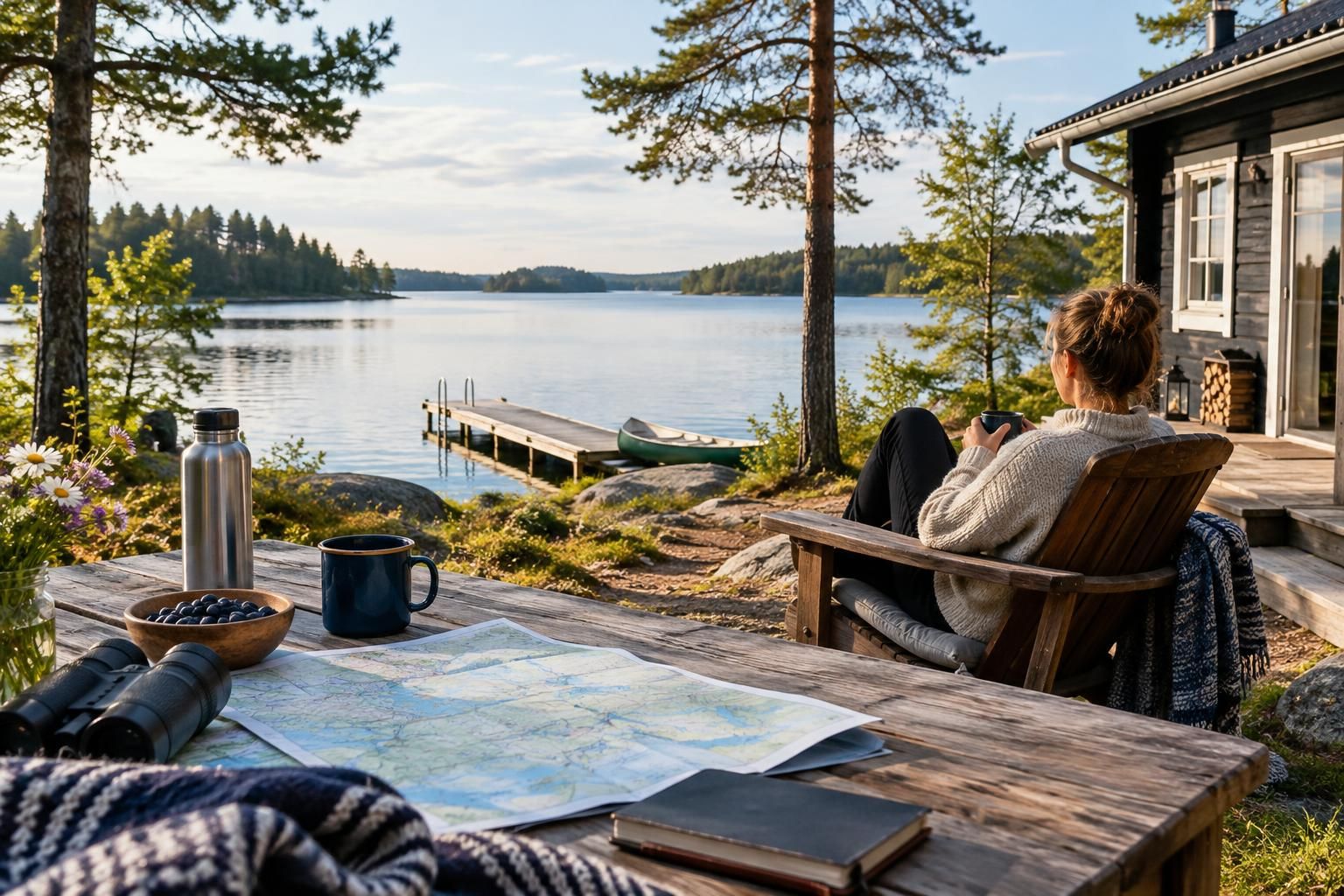
A lakeside cabin holiday in Finland offers a different rhythm from a European city break: breakfast outdoors, a short woodland walk and an afternoon with no fixed appointment. Yet the details matter. A beautiful waterfront setting can also mean a long grocery run, unfamiliar household arrangements or more driving than expected. For a first summer stay, choose your cabin around how you want to spend ordinary days, not just the view. A week in one place leaves room for changing weather, simple meals and the pleasure of returning to the same stretch of shoreline.
1. Choose a lake district around your preferred outings
Start with the balance between seclusion and variety. The Saimaa area in eastern Finland suits travelers drawn to broad lake scenery and possible outings around towns such as Savonlinna or Puumala. Around Tampere, a cabin stay can be paired with urban museums and restaurants. The Jyväskylä area offers another starting point for combining lakeside downtime with architecture and town visits. These are search areas rather than interchangeable destinations: distances between individual properties can be substantial.
Mark two or three places you would genuinely like to visit, then search for cabins within a driving distance you would happily repeat. Do not attempt to sample several lake districts in one week. If most of your imagined days involve reading, cooking and sitting by the water, a comfortable cabin near one useful town may be a better choice than a remote property surrounded by sightseeing possibilities.
2. Read the cabin description as carefully as the photographs
Finnish holiday cottages range from simple seasonal retreats to fully equipped houses. Check the bathroom, water supply, heating, kitchen equipment and sleeping layout individually. Do not assume that a listing described as having a sauna also has an indoor shower, or that every bed is in a separate bedroom. Loft sleeping areas and sofa beds may work for some groups but offer little privacy.
Examine the outdoor setting with equal care. Is the waterfront private or shared? Does access involve steps, a steep path or uneven ground? Is the shore shallow, rocky or reached from a jetty? Ask about neighboring buildings, road noise and the distance between the cabin and parking. For families or anyone with limited mobility, these details can matter more than floor area. Confirm whether linen, towels and final cleaning are included or arranged separately.
3. Decide honestly whether you need a car
A car can simplify a rural cabin holiday, particularly when groceries, restaurants and walking routes are spread out. However, it need not be part of the entire trip. One possible structure is a city stay followed by a train journey to a regional center, with a rental car collected for the cabin portion. Compare the complete door-to-door journey rather than looking only at the longest transport leg.
For a car-free stay, choose the property first by practical access: a manageable arrival transfer, a walkable food shop and enough to enjoy nearby. A cabin described as close to a town may still be inconvenient on foot. Ask for the actual route and distance, and consider how you would carry several days of groceries. Arranging a transfer once does not solve everyday transport if every meal or outing requires another journey.
4. Build the week around a few anchors
For seven nights, plan only two substantial excursions before departure. One might be a town day with a museum, lunch and a grocery restock; another could be a marked walking route or a guided activity. Keep the remaining days flexible. A cabin holiday becomes less restful when each morning begins with a long drive.
Use a simple alternating pattern: arrival and settling in, a cabin day, an outing, another quiet day, then a second outing if everyone feels like it. Keep a wet-weather option within reasonable reach, but also bring things that make staying indoors enjoyable. Books, cards and a shared cooking project can be more useful than a lengthy backup itinerary.
5. Make self-catering part of the plan
Prepare a short shopping list before arrival, including the first evening’s dinner and the next morning’s breakfast. Favor meals that use overlapping ingredients, such as pasta, roasted vegetables, sandwiches and a substantial soup. Check whether the kitchen has an oven, freezer and coffee-making equipment before choosing recipes. Do not assume that oil, seasoning or other cupboard basics will be provided.
Pack for outdoor comfort rather than a different outfit each day. Useful items include light layers, a rain shell, sturdy walking shoes, insect repellent and an eye mask for bright summer nights. Ask whether laundry facilities are available. If the cabin has a wood-fired sauna or other unfamiliar equipment, request operating instructions rather than treating it as self-explanatory.
6. Agree on what a restful stay means
Before booking with friends or family, discuss expectations about shared meals, outings, quiet time and chores. One person’s ideal afternoon of reading may feel uneventful to someone expecting daily activities. Choose a property with separate spaces if your group has different sleep patterns or needs time alone.
Treat boats, swimming and other waterfront activities as optional rather than the foundation of every day. Clarify what equipment is supplied and what instruction is available before making plans around it. Leave the final full day largely open, with time to pack, deal with rubbish and complete any agreed departure tasks. An unhurried finish is part of the holiday, too.
The strongest Finnish cabin itinerary is usually the simplest: one well-chosen location, comfortable accommodation and a few outings worth leaving the shoreline for. Prioritize everyday logistics before adding activities. When groceries, transport and household expectations are settled, an empty afternoon becomes something to enjoy rather than something to organize.
AI-assisted evergreen travel guide. Featured image is an AI-generated illustration, not a specific product or booking.