Busan rewards travelers who resist treating it as a beach stop with a few sights attached. South Korea’s coastal city combines working harbors, hillside neighborhoods, seafood markets and urban beaches, but these experiences are spread across a broad, hilly landscape. Four nights gives you room to explore several sides of the city without spending every day crossing it. The key is to choose accommodation around your priorities, group outings by area and leave enough flexibility for coastal weather. Rather than trying to see every famous viewpoint, build a trip around contrasting neighborhoods and a manageable amount of movement.
Choose a base for your evenings, not just your arrival
Nampo, Seomyeon and Haeundae suit different versions of a Busan trip. Nampo works well if markets, older commercial streets and harbor-side sightseeing are your main interests. Seomyeon is an inland choice for travelers who value transport connections, varied dining and access to different parts of the city. Haeundae suits those who want the beach to be part of daily life rather than a single excursion.
For four nights, one hotel is usually simpler than splitting the stay. Choose the place where you would most enjoy dinner and a walk after sightseeing. Then check the actual walking route from the nearest useful station: a property that looks close on a map may involve a steep slope, stairs or an awkward road crossing. If sea views matter, distinguish a direct waterfront outlook from a partial view between buildings.
Build each day around one part of the city
Busan’s map can tempt you into pairing places that look close across the water but require an indirect journey. Organize days into broad clusters instead. A western day might combine Nampo, Jagalchi and nearby shopping streets. An eastern day could focus on Haeundae and the coast toward Songjeong. Give another day to Gwangalli, a hillside neighborhood or a particular cultural interest rather than attempting all three.
Use a locally supported navigation service to compare complete journeys, including walking and transfers, rather than judging distance alone. Rail is useful for many urban journeys, while buses or taxis can help with places away from stations. A taxi is not automatically faster across the city, especially when traffic is heavy. Before setting out, save your accommodation name and address in Korean for the return journey.
Give the older harbor districts an unhurried day
Around Nampo and Jagalchi, the appeal lies partly in the contrast between busy commercial streets and the waterfront. Start with a market wander, leave time for lunch and add a viewpoint or shopping area according to your energy. Markets are working places rather than staged attractions, so keep clear of deliveries, ask before photographing people and avoid blocking narrow passages.
If you want a seafood meal, establish what you are ordering and how the total is calculated before committing. Preparation, portion size and accompaniments can make comparisons less straightforward than they first appear. Travelers who do not eat seafood can still enjoy the district’s atmosphere and choose a meal elsewhere. You do not need to turn every market visit into a tasting itinerary.
Choose coastal experiences that offer different things
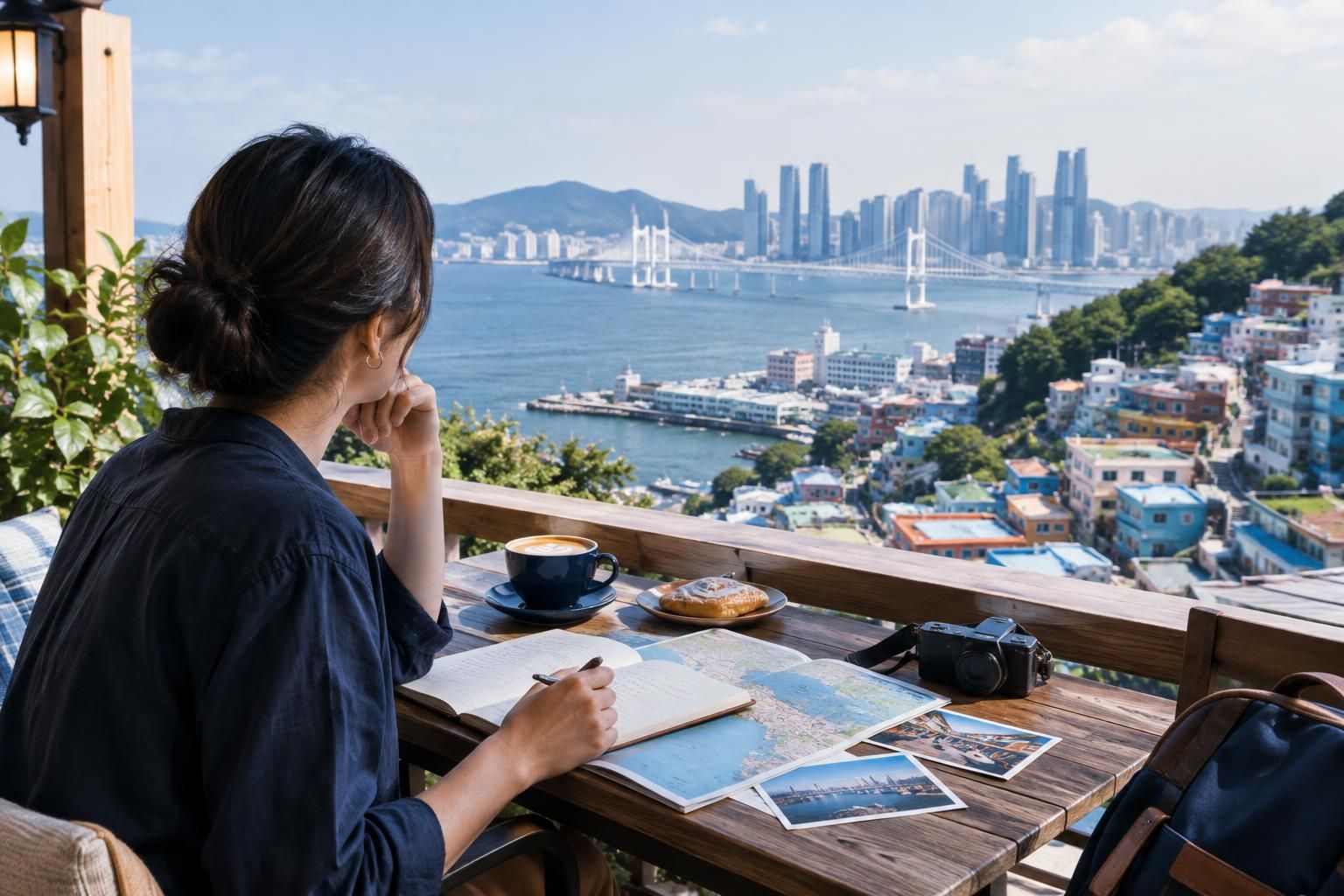
Haeundae and Gwangalli are both urban beaches, but visiting them need not mean repeating the same afternoon. Use Haeundae for a beach-centered outing with a walk and café stop. Save Gwangalli for a later-day visit if the bridge views and waterfront dining appeal. Neither requires a swimming plan to be worthwhile, and a cool or breezy day can still suit a short shoreline walk.
For a different coastal setting, consider a stretch around Songjeong or the temple setting of Haedong Yonggungsa. Treat these as deliberate outings, not automatic additions to an already full beach day. Check the route, access arrangements and return options before leaving. At religious sites, follow posted guidance, keep voices low and give worshippers space rather than approaching the setting only as a photograph.
Plan for hills, showers and the temptation to overbook
Busan’s hillside neighborhoods can involve more climbing than their map footprint suggests. Gamcheon Culture Village, for example, is best approached as a residential area with lanes, slopes and viewpoints, not simply a quick photo stop. Wear comfortable shoes, carry a manageable day bag and respect private doorways and quiet streets. If stairs are difficult, investigate the specific route rather than assuming an entire district is accessible or inaccessible.
Keep one indoor alternative near each day’s main area, such as a museum, exhibition or extended café break. This avoids crossing the city merely to escape rain. Coastal wind can also change how comfortable a walk feels, so a light layer is useful beyond the hottest conditions. Leave room to shorten an outing instead of replacing every abandoned plan with another attraction.
Turn four nights into a flexible itinerary
On arrival day, settle into your chosen neighborhood and have dinner nearby. Use the first full day for Nampo and the harbor districts, the second for Haeundae and one additional coastal experience, and the third for a hillside visit or personal interest followed by Gwangalli. Swap these days around according to the forecast and your energy. Keep departure morning local rather than scheduling a distant final stop.
Book accommodation first, then identify only the experiences that genuinely require advance arrangements. For everything else, maintain a short priority list and a longer optional list. A food-focused traveler might replace a viewpoint with a market lunch; someone interested in photography might revisit one waterfront in different light. Busan becomes more satisfying when the plan supports those preferences rather than competing with them.
A rewarding Busan stay depends less on collecting sights than on reducing unnecessary journeys. Choose a base that suits your evenings, give each day a clear geographic focus and balance busy markets with open coastal space. With four nights and a little flexibility, you can experience the city’s contrasts without turning every outing into a transport exercise.
AI-assisted evergreen travel guide. Featured image is an AI-generated illustration, not a specific product or booking.