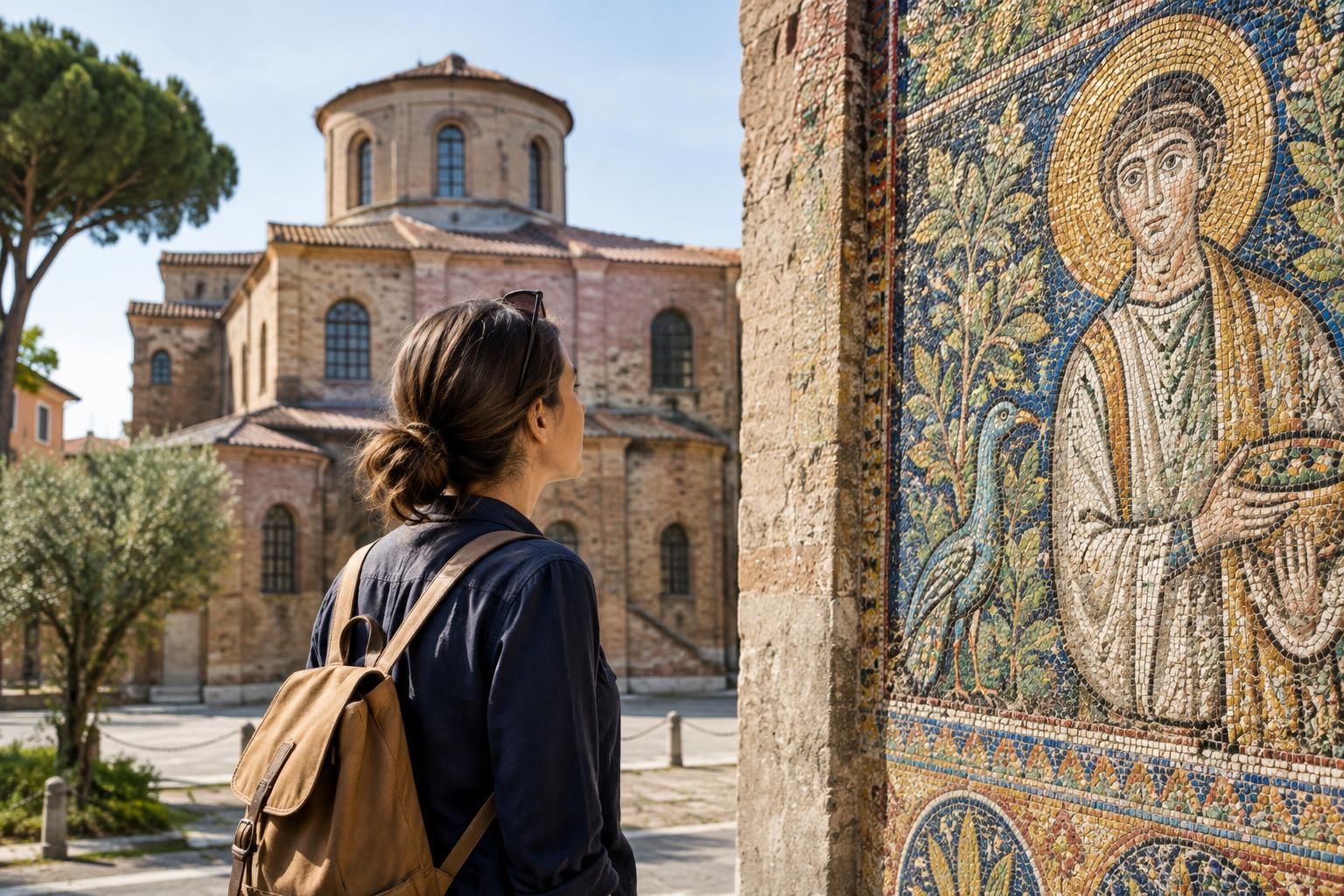
Ravenna rewards looking slowly. In this city in Italy’s Emilia-Romagna region, small pieces of glass and stone create extraordinary scenes of emperors, processions, animals and star-filled skies. The experience is different from a large museum: much of the art remains part of the architecture, so the shape, scale and light of each interior matter. Three nights make a useful framework for a first visit, allowing two full days without turning every hour into a monument stop. Build the trip around a handful of interiors, then leave room for neighborhood walks, simple meals and a closer look at how mosaics are made.
Build the trip around two full days
Think of three nights as an arrival afternoon, two complete sightseeing days and a departure morning. Use the first afternoon to learn the center’s layout rather than commit to a major visit that depends on a punctual arrival. A walk around Piazza del Popolo and the surrounding streets provides an easy introduction.
Give each full day one main theme. The first might focus on the central mosaic monuments; the second could combine another interior with a workshop or an excursion to Classe. If your arrival is late and departure early, resist filling both days completely. Leaving one flexible block makes the itinerary easier to adjust.
Choose accommodation for the walking you will actually do
For a short stay, look first at accommodation in or near the historic center. Compare its position with the monuments you most want to see, rather than choosing solely by distance from the station. A central room can make it practical to take a proper break between visits instead of spending the whole day out.
Ask about stairs, lifts, room access and luggage storage if these affect your plans. Travelers arriving by car should also clarify parking arrangements and the approach to the property before driving into the center. An attractive address on a pedestrian street may require a final walk with bags, which is easier to manage when expected.
Select contrasting monuments rather than collecting every site
San Vitale, the Mausoleum of Galla Placidia and Sant’Apollinare Nuovo offer a strong starting selection. They differ in scale, atmosphere and the way their mosaics occupy the building. San Vitale invites attention to its complex architectural space; Galla Placidia offers a more intimate encounter; Sant’Apollinare Nuovo encourages you to follow long narrative and processional sequences.
Add the Neonian Baptistery if you want another distinct architectural setting, but avoid treating each visit as interchangeable. Before entering, choose one thing to notice: the use of blue, the treatment of clothing, the direction figures face or the relationship between decoration and windows. This gives even a short visit a purpose without requiring specialist knowledge.
Make room for looking, resting and practical checks
Alternate an absorbing interior with a walk or a seated break. Looking upward and concentrating on intricate imagery can become tiring, even when the distances between sites seem modest. Two carefully chosen visits before lunch may be more satisfying than a continuous sequence that leaves the later buildings blurred together.
Before committing to your route, check the admission arrangements for each chosen site, including whether reservations, timed entry or combined tickets are relevant to your dates. Do not assume a ticket includes every monument on your list. Check photography conditions and visitor guidance too, and carry binoculars only if permitted and useful to you.
Consider a workshop as a different kind of art experience
A mosaic workshop can change what you notice afterward: the spacing between pieces, their uneven surfaces and the decisions behind a curve or outline. If this interests you, compare the activity itself rather than choosing by photographs of finished work. A demonstration, a brief introductory session and a longer hands-on class serve different purposes.
Ask what participants actually make, how much guidance is included and whether the finished piece can be taken away immediately. Materials may need setting or finishing time. Also consider the object’s weight and fragility if you are continuing by train or traveling with limited luggage. A workshop should fit your journey, not create an awkward packing problem.
Treat Classe as a separate outing
Sant’Apollinare in Classe stands outside Ravenna’s central sightseeing cluster. Its spacious basilica setting offers a useful contrast to the smaller interiors in town, particularly if you are interested in how mosaic imagery works across an apse. Give it its own block of time rather than squeezing it between central appointments.
Compare transport options for your actual travel date, including the distance from any stop to the entrance and the return journey. If considering a bicycle, assess the full route, road conditions and your confidence rather than judging only by distance. Keep a town-based alternative in mind if weather or transport makes the excursion less appealing.
Budget for depth, and pack for indoor-outdoor days
Set separate allowances for accommodation, monument admission, food, local transport and any workshop. Paying for fewer experiences you genuinely want is usually more useful than adding activities simply to fill gaps. Seasonal conditions also shape the rhythm: warmer days favor longer midday breaks, while cooler or wetter days make a nearby accommodation base especially convenient.
Pack comfortable walking shoes, a compact rain layer and clothing that works for visits to religious buildings. Keep your day bag light enough to carry through several interiors. A small notebook can be more useful than taking dozens of photographs: record a color combination, a detail or a question to explore during the next visit.
The strongest Ravenna itinerary is not the one with the longest monument list. Choose contrasting interiors, protect time to look closely and use a workshop or a Classe outing to broaden the experience. With a convenient base and a little flexibility, three nights can become a focused introduction to both the art of mosaics and the pleasure of a smaller Italian city.
AI-assisted evergreen travel guide. Featured image is an AI-generated illustration, not a specific product or booking.