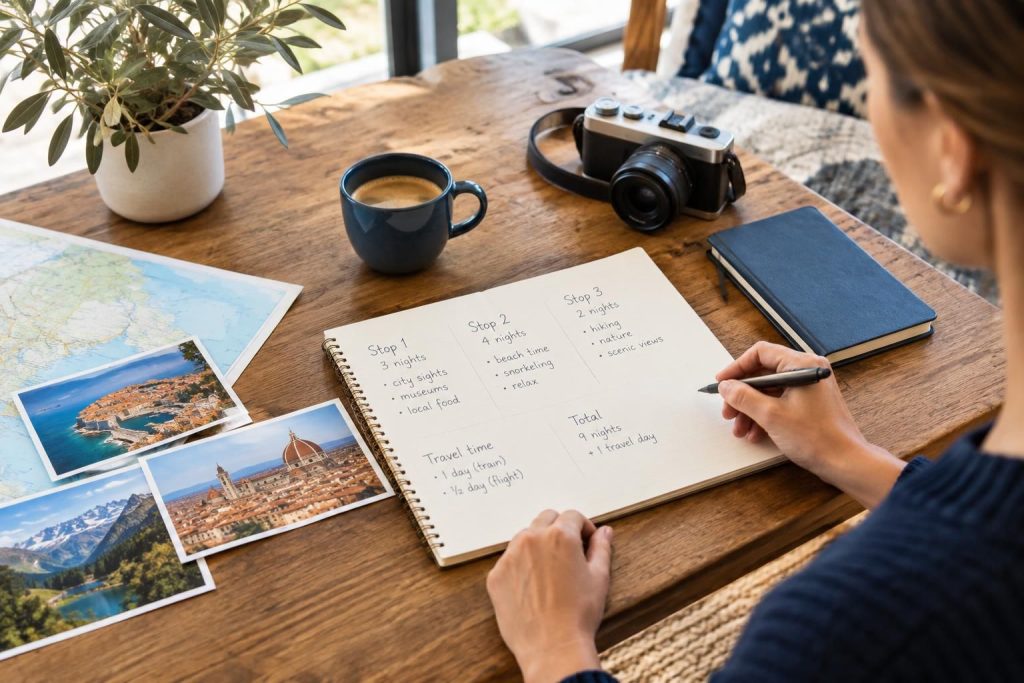
A European sleeper train offers a different rhythm of travel: an evening departure, a compact place to settle in and a new city beyond the window in the morning. It can be a memorable part of a holiday, but it works best when chosen for more than its romantic appeal. Sleep quality, station access, compartment arrangements and what happens after arrival all matter. For a first trip, build one overnight journey into a straightforward itinerary rather than linking several unfamiliar services. The aim is not to cover the greatest distance, but to make the train a useful bridge between two places you genuinely want to visit.
Choose the journey around two worthwhile stays
Start with your destinations, not a photograph of a sleeping compartment. Choose two cities or regions where you would happily spend several nights, then investigate whether an overnight service fits between them. Central European rail hubs such as Vienna, Munich and Zurich can be useful starting points for exploring options, but the exact route, operating dates and stopping pattern need checking before you commit.
Compare the whole journey with a daytime alternative. Include travel to the departure station, time spent waiting and the trip from the arrival station to your accommodation. A shorter overnight ride is not necessarily better: late boarding or a very early arrival can leave little time to sleep. For a first experience, prioritize comfortable timings over maximum distance.
Understand what you are actually booking
A reclining seat, a couchette and a sleeper berth are different experiences. A seat generally means remaining in a seated carriage overnight. Couchettes are bunks in a relatively simple compartment, often shared with other passengers. Sleeper compartments typically offer more privacy and bedding arrangements, though facilities vary considerably between trains and carriage types.
Read the accommodation description closely. Check how many people may share the compartment, whether your booking reserves the whole space or individual berths, and where toilets and washing facilities are located. Do not assume that a private compartment includes a private bathroom. If climbing is difficult, confirm how lower-berth requests work rather than relying on a preference entered during booking.
Compare costs with sleep and flexibility in mind
An overnight train may replace a hotel night, but it is not automatically the cheapest option. Compare the total for your party, including any required berth reservation, meals and onward transport. If using a rail pass, establish whether the journey is covered and what accommodation supplements or separate reservations apply.
Think about the morning afterward, too. A cheaper seat may be poor value if tiredness costs you a day you hoped to enjoy. Conversely, a shared couchette may suit friends who are comfortable with limited privacy. Before paying, check the conditions for changes and cancellations, especially if the train connects with another separately booked journey.
Keep departure evening deliberately simple
Treat departure day as a light sightseeing day. Leave time to collect luggage, eat and find the correct station without rushing. Some cities have several railway stations, and a familiar city name on a ticket does not mean the train uses the most central one. Check the station name and allow room for an unfamiliar layout.
Have dinner before boarding unless you have confirmed a suitable onboard option. Carry drinking water and a modest snack that is easy to eat quietly. If you are arriving by another train, leave a generous connection margin; reaching the departure city earlier in the day is often more relaxing than depending on the final possible connection.
Pack one small bag for the night
Keep your main luggage closed as much as possible. Put a toothbrush, essential personal items, sleepwear, earplugs, an eye mask and a charging cable in a small pouch or day bag. Add a warm layer and footwear that is easy to slip on for trips along the corridor. Compartment storage can be awkward, so luggage you can lift and maneuver yourself makes boarding easier.
Keep tickets, travel documents and valuables accessible and secure. Follow staff instructions about document checks, particularly on international journeys, and do not assume that crossing a border overnight means there will be no interruption. Download booking details and useful arrival information so that patchy mobile reception does not become a problem.
Make shared space comfortable for everyone
In a shared compartment, small courtesies matter more than elaborate equipment. Introduce yourself briefly, organize what you need before others settle down and use headphones rather than speakers. Avoid spreading belongings across spare bunks or seats: another passenger may board at a later stop.
Agree on lights and sleeping arrangements where practical, while following any staff guidance. Expect some movement, corridor noise and stops during the night. If uninterrupted sleep is essential to enjoying your holiday, a daytime train and a conventional hotel may be the better choice. The sleeper experience can be rewarding without being the right option for every traveler.
Give yourself a forgiving arrival day
Plan your first morning around breakfast, luggage storage and a short, uncomplicated outing. Ask your accommodation about bag storage, but do not assume your room will be ready when the train arrives. A neighborhood walk or riverside stroll leaves more flexibility than a timed museum entry or a demanding excursion.
Keep important onward connections and major prepaid activities away from the arrival window where possible. Save a simple offline route from the station to your accommodation, plus an alternative if walking feels unappealing. One flexible day after the journey makes it easier to enjoy both the train and the destination, even if sleep was lighter than expected.
A successful first sleeper-train trip begins with realistic expectations: a suitable route, the right berth and enough flexibility on either side. Choose the journey because it improves your itinerary, not because every overnight train promises perfect sleep. With a compact overnight bag and an easy arrival day, the time between destinations can become a satisfying part of the holiday.
AI-assisted evergreen travel guide. Featured image is an AI-generated illustration, not a specific product or booking.