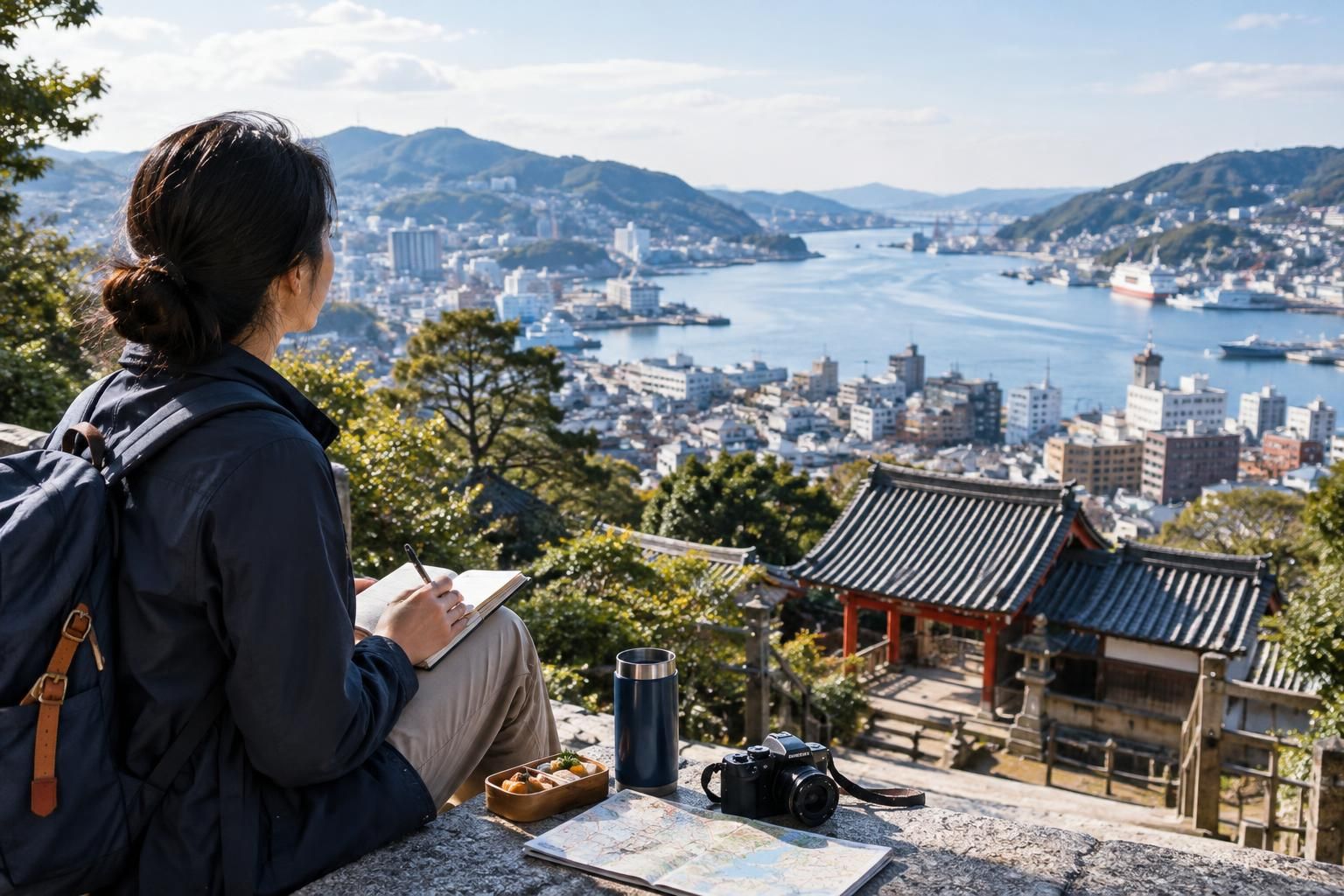
Nagasaki rewards travelers who give it more than a quick stop between larger Japanese cities. Its harbor, steep residential slopes, trading-port heritage and distinctive food create a city break with several different moods. Three nights allow two full sightseeing days, plus smaller outings around arrival and departure. The key is not to collect every viewpoint or cross the city repeatedly: group visits by neighborhood, account for hills and leave space after emotionally demanding historical sites.
Choose a base by the journeys you will actually make
For a short stay, compare accommodation around Nagasaki Station with the central areas near Dejima, Shinchi Chinatown and Hamanomachi. A station-area base suits travelers arriving with larger bags or continuing onward by rail. A more central base can put evening meals and several sightseeing districts closer together. Neither choice removes the hills, so judge the actual approach to a property rather than its straight-line distance from a landmark.
Before booking, examine the route from the nearest transport stop to the entrance. A short walk may involve steps, a steep incline or an awkward luggage approach. Check lift access, room dimensions and luggage-storage arrangements directly in the property details. If quiet evenings matter, consider the immediate street setting as well as the neighborhood: a hillside address may feel peaceful but add effort every time you return.
Build each day around one part of the city
Nagasaki’s streetcars are useful for organizing a visit, but they do not reach every hillside attraction. Think in clusters instead of treating the map as a list. Dejima, Chinatown and the central shopping streets can form one outing. The southern hillside around Oura Cathedral and Glover Garden makes another. The Peace Park area and Nagasaki Atomic Bomb Museum deserve their own substantial block of time.
Check the current route map, fare arrangements and accessibility information before traveling. Walking between nearby districts can reveal smaller streets and harbor views, while a taxi may be a sensible choice for a steep final approach or tired legs. Do not assume a route that looks short is easy: elevation, road crossings and the location of entrances can matter more than distance.
Give the city’s histories different kinds of attention
Dejima provides a starting point for understanding Nagasaki’s role in overseas exchange during Japan’s period of restricted foreign contact. Pair it with a gradual exploration of the waterfront and central streets rather than immediately heading to another museum. Around the southern hillside, Oura Cathedral and Glover Garden offer different perspectives on international connections, religious history and the development of the port.
Set aside an unhurried half-day for the Nagasaki Atomic Bomb Museum and nearby memorial spaces. This is not an ideal visit to squeeze between shopping and a timed excursion. Travelers with children may want to consider the subject matter and choose how much to see together. Afterwards, leave room for a quiet meal or a simple walk rather than scheduling another demanding attraction.
Use a three-night framework without filling every gap
On arrival day, settle in and explore the streets around your accommodation. If time and energy allow, take a gentle waterfront walk or visit Chinatown for dinner. Make the first full day a central-and-southern route: Dejima, a lunch break, then the Oura area. Choose one substantial paid attraction on the hillside if visiting both would turn the afternoon into a rush.
Use the second full day for the atomic-bomb museum and memorial district, followed by a flexible afternoon. A harbor outing, another neighborhood or a rest at the hotel can fill that space according to your interests. Keep departure morning local. Even when your onward journey starts later, a distant excursion adds transport uncertainty and luggage handling to what could otherwise be an easy final few hours.
Treat food stops and viewpoints as flexible rewards
Nagasaki’s food gives structure to a visit without requiring a rigid restaurant itinerary. Look for champon, a noodle soup associated with the city, or sara udon, a noodle dish commonly served with a thick topping. Castella cake makes a different kind of stop, especially with tea or coffee. Share dishes where practical if you want variety, and communicate dietary requirements rather than assuming a familiar-looking dish has familiar ingredients.
For a panoramic view, Mount Inasa is a recognizable option, but the experience depends heavily on visibility. Keep it movable rather than assigning it to one evening regardless of conditions. Check transport and return arrangements before setting out. If cloud obscures the hills or the journey feels excessive after a long day, enjoy the harbor at ground level instead.
Pack for slopes, rain and a city best explored slowly
Comfortable shoes with dependable grip are more useful here than footwear chosen only for flat urban walking. Carry a compact rain layer, a small day bag and whatever layers suit the season. In warmer conditions, start exposed walks earlier and plan indoor breaks. During wet weather, reduce hillside wandering and avoid turning a viewpoint visit into an obligation.
Keep the distinction between a city stay and a regional trip clear. An island excursion or an outing beyond Nagasaki can be worthwhile, but it may consume much of a day and depend on separate transport arrangements. With three nights, prioritize the city unless that excursion is your main reason for coming. If you want both, adding a night is usually more satisfying than compressing the historical visits.
A well-paced Nagasaki stay balances its harbor setting with the histories that shaped it. Choose accommodation with an easy approach, group outings geographically and protect time for reflection as well as exploration. Three nights work best when a clear view, an interesting street or a leisurely meal can change the plan without disrupting the whole trip.
AI-assisted evergreen travel guide. Featured image is an AI-generated illustration, not a specific product or booking.