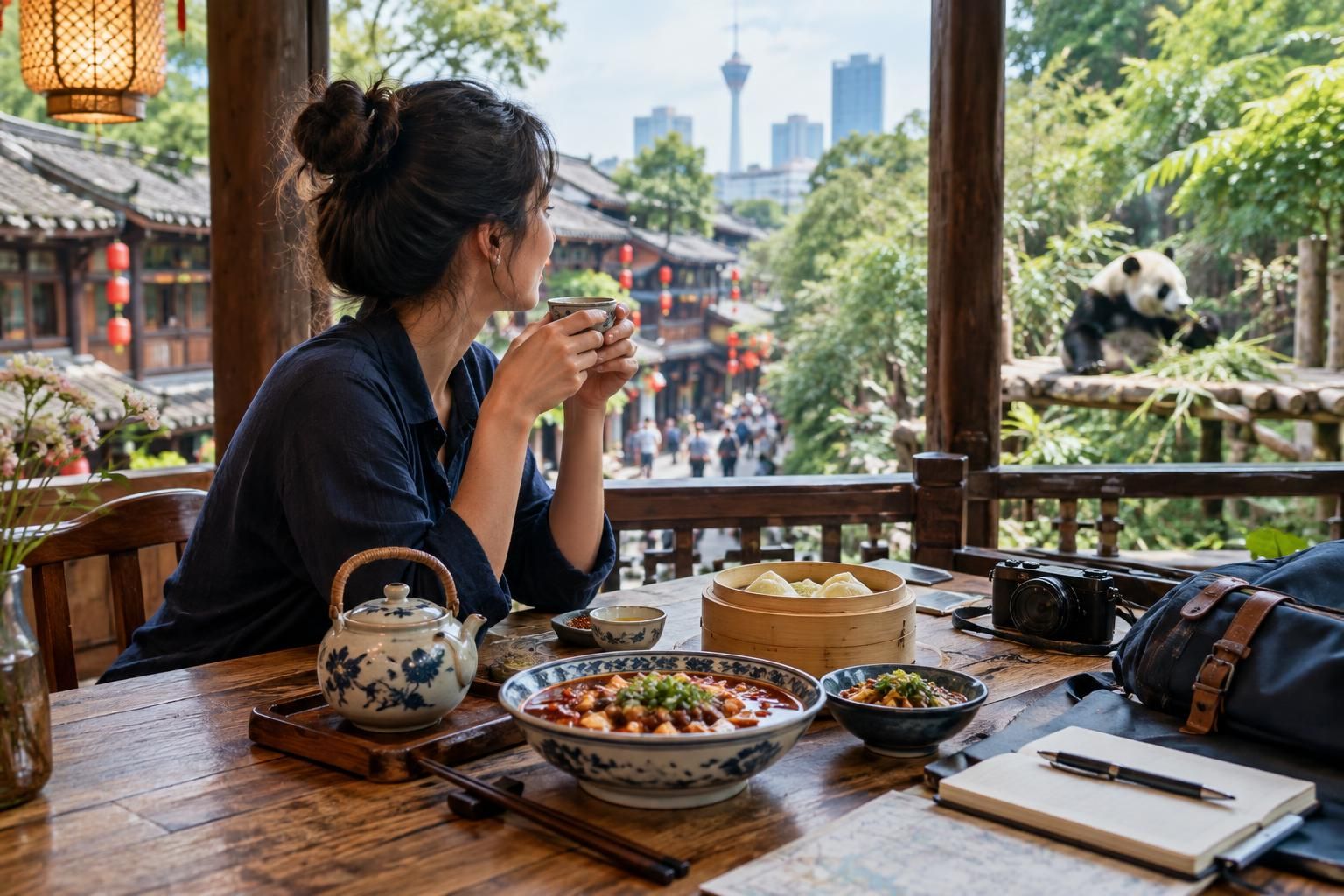
Chengdu works well as a city break for travelers who enjoy meals and everyday street life as much as major sights. A satisfying visit might pair a monastery courtyard with a noodle lunch, or a historic garden with an afternoon over tea. Four nights give you room for these slower experiences alongside a panda outing, without treating the city as a checklist. The most useful planning decision is not how many attractions to fit in, but which parts of the city to group together and where to leave breathing space.
Choose a base for easy evenings, not just sightseeing
For a first visit, compare accommodation around Tianfu Square, Chunxi Road and the Wenshu Monastery area. Tianfu Square suits travelers who want a central starting point. Chunxi Road appeals if shopping and a wide choice of evening meals matter. Around Wenshu Monastery, look for a smaller-scale neighborhood setting, while checking the immediate street rather than assuming every property will be quiet.
Prioritize a straightforward walk to a metro station, nearby breakfast options and a room away from traffic or nightlife if you sleep lightly. A central map pin can conceal an awkward entrance inside a large building. Check arrival instructions, lift access and whether reception can help communicate destination addresses. Four nights in one hotel usually make more sense than changing neighborhoods midway through a short stay.
Give each full day one main focus
With four nights, you will usually have three full days between arrival and departure. Use the first for Wenshu Monastery and surrounding streets, the second for a panda visit followed by a quiet afternoon, and the third for Du Fu Thatched Cottage or another cultural sight plus a teahouse stop. Keep the arrival evening local rather than committing to a cross-city reservation.
Treat this as a framework, not a fixed sequence. Move the outdoor-heavy day to suit the weather and your energy. People's Park can anchor a leisurely outing rather than become an extra stop squeezed between museums. If Jinli or the lanes around Kuanzhai Alley interest you, choose one for an atmospheric stroll, recognizing that visitor-oriented shopping streets offer a different experience from ordinary residential neighborhoods.
Plan a panda outing as a half-day commitment
The Chengdu Research Base of Giant Panda Breeding is a natural consideration for a first stay, but it deserves its own planning space. Before building the day around it, check the official booking process, entry requirements, site map and transport options for your dates. Avoid attaching several distant attractions afterward: reaching the site and walking within it can take a substantial part of your day.
An earlier visit can help you avoid making the warmest part of the day your main walking period, but animal activity and visibility are never guaranteed. Choose a manageable route rather than trying to see every enclosure. Wear comfortable shoes, carry water and follow barriers and staff directions. Travelers concerned about captive-animal tourism can instead devote this day to gardens, history or neighborhood exploration; the city does not depend on a panda visit to be rewarding.
Explore Sichuan food without making every meal a challenge
Sichuan cooking offers more variety than a succession of very spicy hotpots. Balance a shared hotpot meal with options such as dumplings, noodles, vegetable dishes and a simpler soup or rice-based meal. Mapo tofu, dan dan noodles and twice-cooked pork provide starting points, though recipes and heat levels vary. Order a modest amount first, especially when you are still learning portion sizes.
Distinguish chili heat from the tingling sensation of Sichuan pepper when explaining preferences. Asking for less chili may not remove that numbing quality. Keep important dietary requirements translated into Chinese, including relevant ingredients rather than only a broad label such as vegetarian. Meat stocks, minced meat and sauces can be less obvious than the main ingredient, so clarify with staff and do not assume a dish name tells the whole story.
Make room for a proper teahouse pause
A teahouse visit is most enjoyable when you have no immediate appointment afterward. People's Park is a familiar setting to consider, while neighborhood teahouses offer other ways to pause between walks. Choose somewhere that feels comfortable, look at the menu before ordering and ask which tea suits your preferences if the selection is unfamiliar.
Allow an hour or more to sit, talk or watch the surroundings. Follow staff guidance on refills and handling hot water. Carry a light layer for sitting still in cooler weather, and avoid treating other guests as photographic subjects without permission. If optional services are offered nearby, there is no need to participate; tea alone is a complete afternoon plan.
Prepare for the small logistics that shape each day
Use the metro for straightforward journeys and consider a taxi or ride-hailing service when a route involves awkward transfers or you are tired. Save your hotel name, entrance and destinations in Chinese, alongside offline screenshots. Large roads and station complexes can make short-looking walks less direct, so check the relevant exit and walking route rather than judging distance alone.
Before departure, confirm which payment methods, transport tools and attraction-booking systems you can access as an international visitor. Set up essential services where possible and keep a backup payment method. Pack supportive shoes, compact rain protection and a small day bag. For the final evening, stay near your base and leave packing time rather than adding one last distant sight.
A well-paced Chengdu visit needs only a few anchors: a convenient base, one main outing each day and enough flexibility for a long meal or another pot of tea. Choose experiences that match your interests, group nearby stops and let quieter hours carry as much weight as the headline attractions.
AI-assisted evergreen travel guide. Featured image is an AI-generated illustration, not a specific product or booking.