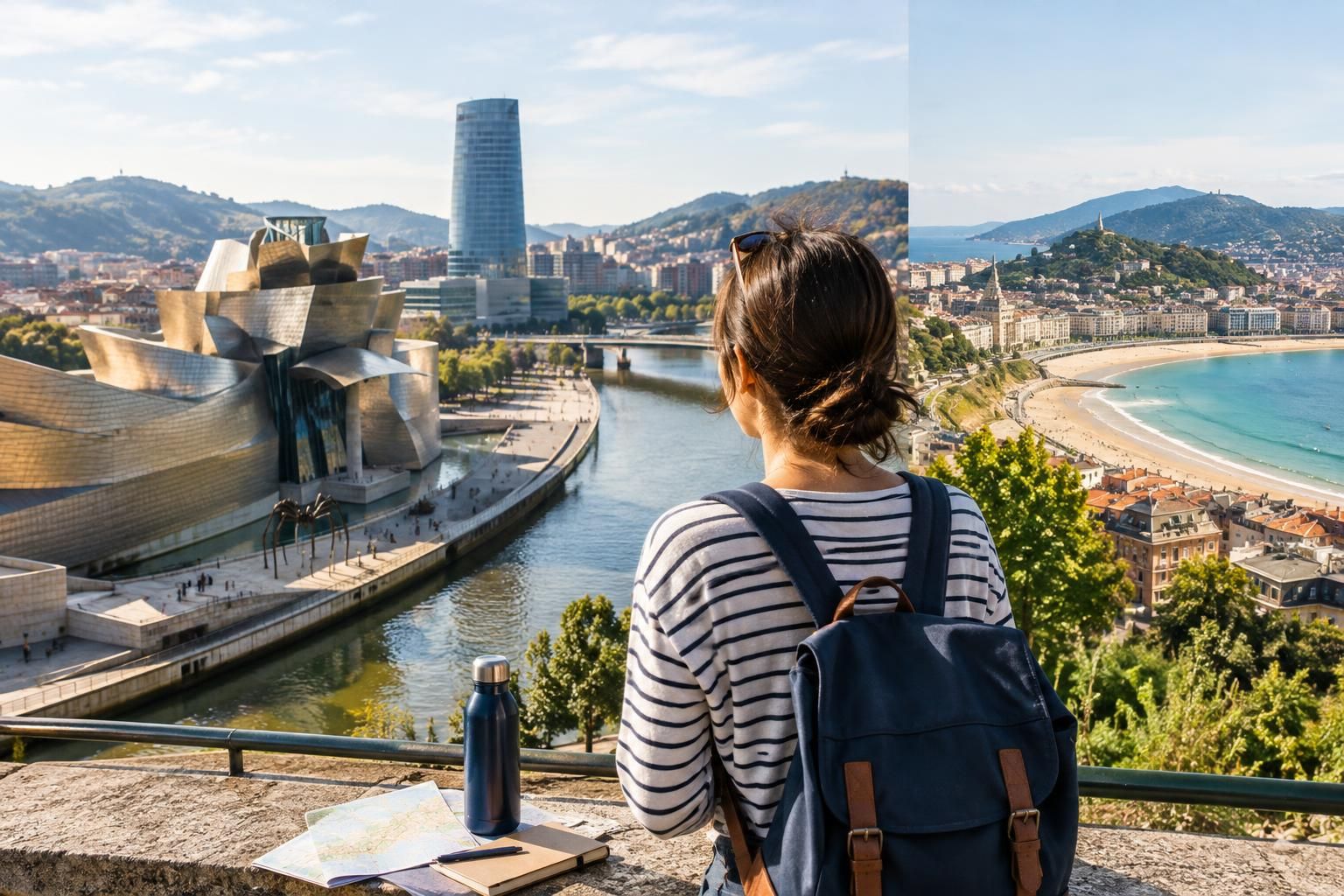
Bilbao and San Sebastián make a rewarding pairing for a northern Spain trip: one offers a river-shaped cityscape and an industrial-to-cultural transformation, while the other wraps urban life around sheltered bays. Both suit travelers who enjoy walking, eating well and spending several nights in one place rather than changing hotels daily. A car-free itinerary keeps the focus on the cities themselves, though coastal excursions need more planning. Give the trip five to seven nights if possible, and treat time outdoors as flexible rather than tying every day to beach weather.
1. Divide your nights around your interests
For a six-night trip, a useful starting point is three nights in Bilbao followed by three in San Sebastián. This gives each city two full days, with the transfer occupying part of a third. Start in whichever city makes your arrival simpler; there is little benefit in forcing a particular order if it creates an awkward connection.
Shift the balance toward Bilbao for museums, architecture and neighborhood wandering, or toward San Sebastián for coastal walks, beach time and food-focused evenings. With only four nights, choose one base and accept that a visit to the other city will be selective. Two hotels are worthwhile when they reduce repeated travel, not simply because an itinerary looks more complete.
2. Choose accommodation for the evenings you want
In Bilbao, the Casco Viejo suits travelers who want old streets and places to eat close at hand. Its atmosphere can also mean evening noise, so ask about the room’s orientation rather than judging only the address. Abando and the wider Ensanche area offer a different balance: a more regular street layout, urban shops and a convenient position for exploring both the riverfront and older quarters.
In San Sebastián, consider the Centro area for access to La Concha and a central walking base. Gros, across the Urumea River, suits travelers drawn to Zurriola beach and a neighborhood setting beyond the historic core. The Parte Vieja puts food and atmosphere outside the door, but quiet sleepers should look carefully at room location. In either city, check lift access, steps at the entrance and whether luggage storage fits your arrival plans.
3. Make the intercity transfer a simple travel day
Compare coach and rail options for the Bilbao–San Sebastián leg using your actual travel date. Journey length, departure point and the distance from the arrival stop to your hotel matter more than the transport label. If a rail option involves a slower regional journey, decide whether that ride is part of the experience or time you would rather spend in the city.
Avoid placing a prepaid attraction immediately after the transfer. Have breakfast, travel, leave your bags and spend the afternoon exploring near your accommodation. A compact bag makes station approaches and city walking easier. For airport travel, assess the whole chain before booking: a convenient flight can lose its advantage if it requires an additional cross-region transfer or an overnight stay.
4. Build each city day around one anchor
In Bilbao, make an art visit your anchor, then connect it with a river walk and time in the older streets. The Guggenheim is an obvious choice for travelers interested in modern art and architecture, but leave room to decide how much indoor time you actually want. Even without filling every hour with attractions, bridges, riverfront spaces and changing streetscapes give a walk structure.
In San Sebastián, use the bay as your organizing feature. Pair a La Concha promenade walk with the old town, or explore Gros and Zurriola as a separate half-day. Monte Urgull offers a hillier contrast to the waterfront; consider gradients, surfaces and your energy before adding it. Keep an indoor alternative for wet weather, and avoid making the success of your stay depend on swimming or clear views.
5. Treat pintxos as a flexible meal, not a checklist
Pintxos, small portions associated with Basque bar culture, make it easy to build an evening around several short stops. Begin with one or two items somewhere that appeals to you, then decide whether to move on or stay for something more substantial. A slower approach gives you time to understand menus and notice which dishes interest you rather than ordering simply because a counter is crowded.
Service and ordering customs vary, so watch briefly or ask how a particular bar works. Do not assume every displayed item is self-service or that all food follows the same pricing system. Travelers with dietary restrictions should ask about ingredients and preparation directly. Balance grazing evenings with a seated meal when you want a predictable pace, and carry a light snack for travel days rather than depending on a perfectly timed lunch.
6. Add a coastal excursion only if it improves the trip
Getaria or Zarautz can provide a different coastal setting from San Sebastián, while the Bilbao side offers opportunities to explore the estuary and nearby coast. Choose one excursion rather than trying to collect several towns in a day. Before committing, compare the outward and return journeys, the walking distance from the stop and what you would do if rain shortened your visit.
Pack for changeable Atlantic conditions: a rain layer, comfortable shoes with useful grip and clothing that works in layers. Beach items are optional extras, not the foundation of the packing list. Keep one unscheduled half-day across the trip for a missed walk, a longer meal or a neighborhood you want to revisit. That buffer often adds more value than another destination.
A good Bilbao and San Sebastián itinerary does not need a car or a long list of side trips. Choose accommodation that suits your evenings, keep the transfer day light and give each city enough unhurried time to feel distinct. The combination works especially well when art, waterfront walks and meals provide the structure, with the weather and your energy deciding the details.
AI-assisted evergreen travel guide. Featured image is an AI-generated illustration, not a specific product or booking.