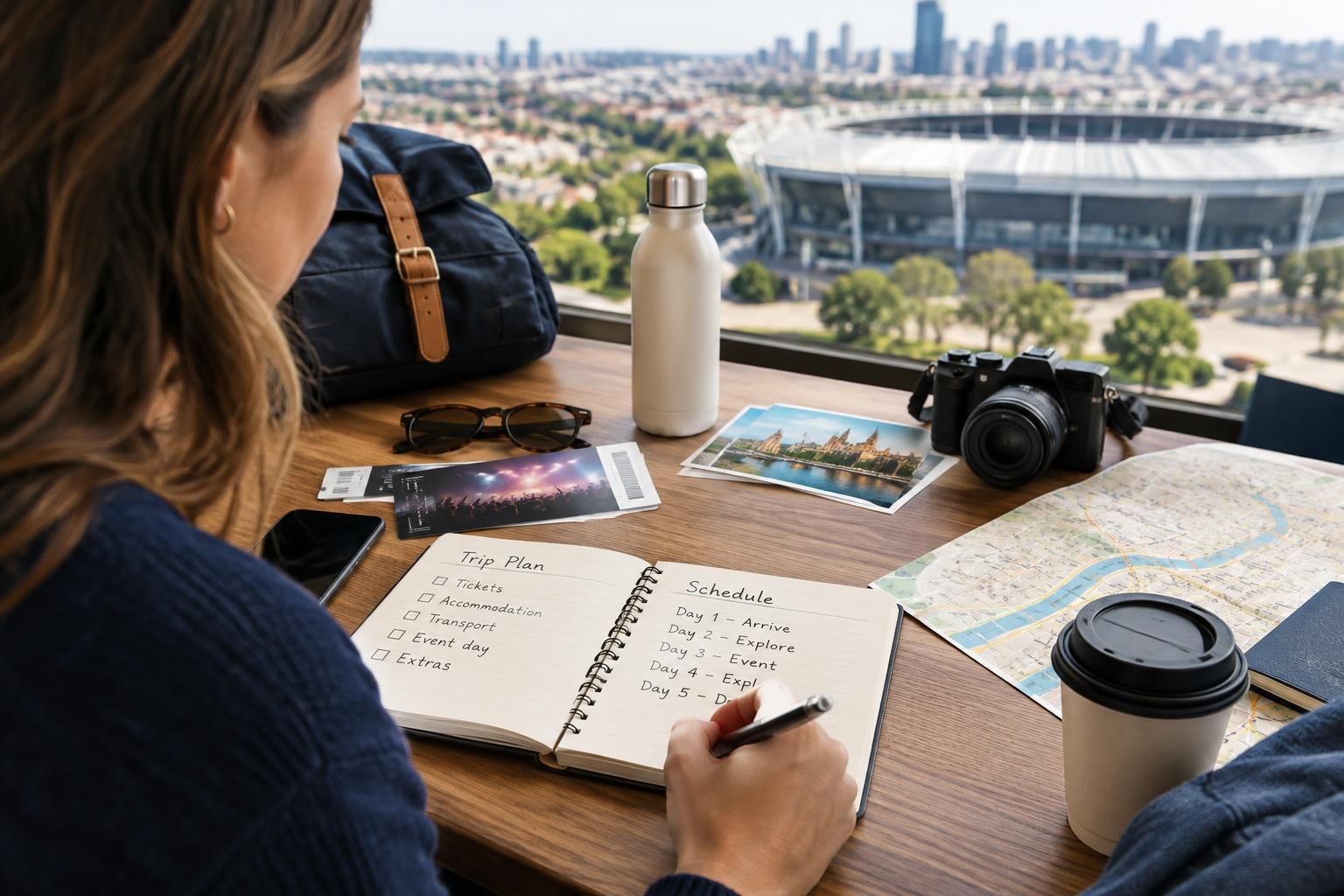
A concert, sporting fixture, festival or special exhibition can give a trip a clear purpose. It also creates a planning challenge: one experience has a fixed place and time, while almost everything else must fit around it. The most useful approach is to treat the event as an anchor, not as the entire itinerary. Start with the commitments that cannot move, build a comfortable margin around them, and use the remaining time for experiences that make sense geographically. That way, the journey can feel worthwhile without becoming an expensive chain of tightly connected bookings.
Separate the essential event from the optional extras
Define what you are actually traveling for before choosing dates or accommodation. Is it one evening performance, a particular day of a festival, or several sessions spread across a weekend? Write down the essential commitment and distinguish it from appealing extras. A fan gathering, stadium tour or second performance might enrich the trip, but it should not quietly become another nonnegotiable expense.
Then ask what would make the journey worthwhile beyond the event. Choose two or three possibilities, such as a neighborhood food walk, a coastal afternoon or a major museum. This is not a substitute itinerary to plan in full. It is a simple test: if the event changed, would you still want to visit, shorten the trip or abandon it? Your answer should influence how much you commit in advance.
Coordinate the bookings that depend on one another
Avoid treating tickets, transport and accommodation as separate purchases. Before committing to any one of them, check whether the other two appear workable for your intended dates and budget. An appealing ticket is less useful if suitable lodging would stretch the budget or the journey would require an uncomfortable connection. Compare the whole trip cost, including transfers, meals and any extra night needed.
Choose your booking order according to the least replaceable element. For a trip that only makes sense with admission, securing that admission may come first. Where accommodation or transport options are limited, understand those constraints before buying a restrictive ticket. Read the relevant cancellation, date-change and ticket-use conditions rather than assuming that any booking can be altered or transferred.
Choose accommodation for the return journey
For an event-centered trip, the journey back to your room can matter more than the journey out. Compare three possible bases: near the venue, near a useful transport connection, or in the area where you want to spend your non-event days. Each solves a different problem. A venue-side stay may simplify the main evening, while a central base may make the rest of the trip more enjoyable.
Map the complete return route, including the final walk, transfers and alternatives if your preferred service is not suitable. Do not assume an outward route will work equally well after the event. Check relevant transport information close to travel, and consider whether you would be comfortable navigating that route when tired. If your group may split up, make sure everyone can independently find the accommodation.
Keep the event day deliberately uncomplicated
Build the day backward from when you need to be at the venue, allowing time for the approach, entry procedures and finding your place. Add a proper meal and any necessary stop at your accommodation. Check the organizer’s current entry and bag conditions before deciding what to carry; a sightseeing bag that works elsewhere may not suit the venue.
Keep earlier activities nearby, short and easy to leave. A relaxed breakfast and a neighborhood stroll usually fit better than a distant excursion with several connections. If the event is the main reason for traveling, consider arriving the previous day rather than relying on a same-day journey. That extra night has a cost, but so does building the trip around a connection with little room for disruption.
Give the surrounding days their own character
Resist filling every remaining hour with related activities. After a crowded or high-energy event, a quieter day can provide useful contrast: a garden, a waterfront walk or a leisurely lunch in another neighborhood. Before the event, choose experiences that introduce the destination without exhausting the attention or energy you want to save for the main occasion.
Organize these days by area rather than by a long list of attractions. Pair one substantial activity with an optional nearby stop and leave room for meals and wandering. If traveling with someone who is less interested in the event, agree on a shared experience that reflects their interests too. The trip should not reduce one traveler to a companion waiting for the headline moment.
Make a simple plan for changes and group coordination
Decide in advance what you would do if the event moved, shortened or no longer fitted your plans. Keep booking conditions and essential confirmations together, with accessible offline copies where practical. Avoid adding several restrictive extras merely because the main event is already fixed; each additional commitment can make a change harder to manage.
For groups, agree on meeting points, spending expectations and whether everyone must arrive and leave together. Choose a specific place to regroup if people become separated, rather than relying entirely on messages. After the event, leave the following morning reasonably light, especially if departure involves packing and a transfer. A calm finish is often more valuable than squeezing in one final attraction.
A successful event trip balances one fixed commitment with a flexible surrounding journey. Coordinate the essential bookings, choose a base that works after the event, and protect the main day from unnecessary complications. Then give the destination some space of its own. You will have a trip with a clear highlight, rather than a single experience carrying the weight of every travel decision.
AI-assisted evergreen travel guide. Featured image is an AI-generated illustration, not a specific product or booking.