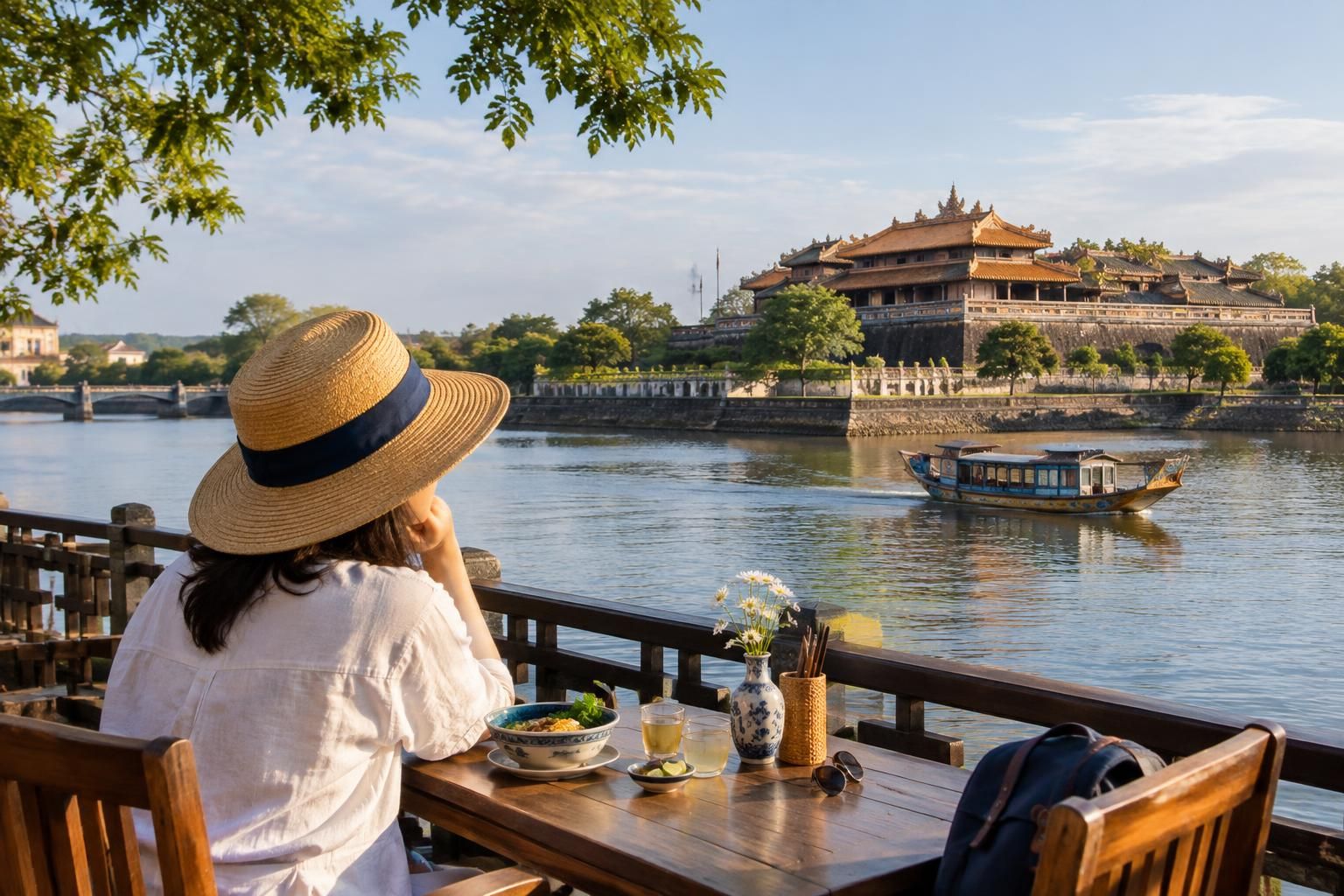
Hue rewards travelers who resist treating it as a quick stop between Hanoi and Hoi An. Vietnam’s former imperial capital offers more than a single palace visit: the Perfume River shapes the city, royal tombs spread into the surrounding countryside, and meals provide their own reason to slow down. Three nights gives you two full days without requiring a packed itinerary. The key is to separate the central historic sights from the more dispersed monuments, choose accommodation for your preferred evenings, and leave room for heat, rain and simple curiosity.
Decide whether Hue fits the trip you want
Hue is a strong choice if you enjoy architecture, dynastic history, regional cooking and observing everyday life between major sights. Its appeal is often quieter than a beach resort or a city built around nightlife. Expect courtyards, gateways, gardens and river views rather than a continuous sequence of headline attractions.
Three nights works particularly well when you arrive partway through the first day and leave after two full days. If your arrival is late and departure early, treat that as a two-day visit rather than four sightseeing days. Travelers with a deeper interest in imperial architecture may prefer an extra night; those mainly seeking beaches should allocate more time elsewhere.
Choose your riverbank and evening atmosphere
Start your accommodation search with the south bank of the Perfume River if you want a convenient choice of places to eat and an easy return after dinner. Compare the actual street setting, not just the neighborhood label. A room above a busy social street can feel very different from one tucked into a nearby lane.
Staying near the Citadel on the north side can suit travelers who prioritize historic surroundings and neighborhood wandering. A countryside property offers another experience, but each restaurant visit or city outing may require transport. Before booking, check the map against your intended activities and ask about room access, cooling, street noise and arrangements for arriving with luggage.
Give the Imperial City its own unhurried block of time
Make the Imperial City the anchor of one day rather than squeezing it between distant tombs. The Citadel is the broader fortified area; the Imperial City sits within it. Understanding that distinction helps when reading maps and deciding where to begin. Allow time to notice the sequence of gates, ceremonial spaces and smaller architectural details.
Choose a few themes to follow instead of trying to absorb every name: court ceremony, royal households, or how buildings relate to courtyards and landscape. A guide can add context if you prefer a narrative visit. Afterwards, leave space for lunch and a quieter neighborhood walk rather than immediately adding another large historic complex.
Visit fewer royal tombs, with more attention
Hue’s royal tombs are not interchangeable, and they are dispersed beyond the central sightseeing area. Tu Duc’s complex is associated with a landscaped, contemplative setting; Khai Dinh’s is known for its dramatic approach and elaborate decoration; Minh Mang’s emphasizes a formal relationship between buildings, water and landscape. Two contrasting tombs can make a more satisfying day than a hurried circuit of many.
Plan the route geographically with a driver or guide, rather than assuming the order on your wish list is efficient. Confirm the stops, waiting arrangements and return point before setting off. Walking surfaces, steps and exposed areas differ between sites, so discuss accessibility needs specifically. Keep a third stop optional, especially if you prefer photography or detailed exploration.
Use food and the river to balance the monuments
Build meals into the plan as experiences, not merely gaps between tickets. Hue is associated with dishes such as bun bo Hue, a beef noodle soup, and small rice-based dishes including banh beo. Ordering several small dishes can introduce different textures without committing every meal to a long tasting experience. Ask about ingredients when dietary requirements matter.
Reserve part of an afternoon or evening for the Perfume River. A riverside walk offers a different perspective from enclosed palace grounds, while a boat outing may appeal if being on the water is part of the attraction. Clarify the route and duration before choosing one; a river trip should not automatically be treated as the simplest way to connect scattered monuments.
Keep the schedule flexible and pack for outdoor sightseeing
A workable sequence is an arrival-day neighborhood walk, an Imperial City day with a relaxed evening, and a countryside day focused on two tombs. If you add a pagoda or craft stop, remove something else rather than continually extending the day. Avoid turning the transfer onward into another ambitious sightseeing circuit unless the journey itself is a priority.
Bring comfortable walking shoes, a compact rain layer, sun protection and a small bag that leaves your hands free. Clothing that can cover shoulders and knees is useful for religious sites. During hot or wet spells, shorten exposed walks and allow a longer meal break. Keep your departure day light enough to accommodate packing and the transfer to your onward transport.
The most rewarding Hue itinerary is not the one with the longest monument list. Choose a base that suits your evenings, give the Imperial City room to unfold, and compare a small number of royal tombs thoughtfully. With meals and river time woven between those visits, three nights can feel like a coherent stay rather than a stopover spent moving between sights.
AI-assisted evergreen travel guide. Featured image is an AI-generated illustration, not a specific product or booking.