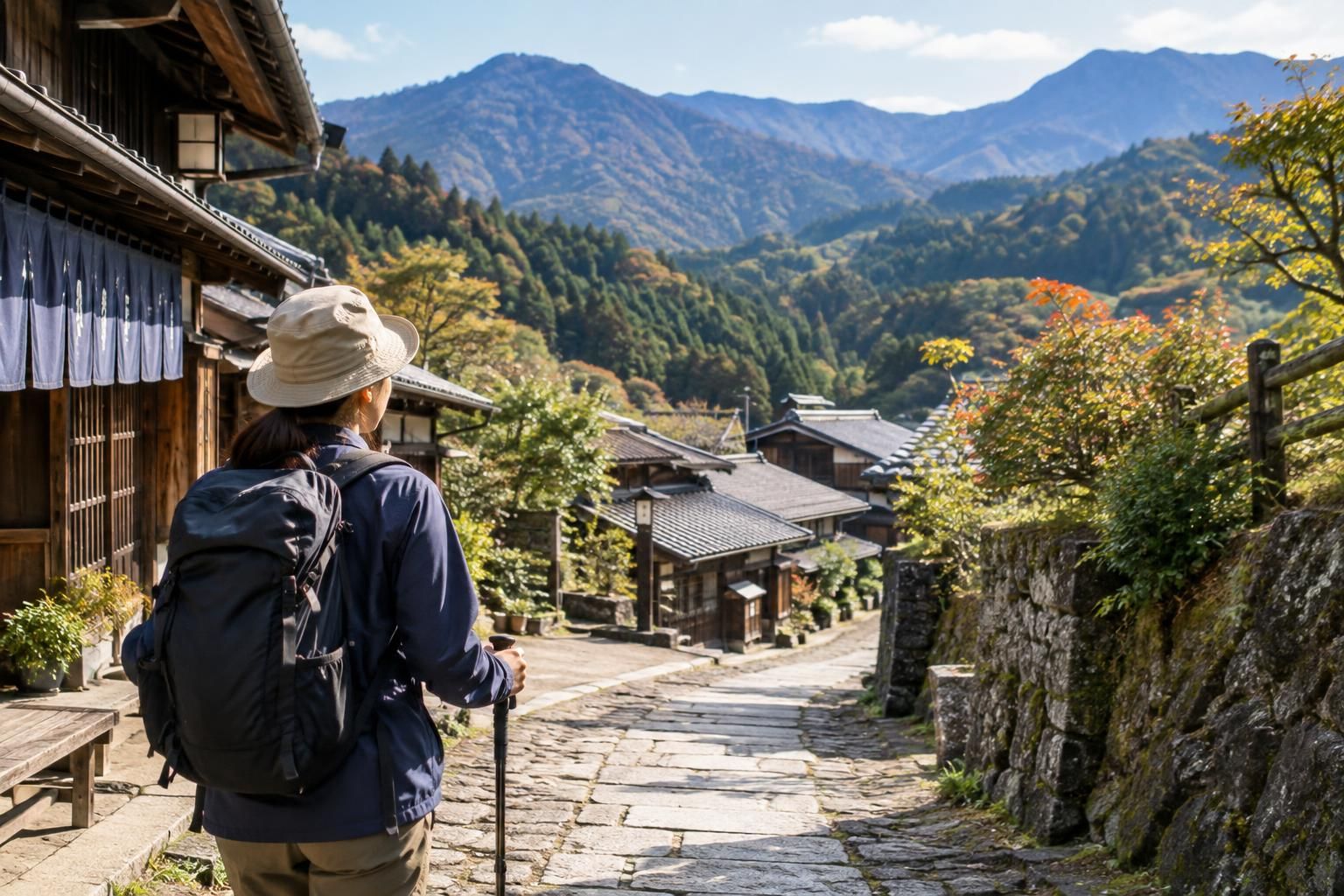
Japan’s Kiso Valley offers a different rhythm from a city-focused itinerary: wooden-fronted streets, forest paths and small settlements shaped by the old Nakasendo route between Kyoto and Edo, now Tokyo. You do not need to attempt a long-distance trek to appreciate it. A short stay built around Magome and Tsumago can combine a satisfying countryside walk with time to enjoy the towns themselves. The key is to treat the valley as a walking destination with transport connections, rather than as a quick sightseeing stop where everything falls neatly beside a railway station.
Choose the experience before choosing the number of nights
Start by deciding whether your priority is walking, historic streets or an overnight stay in a smaller community. These overlap, but they create different itineraries. A traveler mainly interested in architecture might prefer a gentle town visit and a short out-and-back walk. Someone seeking a countryside break may value a full trail day and an unhurried evening more than seeing several post towns.
One night creates space around the main walk, while two nights can provide flexibility for weather and onward travel. A day trip is another option, but calculate the complete journey rather than only the train segment. Connections between the railway, your chosen town and the trail can consume a meaningful part of the day.
Use Magome and Tsumago as a focused starting point
The well-known walking route between Magome and Tsumago is roughly eight kilometers, making it a useful introduction to the region without committing to a multi-day trek. It includes wooded stretches, slopes and smaller settlements as well as the historic town streets. Think of it as a half-day outing with pauses, not simply a distance to complete at your normal pavement-walking speed.
Walking from Magome toward Tsumago generally involves less total climbing than the reverse direction, although neither direction is entirely downhill. Choose according to your accommodation and transport arrangements as well as your preference for gradients. If anyone in your group finds uneven ground difficult, consider shorter walks around a town instead of assuming the full route will suit everyone.
Plan transport around the trail, not just the railway
Nakatsugawa and Nagiso are useful railway gateways when considering access to Magome and Tsumago. The important planning task is the connection beyond the station. Map the full chain: arriving train, onward bus or other transfer, walking start, walking finish and final connection to your accommodation.
Before fixing your itinerary, check transport for your actual travel date, including the last useful departure from your finishing point. Avoid relying on an immediate connection after the walk. Photography, lunch and tired legs can all stretch the day. If you are continuing to another city afterward, leave more margin than you would for a simple station-to-station journey.
Choose accommodation for the evening you want
An overnight stay in or near a post town emphasizes atmosphere: quieter streets after the main sightseeing period, a slower meal and an early look around before moving on. Accommodation near a railway gateway may make arrivals, departures and luggage handling simpler. Neither is automatically better; the right choice depends on whether village time or logistical convenience matters more.
Look carefully at room arrangements, bedding, bathroom access and whether meals are included. For an inn stay, confirm arrival expectations and discuss dietary requirements before booking. Do not assume that a small settlement will offer the same range of late dining options as a major city. If dinner is not provided, decide how you will eat before setting off on the trail.
Keep your walking bag small and your main luggage separate
A full suitcase is awkward on sloping streets and unsuitable for a woodland trail. The simplest arrangement is often to leave larger luggage at a continuing accommodation base and take only what you need for a short side trip. Another option is to investigate luggage forwarding between longer stays, provided the delivery timing fits your itinerary.
Do not build your day around assumed locker space or a town-to-town baggage service. Confirm any storage or transfer arrangement you intend to use, including collection requirements. For the walk itself, carry water, a snack, a weather layer, a compact rain jacket and a charged phone with an offline map. Comfortable footwear with dependable grip matters more than specialized trekking equipment.
Let weather and daylight shape the day
The valley’s appeal changes with the seasons, from fresh greenery to autumn color and colder, quieter landscapes. Conditions also change what a comfortable walk looks like. Rain can make stone and earthen surfaces slippery, summer weather can make climbs tiring, and winter conditions may demand a different plan altogether.
Check the local forecast and trail information close to your visit, then set a turnaround or finish time that leaves daylight and transport margin. A useful fallback is a town-focused day with a shorter walk when conditions allow. Avoid squeezing the route into a narrow gap between a late arrival and an inflexible onward connection.
Leave room for the towns rather than collecting more stops
A balanced one-night visit might begin with arrival and a leisurely look around your overnight base, followed by the main walk the next morning. With two nights, you can separate travel from walking and add another place, such as Narai, only if the additional rail journeys fit comfortably.
The reward is not a tally of post towns. Allow time to notice the buildings, stop for refreshments and step aside where narrow streets also serve residents. Respect private entrances and photography restrictions. A modest itinerary gives you more opportunity to appreciate the relationship between the old road, the settlements and the surrounding landscape.
A rewarding Kiso Valley visit needs fewer stops than you might expect. Choose one main walk, make the station-to-trail connections explicit and keep large luggage out of the walking day. With a suitable overnight base and room to adjust for weather, this small section of Japan can become a memorable countryside pause rather than another rushed transfer.
AI-assisted evergreen travel guide. Featured image is an AI-generated illustration, not a specific product or booking.