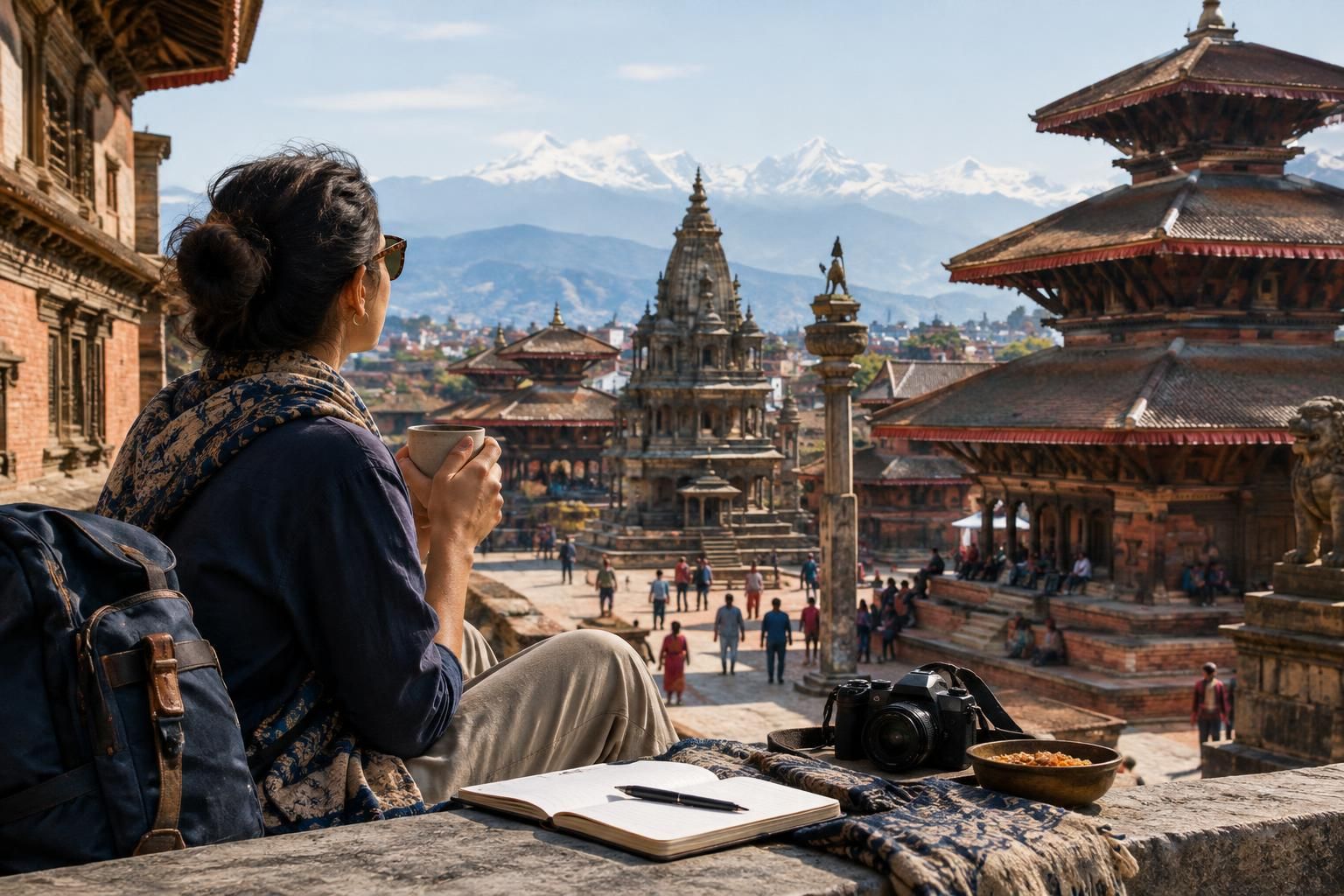
Nepal does not have to mean a trekking itinerary. The Kathmandu Valley offers a different kind of journey: brick courtyards, carved timber, Buddhist stupas, Hindu temples and neighborhoods where sacred spaces are part of everyday life. A week gives you room to explore Kathmandu, Patan and Bhaktapur without treating them as interchangeable stops. The key is to organize your stay around compact walking areas, allow generously for road travel and choose accommodation for the surroundings you actually want to return to each evening.
Choose one base or make one deliberate move
For a first visit, one comfortable base can be enough. Kathmandu suits travelers who want a broad choice of places to eat and convenient access to trip-planning services. Thamel is a familiar starting point, but accommodation on a quieter side street may be a better fit than a room directly above busy evening activity. Ask about vehicle access and street-facing rooms before choosing.
Patan, also known as Lalitpur, is an alternative for travelers drawn to courtyards, traditional architecture and a neighborhood-centered stay. Bhaktapur makes a worthwhile second base if you want to experience its historic streets early and late rather than only between transfers. For six nights, consider four in Kathmandu or Patan and two in Bhaktapur. Avoid changing hotels simply to shorten every sightseeing journey.
Plan by clusters, not by the number of landmarks
The valley looks compact on a map, but road journeys can consume more of the day than expected. Group nearby sights and leave room between outings. A Kathmandu heritage day might focus on Durbar Square and surrounding lanes; another outing could center on Swayambhu and its hilltop setting. Give Patan its own substantial block of time rather than adding it to an already crowded afternoon.
For a six-night outline, use your arrival day to settle in, then allow separate days for old Kathmandu, Patan and the Boudhanath area. Move to Bhaktapur for the final two nights, or visit it from your existing base and retain a flexible day. This is a framework, not a requirement to fill every slot: weather, fatigue and a particularly engaging neighborhood may justify changing the order.
Make heritage walks more rewarding
Kathmandu, Patan and Bhaktapur each have a Durbar Square, but seeing all three need not become an exercise in repetition. Give each visit a different emphasis: the relationship between markets and monuments in Kathmandu, courtyard spaces and metalworking traditions in Patan, and brick architecture and pottery in Bhaktapur. Look beyond the main square, while respecting private courtyards and residential thresholds.
A guided walk can be useful early in the trip, especially if you want context for Newar architecture and the valley’s overlapping religious traditions. When arranging one, explain whether you prefer architecture, food, crafts or religious history, and agree on the walking pace and duration. Leave some time afterward to revisit a small area independently instead of immediately transferring elsewhere.
Treat religious places as living spaces
Boudhanath offers a different experience from the royal squares: the stupa and surrounding streets invite a slower visit built around observation and a meal nearby. Swayambhu combines religious activity with a hilltop outing, so account for steps and your own comfort with climbing. Neither needs to be squeezed into a brief photographic stop.
At active religious sites, follow posted guidance and local direction about footwear, photography and access. Ask before photographing people, ceremonies or worship at close range. Some spaces may not be open to every visitor, and observing respectfully from outside can still be meaningful. Pack clothing that offers flexible coverage, and avoid building an itinerary that depends on entering every shrine.
Choose accommodation and transport for everyday comfort
Atmospheric architecture does not automatically mean restful accommodation. In a traditional building, ask about stairs, bathroom arrangements, ventilation and heating or cooling appropriate to your travel season. If you are sensitive to noise, prioritize room position over a rooftop view. A property with a comfortable common area is useful when you want a break without retreating to bed.
For road transfers, compare the convenience of a prearranged vehicle with the flexibility of organizing individual journeys. Agree on the destination, any waiting time and the return arrangement before departure. Keep your hotel’s name and location saved offline. On departure day, leave a generous buffer rather than scheduling a final cross-valley excursion before your onward journey.
Leave room for food, crafts and an unstructured afternoon
Balance major monuments with ordinary pleasures: a leisurely momo lunch, a courtyard café or time browsing handmade paper, ceramics or metalwork. If a workshop interests you, ask what you will actually do, how long it takes and whether the focus is demonstration or hands-on participation. That helps distinguish an experience you want from a shopping stop you did not intend.
Pack comfortable shoes for uneven paving, a light layer and a small day bag. Choose travel dates with your tolerance for rain, cooler evenings and variable visibility in mind; do not make distant mountain views the sole purpose of the visit. Keep one afternoon uncommitted for a return walk, a longer meal or simply resting.
A satisfying Kathmandu Valley trip depends less on covering every monument than on giving its distinct places enough time. Choose a base that suits your evenings, group outings geographically and make only one hotel move if it adds something meaningful. With that structure in place, a week without trekking can feel like a complete Nepal journey rather than a pause before one.
AI-assisted evergreen travel guide. Featured image is an AI-generated illustration, not a specific product or booking.