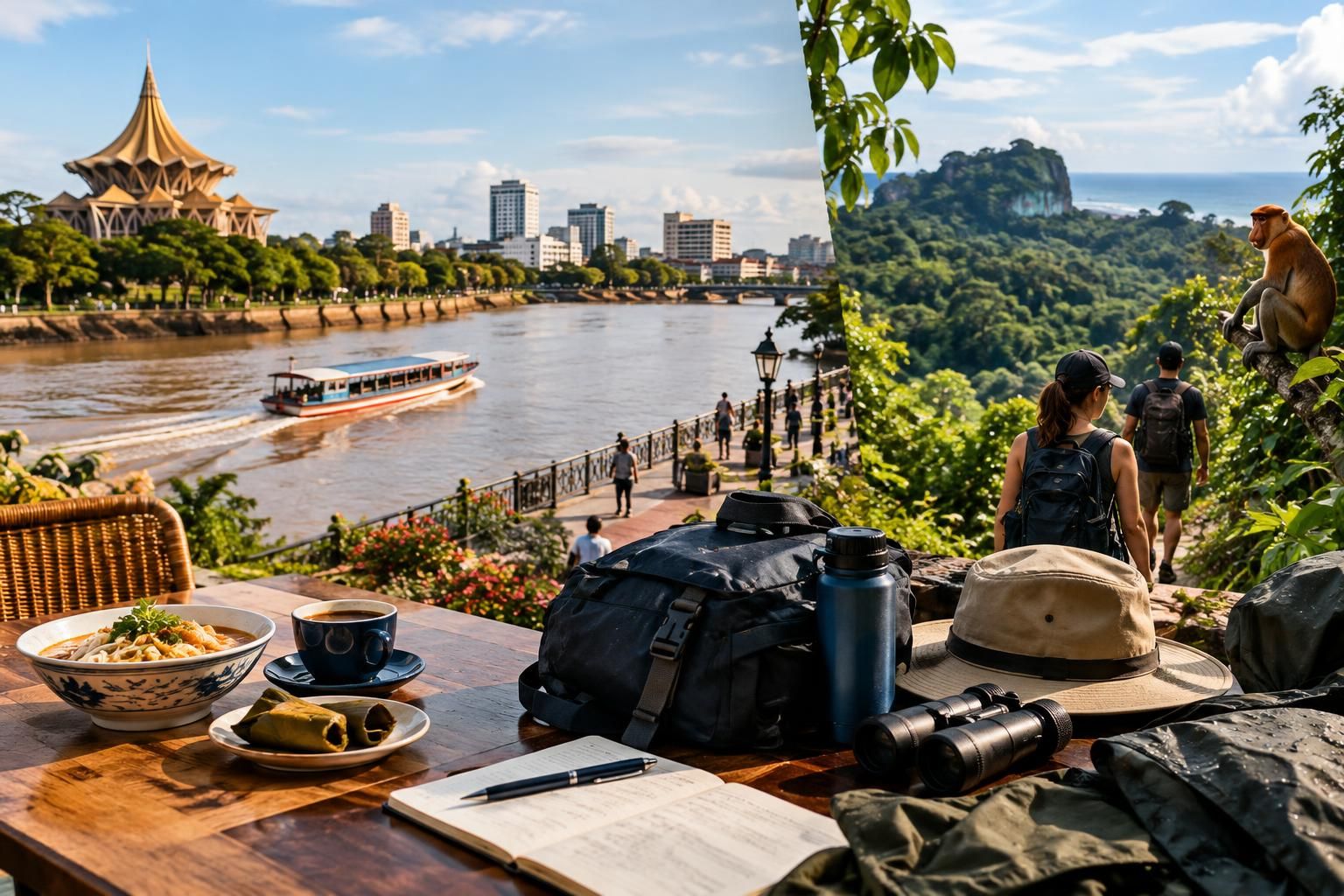
Kuching offers a manageable starting point for exploring Malaysian Borneo without moving accommodation every night. The city sits on the Sarawak River, with older commercial streets, food stops and museums providing a contrast to nearby forest excursions. The planning challenge is deciding how much nature to fit around a city base: a full day outdoors can involve road travel, boats, walking and weather-related uncertainty. For a first visit, choose one main rainforest experience, leave room for Kuching itself, and add an overnight outside the city only when it offers something you genuinely want.
Give Kuching time beyond the arrival night
A four- or five-night stay provides a useful framework for combining city exploration with one or two excursions. Think in usable days rather than calendar dates: a late arrival and an early departure contribute little sightseeing time. With only three nights, keep the plan selective rather than trying to include a national park, wildlife visit and distant cultural excursion.
A balanced sequence is an arrival evening near your accommodation, a city day, a forest outing and a flexible final day. That spare day can absorb tiredness or a changed excursion, but it also has value on its own. Markets, galleries, riverside walks and unhurried meals make Kuching more than a place to sleep between trips.
Choose accommodation for evenings and excursion pickups
For a first stay, consider accommodation within a comfortable walk of the waterfront and older central streets. This makes it easier to return for a rest, find dinner without another vehicle journey and explore in shorter bursts. Check the actual walking route rather than relying only on a map pin: road crossings, shade and the location of the entrance affect everyday convenience.
Compare practical details before decorative ones. Air conditioning, somewhere to dry damp clothing, luggage storage and a clearly understood check-in process can matter after a humid outing. If you plan organized excursions, ask whether pickups cover your chosen property. Travelers considering a night outside Kuching should also establish whether their city accommodation can store the main suitcase.
Make Bako a deliberate choice, not an automatic addition
Bako National Park is a distinctive option for coastal forest scenery and the possibility of seeing wildlife, including proboscis monkeys. Access involves a road journey to the departure area and a boat connection, so it deserves more planning than an ordinary city attraction. Confirm access arrangements, accommodation options and suitable routes for your dates before building other commitments around it.
A day visit suits travelers who want to return to familiar accommodation and carry little equipment. An overnight stay may appeal if you value more time in the forest and are comfortable with simpler facilities. Neither choice guarantees sightings. Ask about trail conditions, walking demands, meals, bedding and bathroom arrangements; do not assume that a short trail will feel easy in tropical humidity.
Treat wildlife visits and cultural experiences thoughtfully
Semenggoh is another excursion to consider, particularly for travelers interested in orangutan conservation. Its semi-wild setting means animal appearances should not be treated as a guaranteed performance. Check visitor arrangements and guidance before going, then leave space in your expectations for a worthwhile visit that may not produce the photographs you imagined.
For cultural experiences, distinguish between a museum, a staged introduction to regional traditions and a hosted community visit. Each offers something different. Before booking a longhouse visit, ask who hosts it, how the visit is arranged, what participation involves and whether photography requires permission. Choose an experience with a clear explanation of the welcome rather than one promising unrestricted access to local life.
Use city days for food, context and a slower rhythm
Kuching’s city days work best as clusters of nearby stops rather than a checklist spread across town. Pair the waterfront and older shopping streets with a museum visit, then leave an open stretch for lunch or a café break. The Borneo Cultures Museum is one option for adding regional context; check its visitor information when arranging your day.
Food can provide a loose structure without requiring reservations for every meal. Sarawak laksa and kolo mee are recognizable starting points, while coffee shops and food courts offer opportunities to explore further. Travelers with dietary restrictions should ask about broths, toppings and sauces rather than judge a dish by appearance. Keep one or two alternative meal options near your accommodation.
Pack for damp conditions and keep transfers realistic
Pack quick-drying clothing, comfortable footwear with grip, a light rain layer and a small day bag. A waterproof pouch or inner dry bag is useful for electronics during boat travel and sudden rain. Carry what your excursion requires, but avoid taking your full luggage on a forest outing when storage arrangements allow you to leave it behind.
Before committing to any excursion, establish what the quoted arrangement includes: road transport, boat travel, guiding, entry costs and meals may be separate elements. Avoid placing a boat-dependent outing immediately before an important onward departure. For a night outside Kuching, keep the following morning flexible rather than assuming every connection will align neatly.
The strongest Kuching itinerary is not necessarily the one that reaches the most places. A convenient city base, one carefully chosen forest experience and time for food and regional history can create a varied introduction to Sarawak. Add an overnight excursion when its setting and pace appeal to you—not simply because it appears on a standard Borneo itinerary.
AI-assisted evergreen travel guide. Featured image is an AI-generated illustration, not a specific product or booking.