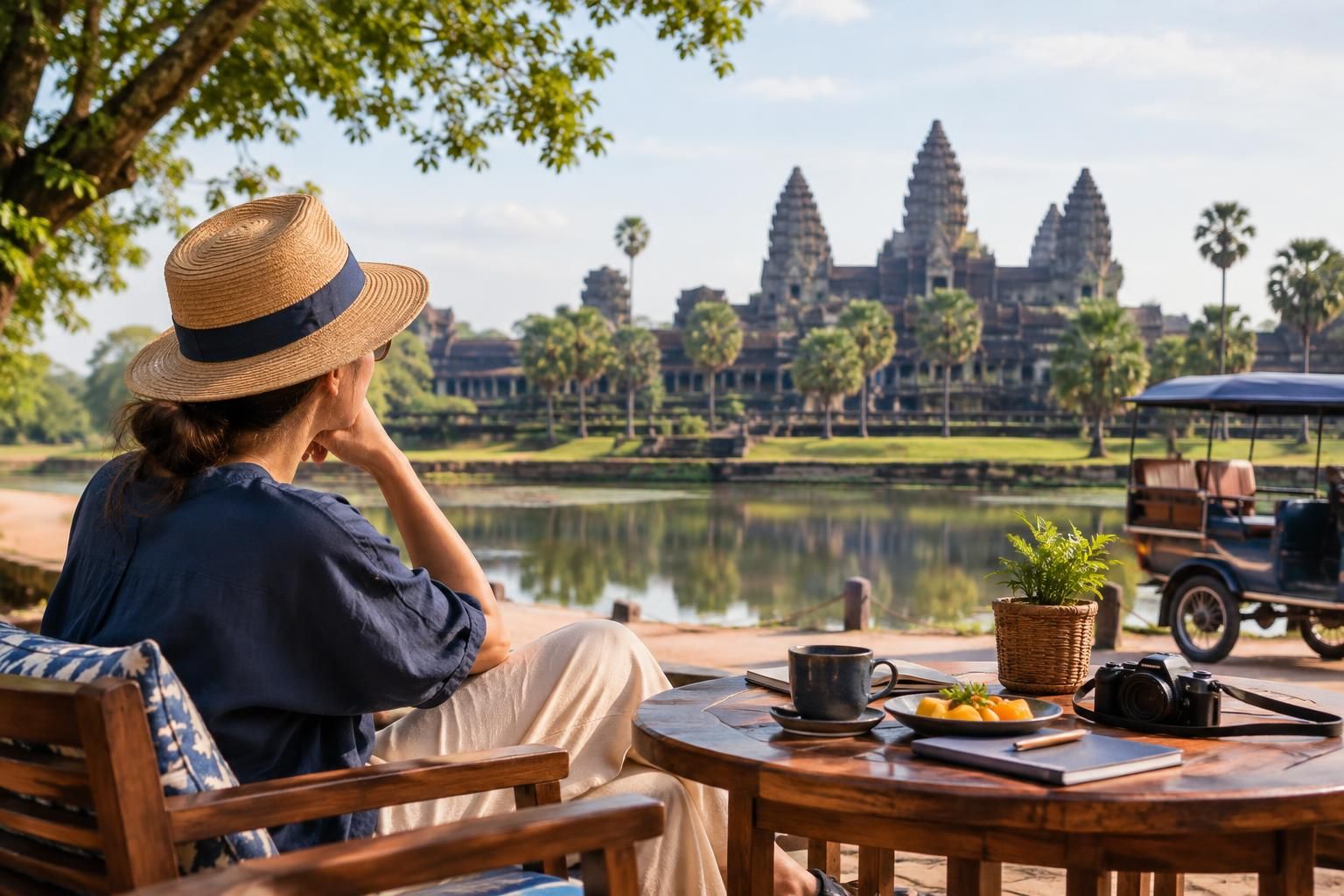
Angkor rewards attention more than speed. A carved doorway, a shaded courtyard or the changing outline of a temple can be more memorable than another hurried stop. Yet planning a visit from Siem Reap can easily become an exercise in collecting names and filling every daylight hour. A better approach is to decide how much temple exploring you actually enjoy, group outings sensibly and leave room for meals, rest and contemporary Cambodian life. For many travelers, a four-night stay offers a useful starting framework: enough space for contrasting temple visits without making every day feel alike.
1. Plan your stay around energy, not the number of temples
Start by choosing two substantial temple outings rather than compiling an exhaustive list. One can focus on the best-known monuments, while the other explores a different architectural setting or a smaller group of sites. Add another outing only if archaeology, photography or detailed historical interpretation is a central reason for your trip.
A workable four-night structure is an arrival afternoon, a main temple day, a lighter city day and a second temple day before departure. This separates the most demanding walking days and creates flexibility if heat, rain or tiredness changes your plans. With only two nights, prioritize one satisfying outing instead of squeezing several long circuits between transfers.
Avoid treating sunrise as compulsory. It can suit photographers and naturally early risers, but it also affects sleep, breakfast and the rest of the day. If an early start appeals, make the following afternoon deliberately light rather than attaching another ambitious excursion.
2. Give each temple outing a different purpose
Angkor Wat, the Bayon within Angkor Thom, and Ta Prohm offer notably different experiences: monumental scale and galleries, sculpted faces and layered spaces, and the relationship between trees and masonry. These contrasts provide a useful foundation for deciding what interests you. You do not need to approach each site with equal intensity.
Choose one place for a slower, more interpretive visit and allow shorter stops elsewhere. For example, spend time understanding Angkor Wat's layout and reliefs, then make another outing about the atmosphere and spatial variety of Angkor Thom. Leave breathing room between major stops rather than adding every nearby monument simply because it appears on a map.
Treat more distant temples as separate decisions. Banteay Srei may appeal for its detailed carving, but an excursion beyond the central group adds road time. Ask whether that contrast matters more to you than another relaxed meal, a museum visit or an unstructured afternoon.
3. Choose transport for the whole day's comfort
Distances between temple areas make transport an important part of the experience. A tuk-tuk can suit travelers who enjoy an open-air ride and a slower sense of the landscape. An air-conditioned car may be more comfortable for those sensitive to heat, traveling with young children or planning longer road journeys. Cycling is better treated as an activity in its own right, with realistic consideration of distance, weather and traffic.
Before agreeing to an outing, clarify the proposed stops, pickup point, waiting arrangements and whether the driver returns you to your accommodation during a break. Distinguish transport from guiding: a driver and a guide serve different roles, and historical interpretation should not be assumed to be included.
A guide can be especially useful for your first major temple visit. Explain whether you prefer architectural detail, historical context or a broad introduction, and ask for a pace that leaves time to look around independently.
4. Pick accommodation that makes recovery easy
For this trip, the practical value of a room extends beyond sleeping. Effective cooling, a comfortable shower and somewhere pleasant to sit can matter more than decorative extras. A pool may be useful if you genuinely enjoy swimming between outings, but it need not be a requirement.
A central location can simplify meals and evening walks, while a quieter property farther from the busiest streets may suit light sleepers. Look closely at the immediate setting rather than relying on a broad neighborhood label. Ask about potential nighttime noise and vehicle access, especially if your plans involve early departures.
For families or mixed-energy groups, prioritize accommodation where some people can rest comfortably while others go out. That flexibility helps prevent every decision from becoming a group negotiation.
5. Make non-temple time part of the trip
Siem Reap should not function only as a place to sleep between ruins. Build in time for Khmer food, a cooking class, craft-focused browsing or a museum that adds context to what you have seen. Choose one purposeful activity on your lighter day, then leave the remaining hours open.
Countryside and Tonle Sap excursions need more thought than an empty afternoon slot. Water levels, routes and the character of a visit can vary. Ask what the outing involves, how long you will spend traveling and how the operator handles visits to residential communities. Avoid experiences centered on intrusive photography, school visits or pressure to make purchases.
At temples and in communities, follow posted guidance, dress respectfully and ask before photographing people. Treat religious spaces as places of continuing significance, not simply backdrops.
6. Pack for uneven ground and flexible days
Bring comfortable footwear with reliable grip, breathable clothing that covers shoulders and knees for religious-site visits, sun protection and a compact rain layer. Temple exploring can involve uneven paving, steps and exposed stretches, so carry a small day bag rather than everything you brought to Cambodia.
Keep water accessible, protect electronics from sudden showers and allow for regular breaks. Travelers with mobility needs should ask specifically about surfaces, stairs, access points and viewing alternatives at each planned site; a generally manageable itinerary does not mean every temple space is accessible.
Before committing to your route, check current ticket arrangements, entry requirements for individual sites and any access restrictions. Keep the underlying plan simple enough that changing one stop does not unravel the whole day.
A satisfying Angkor visit does not require an exhaustive circuit. Choose a few contrasting sites, match transport and accommodation to your comfort needs, and separate demanding outings with time in Siem Reap. Leaving something unseen is often a better trade than losing the energy to appreciate what is in front of you.
AI-assisted evergreen travel guide. Featured image is an AI-generated illustration, not a specific product or booking.