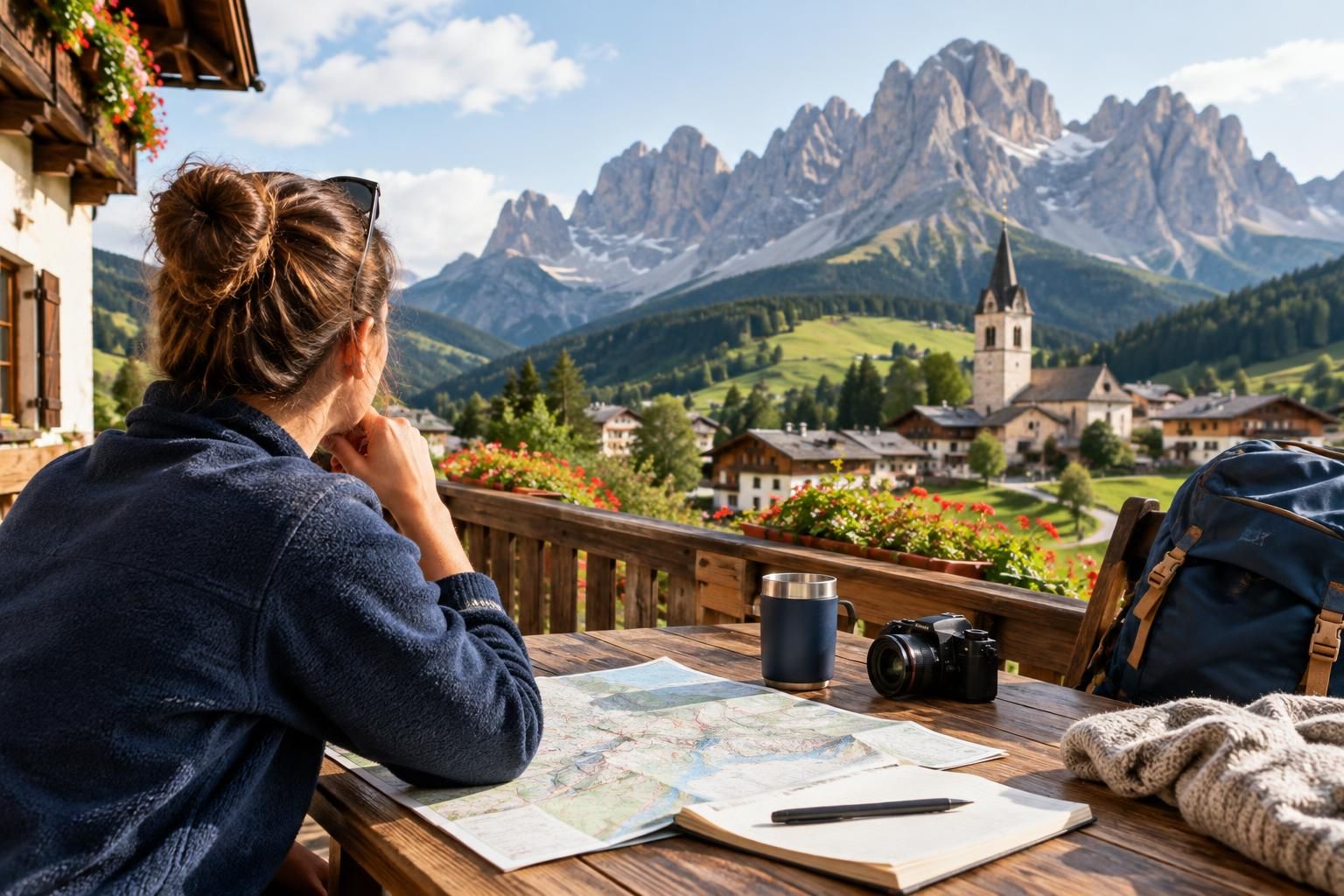
A Dolomites holiday does not have to revolve around long trails or ambitious summit days. Northern Italy’s mountain landscapes also reward travelers who prefer village wandering, leisurely lunches and short outings with time to stop. The key is to plan around the effort involved in reaching a view, rather than judging an excursion only by its walking distance. A modest-looking route can involve steep ground, while an upland viewpoint reached by lift may require relatively little walking. For a first visit, a compact itinerary with one well-chosen base often works better than trying to collect every famous lake, pass and panorama.
Choose one mountain area rather than the whole region
The Dolomites cover a broad area, and journeys between valleys can absorb more time than a map suggests. Winding roads, mountain passes and repeated stops turn apparently short distances into substantial outings. For a stay of four to six nights, choose one main valley and treat other areas as optional rather than essential.
Val Gardena is worth considering if you want village life combined with access to upland scenery. The area around Cortina d’Ampezzo suits travelers drawn to the eastern Dolomites and excursions toward dramatic rocky landscapes. Alta Badia offers another setting for a village-centered holiday. These are different starting points, not stops that must all appear on one trip. Compare the excursions nearest each before choosing.
Match your base to the evenings you want
Accommodation photographs tend to emphasize mountain views, but the practical location matters just as much. A hillside property may offer a beautiful outlook while making every dinner or grocery stop a separate journey. A central village stay can be more useful if you want to walk out for a meal and leave the car parked.
Check the route between your accommodation and the village center, not simply the distance. Slopes, steps and road crossings can change how convenient a location feels. If you prefer quiet evenings at your accommodation, prioritize usable outdoor space, a comfortable sitting area and meal arrangements that suit you. For an apartment, establish whether buying groceries will require a detour before arrival.
Decide whether a car solves your actual transport needs
A car gives flexibility for scattered viewpoints, luggage and spontaneous stops, but it also brings parking decisions and mountain driving. It is most useful when your chosen outings lie in several directions. If your plan centers on one village and nearby lift-accessed scenery, compare public transport and transfer options before assuming that a rental is necessary.
For a car-free trip, build the itinerary outward from your accommodation. Check the relevant seasonal bus services, lift access and connections for your dates, including the return journey. Avoid designing a day that depends on several tight transfers. With a car, keep excursions geographically grouped: a lake and a nearby village make a more relaxed pairing than two celebrated sights on opposite sides of the mountains.
Plan scenic outings by terrain, not by distance alone
Look for three types of outing: village-level walks, lake or valley excursions, and lift-assisted mountain days. Mixing these gives the trip variety without requiring a major hike each morning. A village stroll followed by lunch can be a complete day, especially when the alternative is a long drive to another viewpoint.
For any walk, examine elevation change, surface, exposure and the route back. A short path can still be rocky or steep. For a lift outing, establish what the arrival area is like and whether the views you want require further walking. If someone in your group uses a wheelchair, pushes a stroller or needs step-free access, seek specific details about entrances, surfaces and facilities rather than relying on a general accessibility description.
Give your itinerary room to respond to mountain conditions
Rather than assigning a fixed excursion to every date, create a small menu of days. Include two mountain-view outings, a lower-level walking day and a village-focused day. Choose the order during the trip according to weather, local conditions and everyone’s energy. Check seasonal operating periods before building plans around lifts, mountain roads or upland facilities.
A five-night stay might begin with a gentle arrival afternoon, followed by a scenic lift outing, a lake excursion and an unhurried village day. Keep the remaining full day open for another nearby outing or a return to a favorite place. Lower cloud need not mean chasing clearer skies across several valleys; it can be a reason to enjoy local architecture, browse shops or settle into a long lunch.
Pack for short outings and comfortable downtime
Even without long hikes, bring footwear suited to the surfaces you intend to use, layers for changing temperatures and protection from rain and sun. A small day bag should accommodate water, snacks and an extra layer without becoming cumbersome. Keep your packing tied to planned activities rather than buying equipment for an imagined expedition.
Budget for the shape of the holiday, not only the room. Lift journeys, parking, transfers and meals away from your accommodation can all influence daily spending. Balance paid panoramic outings with simpler village and valley days. On departure day, leave space between leaving the mountains and any onward connection; the final scenic detour is rarely worth making the rest of the journey feel rushed.
The most rewarding low-hiking Dolomites itinerary is selective. Choose a base that supports easy evenings, organize outings around realistic terrain and travel time, and keep mountain-view days flexible. With fewer transfers and less pressure to reach every landmark, there is more room to enjoy the scenery you came for.
AI-assisted evergreen travel guide. Featured image is an AI-generated illustration, not a specific product or booking.