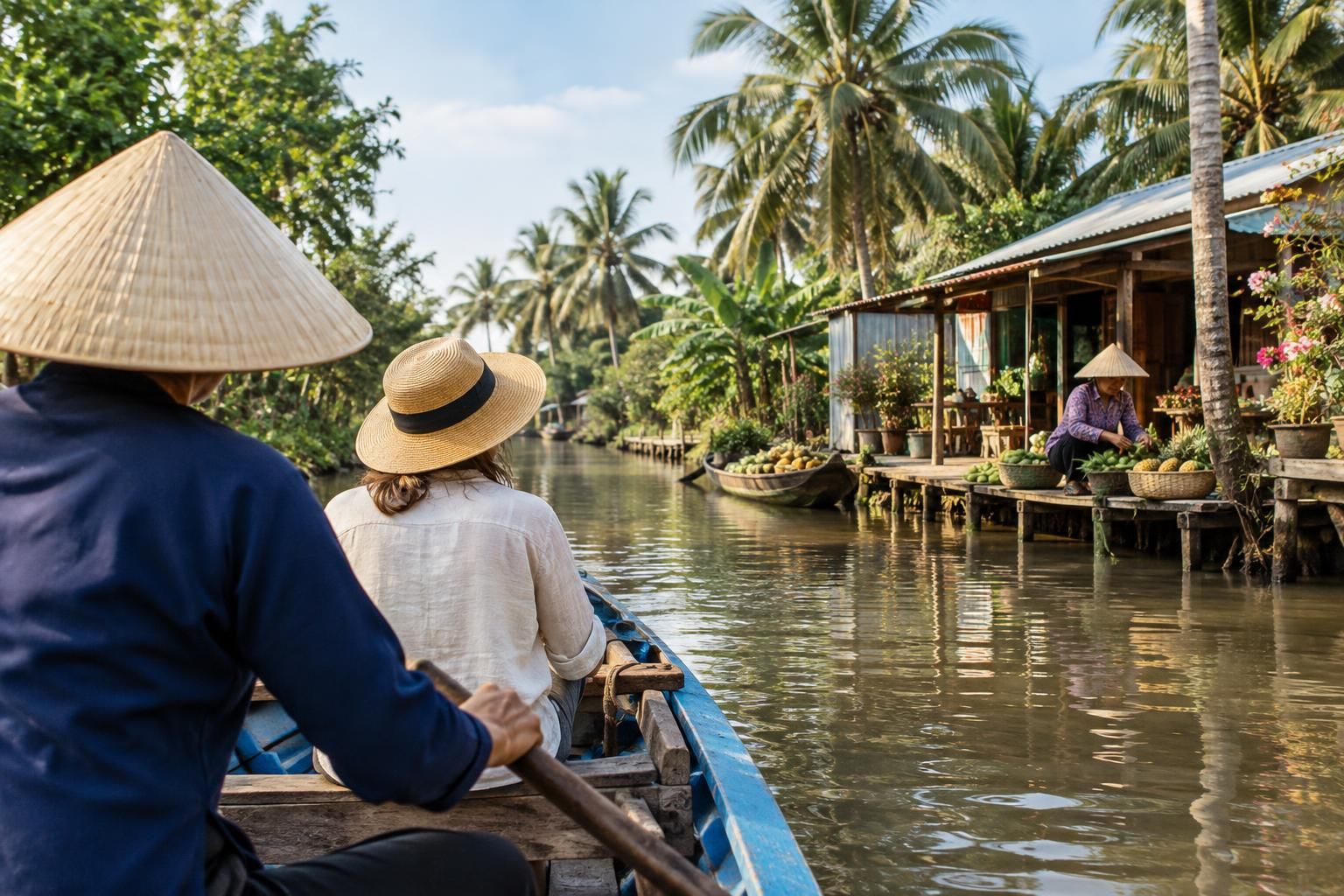
Vietnam’s Mekong Delta rewards travelers who leave room between activities. Its appeal lies as much in ordinary details—riverside kitchens, fruit gardens and boats carrying everyday goods—as in headline attractions. A two-night stay gives you time to experience a morning on the water without making the entire visit an extended excursion from Ho Chi Minh City. The key is choosing one base, understanding the journeys involved and deciding what kind of river experience you actually want.
Choose Ben Tre for countryside or Can Tho for a city base
Ben Tre suits travelers drawn to coconut-growing countryside, smaller waterways and accommodation surrounded by gardens. It works particularly well when the stay itself matters: a shaded terrace, meals at your guesthouse and short outings nearby. However, properties described as being in Ben Tre can be spread across a wide area, so the exact location matters more than the destination label.
Can Tho offers a more urban base, with a riverfront setting and a broader choice of independent dining and accommodation. It is a useful choice if you want to combine river excursions with time exploring a city. For only two nights, choose one of these areas rather than trying to include both. Moving hotels can consume the time you hoped to spend enjoying the delta.
Treat the transfer as a substantial part of the trip
A map can make the delta look like a simple extension of Ho Chi Minh City, but road access, bridges and the final approach to your accommodation shape the journey. Compare door-to-door arrangements rather than just the main bus or car journey. A rural guesthouse may require an additional local transfer after you reach the nearest town.
A shared bus or minibus can suit independent travelers staying near a convenient arrival point. A private transfer may be worth considering for a family, a small group or a property outside town. Before committing, establish the pickup and drop-off locations, luggage arrangements and whether a final boat crossing is involved. Leave the arrival afternoon lightly planned instead of attaching a tightly timed excursion to it.
Pick accommodation for access, not just river views
A countryside stay and a city hotel create very different trips. In a rural property, ask whether meals are available, whether you can walk anywhere useful and how excursions begin. A beautiful garden setting can feel restrictive if every outing requires transport. In Can Tho, consider whether you prefer easy access to restaurants or a quieter setting farther from the central riverfront.
Look closely at room descriptions and practical details: air conditioning or fans, private bathrooms, window screens, steps and the distance between rooms and communal areas. Ask how luggage reaches the property if access involves a narrow path or boat. Travelers with limited mobility should request specific descriptions of boarding points and pathways rather than relying on a general claim that a stay is accessible.
Choose a river outing by its content
Boat trips are not interchangeable. Some emphasize larger river channels and trading activity; others focus on smaller waterways, gardens or craft workshops. Ask what you will actually do, how much time is spent aboard, whether the boat is shared and how many stops are included. A shorter outing with a clear focus may be more satisfying than a long circuit filled with loosely related visits.
If a floating market is your main interest, keep expectations grounded. These are working places whose activity can vary, not fixed performances for visitors. Ask the operator what an ordinary visit involves and whether the route includes other worthwhile experiences. For any boat outing, establish the boarding arrangement, shade provision and availability of appropriately sized life jackets before booking.
Build a flexible two-night rhythm
Use the first afternoon to settle in, explore the immediate area and arrange the next day’s main activity. On the middle day, choose one substantial outing: perhaps a river excursion followed by a relaxed lunch, or a countryside route linking a garden and a small workshop. Keep the later part of the day open for a walk, reading or simply watching the river.
On departure morning, have breakfast and allow room for the onward journey rather than squeezing in another distant stop. Cycling can be an enjoyable addition where suitable routes and bicycles are available, but do not assume every rural lane is quiet or easy to navigate. Ask about surfaces, traffic, route length and alternatives before deciding whether it fits your group.
Pack lightly and approach village visits thoughtfully
Bring lightweight clothing, a sun hat, rain protection and footwear with a secure grip for uneven or damp surfaces. Keep your phone and essentials protected from splashes, and use a small day bag for boat outings. If the delta visit sits between longer stays, ask your Ho Chi Minh City accommodation whether luggage storage is possible rather than assuming you must carry everything.
At gardens, homes and workshops, follow your host’s lead about where to enter and ask before photographing people. Clarify which tastings, meals or activities are included and which are optional purchases. Choose a few stops that genuinely interest you rather than treating every workshop as compulsory. The most rewarding itinerary leaves time for conversation without making local residents part of a checklist.
For a first Mekong Delta stay, two nights in one well-chosen base is a practical starting point. Choose Ben Tre for a countryside-centered visit or Can Tho for a city-and-river combination, then organize the trip around one meaningful outing. Clear transfer arrangements, suitable accommodation and generous unplanned time matter more than collecting the largest number of stops.
AI-assisted evergreen travel guide. Featured image is an AI-generated illustration, not a specific product or booking.