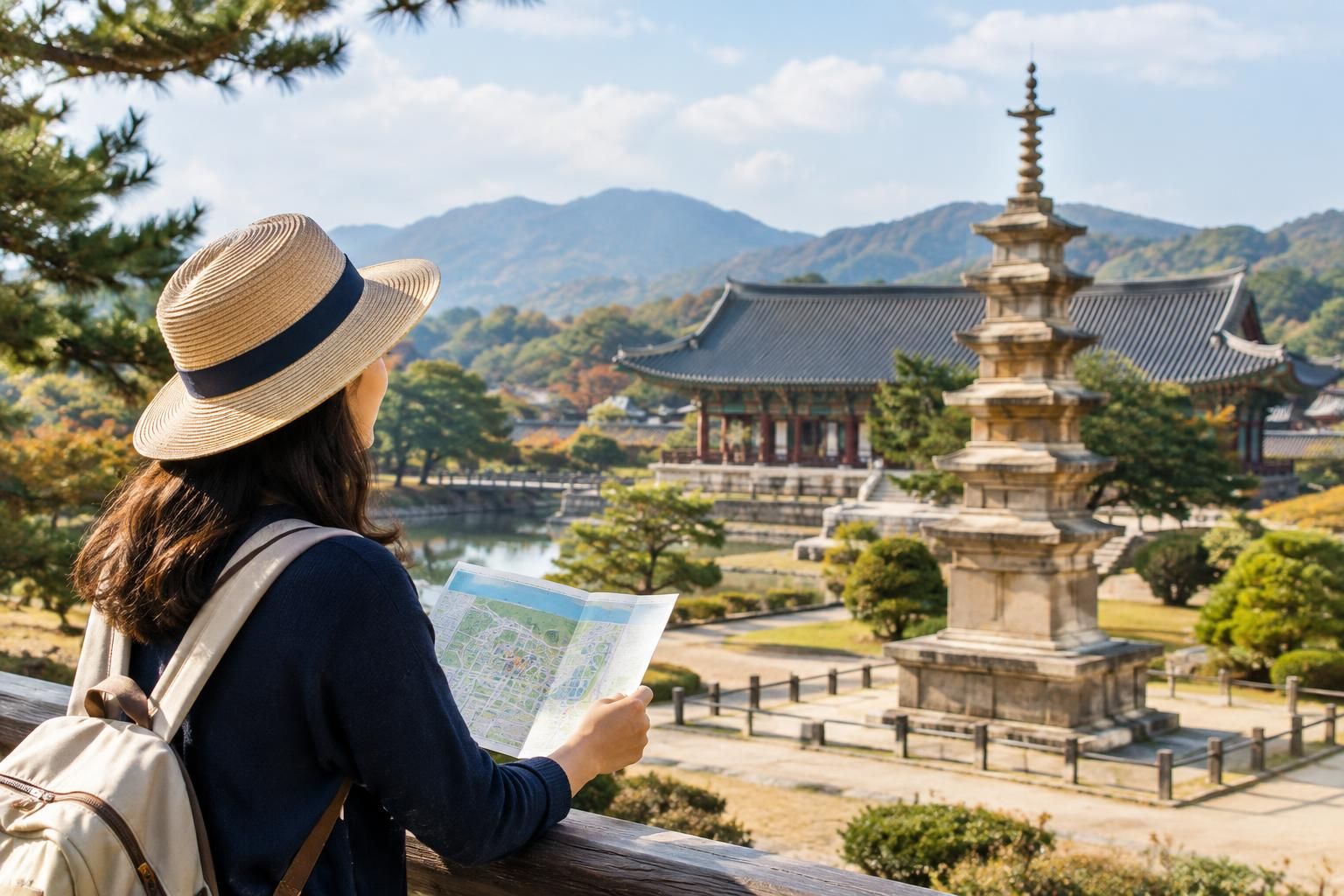
Gyeongju rewards a different approach from South Korea’s larger cities. Its appeal lies in the space between places: rounded royal burial mounds, low-rise streets, temple landscapes and stretches of open ground where the historic city becomes easier to imagine. Once the capital of the Silla kingdom, it offers enough cultural depth for several days without requiring a packed sightseeing schedule. A three-night stay gives you two full days plus flexible arrival and departure time. Without a car, the key is to distinguish the central historic area from outlying destinations, then choose accommodation and excursions that keep those journeys manageable.
Understand the layout before building your itinerary
Think of Gyeongju as several sightseeing areas rather than one compact collection of monuments. The central historic district includes royal tomb landscapes, Cheomseongdae observatory and the streets around Hwangnidan-gil. Donggung Palace and Wolji Pond and the Gyeongju National Museum belong to a broader central sightseeing area, but visiting everything still involves substantial walking.
Bulguksa Temple, Seokguram Grotto, Bomun Lake and Yangdong Village require separate transport planning. Do not treat them as quick additions simply because they appear on the same destination map. For a short first visit, prioritize the central heritage area and one outlying destination. That leaves room to appreciate what you see instead of spending both full days moving between scattered stops.
Choose accommodation for evenings and everyday convenience
For most car-free visitors, a base near the central historic district is the simplest choice. Look at the actual walking route to food, transport and the places you expect to visit, not just the property’s distance from a landmark. A charming address can become inconvenient if every dinner or bus connection requires another journey.
A hanok-style guesthouse can complement the setting, while a conventional hotel may suit travelers who prioritize familiar bedding, larger bathrooms or easier luggage handling. Property descriptions matter more than the label. Ask about floor bedding versus raised beds, private bathrooms, steps, sound insulation and where luggage can be stored. If you prefer the resort atmosphere around Bomun Lake, weigh that space and setting against the additional travel needed for central sightseeing.
Give the central sights a full, unhurried day
Build your first full day around the royal tomb area and nearby historic streets. Daereungwon provides a useful introduction to Gyeongju’s burial landscapes, while Cheomseongdae offers a different connection to the Silla period. Choose a few places to understand properly rather than trying to photograph every named feature. Interpretive displays can help make sense of landscapes whose significance is not immediately obvious.
Use Hwangnidan-gil for a meal or café break, then decide whether your energy suits more walking or time at the Gyeongju National Museum. The museum is particularly useful for travelers interested in the objects and craftsmanship behind the outdoor sites. Keep Donggung Palace and Wolji Pond as a flexible additional visit rather than an obligation. You can also divide these central places between arrival afternoon and the following day.
Pick one countryside outing that matches your interests
Choose Bulguksa if temple architecture and a wooded setting are your main interests. Allow time for the approach, steps and pauses within the grounds rather than treating it as a brief photo stop. Seokguram is a separate site higher on the mountain, not simply another courtyard at Bulguksa. Adding it means considering another transfer and more walking; confirm access arrangements before deciding to combine them.
Yangdong Village offers a different excursion, focused on a traditional village landscape rather than monumental temple architecture. It is also a living community, so keep to visitor routes and respect private homes. Bomun Lake is another option if you would rather have a less history-heavy outing. For two full days, choose among these experiences instead of trying to collect all of them.
Use public transport selectively, with a taxi fallback
Car-free does not have to mean bus-only. Walking works well for selected central clusters, while buses can suit longer journeys when the route and waiting time fit your day. A taxi can be a practical fallback for an awkward connection, tired legs or the final leg back to your accommodation. Set aside some transport flexibility rather than designing an itinerary that depends on every connection working perfectly.
Before arrival, check where your intercity train or bus actually stops and how you will reach your accommodation from there. Save your lodging address and key destination names in Korean, and download useful map information. For an outlying excursion, check both outward and return options before setting off. Avoid placing a countryside visit immediately before a tightly timed onward departure.
Plan for outdoor exposure, meals and a manageable departure
Much of Gyeongju’s appeal is outdoors, so weather can change the rhythm of a day. Carry comfortable walking shoes, a compact rain layer and sun protection appropriate to the conditions. In hot weather, split longer walks around a substantial indoor break. In cooler conditions, allow for exposed paths and time spent standing at outdoor sites. Keep the museum as a possible change of pace, checking its visitor information when finalizing plans.
A simple three-night structure is enough: settle in and explore nearby streets on arrival day, devote one full day to central heritage, and use the other for your chosen excursion. Leave departure morning for breakfast, packing and perhaps a short local walk. Keep meals flexible, but save a couple of alternatives near your accommodation so that a long sightseeing day does not end with another complicated journey.
Gyeongju works best without a car when you plan around geography rather than a long attraction list. Stay somewhere that makes central walks and evening meals easy, give the historic core proper attention, and choose one outlying experience that genuinely interests you. Three nights then become enough for a rewarding introduction, with space to notice the landscapes that make the city distinctive.
AI-assisted evergreen travel guide. Featured image is an AI-generated illustration, not a specific product or booking.